Archives

A Common Thread: Weaving Traditions of Norway and Sweden

Editor’s Note:  This article by Katherine Larson was originally published in Vesterheim, a publication of Vesterheim Norwegian-American Museum, volume 3, number 2, 2005, and is reprinted with permission.  Read the full article in pdf version HERE.   (Note: This is a large file with photos, and may load slowly.) In addition, Vesterheim Curator Laurann Gilbertson provided photographs and information below from the labels used in the exhibit.

Monk’s Belt  (Norwegian: Tavlebragd, Swedish: Munkebälte)
The small and large squares characteristic of both Norwegian and Swedish monk’s belt coverlets were often arranged to form either cross patterns (hanging) or square grids (trunk, left). Occasionally horizontal stripes of colored wool weft were used to separate the bands of monk’s belt patterns (trunk, right). The weavers in Skåne, Sweden, frequently wove their coverlets on a dark ground (hanging), a departure from the neutral linen or cotton ground that was more common elsewhere in Sweden and in Norway.

Common Thread 030

(Hanging: Table cover from Skåne, Sweden, Nordic Heritage Museum; Trunk left: Coverlet from Sogn, Norway, Vesterheim; Trunk right: coverlet from Nordfjord, Noway, Nordic Heritage Museum)

Tapestry (Norwegian: Billedvev)
Norwegian tapestry coverlets commonly depicted Biblical themes, such as the Adoration of the Magi. Tapestries were woven on their side to reduce the number of vertical dovetail joins required. A tapestry of this size and complexity was probably woven by a specialist that worked on a loom as broad as the finished weaving was high. (Adoration of the Magi, Norway, Vesterheim Museum)

1984.123.001asm(Swedish: Flamskväv)
The weavers in northeast Skåne were noted for coverlets that contained eight-petaled roses and the figures of men, women, birds, and horse. These coverlets, woven in the geometric tapestry technique, were executed in such fine detail that they included buttons on the men’s jackets and tiny candles. In contrast to Norwegian tapestry coverlets, which were woven while turned sideways on wide looms, these coverlet were made in two narrow sections on the smaller looms typical of home weaving. The two pieces were then sewn together to create a coverlet. The inscription at the top reads, “In the name of God the Father, and the Son, and the Holy Ghost.” Initials and date, 1857, also personalize the coverlet. (Left, below: Geometric tapestry coverlet, Skåne, Sweden, private collection)

Common Thread 034

Three Holy King billedvev match with a Swedish weaving. Right: Geometric tapestry coverlet, Skåne, Sweden, private collection

Tapestry (Norwegian: Billedvev, Swedish: Flamskväv)
The Red Lion, a popular motif in Swedish tapestry cushion covers, was probably a simplification of earlier tapestries depicting Samson and the Lion. Norwegian and Swedish tapestry weavers often drew on Biblical these for their subject matter. The Wedding in Canaan is believed to be the inspiration for the banquet scene in this cushion cover.

Common Thread 026

Left: cushion cover from Skåne, Sweden, private collection; Right: cushion cover, Vesterheim

Thanks to Laurann Gilbertson, Curator of the Vesterheim Norwegian-American Museum, for arranging permission to post the original article, and for providing extra information and photos from the exhibit labels.


A Personal Scream Series

Editor (and author) note:  This article was published in the Fall 2015 issue of the British Journal for Weavers, Spinners and Dyers, and is reprinted with permission. Read the pdf version of that article HERE.

journal coverBy Robbie LaFleur

Almost every mention of Edvard Munch’s expressionist painting, Skrik or “Scream,” is followed by a phrase along the lines of, ’one of the world’s most recognizable works of art.’

I’ve contemplated Munch’s Scream since the first time I saw one of the paintings in Norway during weaving school in the late 1970s; he had painted several versions of the Scream. My own interpretations began in 2001, during a Scream-worthy situation. I worked for the Minnesota Legislature, and the legislative session dragged on in overtime, into the summer, filled with acrimony and budget dilemmas. It seemed like a good time to weave Edvard Munch’s image of angst. I set up my tapestry loom in the living room and wove as frequently as possible, telling myself that when the tapestry was finished, the special legislative session would wrap up its work. I was right.scream-tapestry-s

A photocopy of the image, taped to a top corner of the loom, guided my color choices as I wove the background behind the figure on the bridge. The wavy lines created with a distorted, or eccentric weft, didn’t exactly match Munch’s paint strokes, but they created a similar feeling of unease. I’ve displayed the small tapestry (11in x 7in) many times during the past decade, often during a weaving demonstration. Each time at least one person asks, ‘Can I buy this?’. I could have sold it many times over, but maybe not, if I’d actually suggested a price that could make me part with it.

The tapestry was the beginning of a series, partially prompted by a friend who suggested I continue making Scream in various textile techniques. It is a great image for exploration. The painting is meaningful and powerful, yet also recognizable to the point of kitsch. It is also fun to examine for line and color, to determine how to use each textile medium to advantage.

French Knots

The French Knot Scream was an experiment in shading to achieve a photo-like quality. I chose a portion of Munch’s image and using an inkjet printer, printed it onto a sheet of fabric. I carried around the small embroidery (7in x 5in) for a whole summer, adding a few more of the approximately 9,500 knots during car trips and snatches of free time. The knots were made with two strands of embroidery floss, which made many subtle shades possible. I framed the embroidery in a substantial gold frame, which seemed to draw viewers in to figure out how it was created.

french-embroidery2

Line Embroidery

Another summer, a line embroidery of Scream occupied my travel bag, starting, appropriately, on a trip to Norway. The face is surrounded by a phrase used by my Scottish grandmother in a letter to me when I was 21, ‘We sure have missed you, but life doesn’t hand us all our desires’ (I think Munch would agree). This has been embroidered in her handwriting. The line drawing itself, embroidered in a variegated purple silk thread, seemed dull, so I quilted the linen backing with thin batting and short, randomly-placed linen stitches. The practical part of me felt this piece should become a pillow (completed size: 15in x 13in).

scream-pillow-s

Fabric Printing

I carved a Scream linoleum-block image for textile printing. It has been well-used; many of my friends have napkins and guest towels with the image. I titled my original textile piece was “Edvard Munch Kommentarer Paa Opvask” (Edvard Munch Comments on Washing Dishes).  Five IKEA dishtowels, printed with the same screaming figure, hang from a towel bar, which portrays the title in gothic script. (total dimensions: 29in x 31in) It’s intended to be amusing, but also a comment on Munch, a serious male Expressionist painter who likely spent little time thinking about domestic arts.

kommentarers

Skinnfell

In 2010 I took a course from a Norwegian instructor, Britt Solheim, on making skinnfell (coverlets sewn of several sheepskins). In traditional skinnfell pieces, which have become popular again in Norway, the smooth side was either wood-block printed with traditional motifs or covered by a woven textile, or sometimes both, leaving secret designs underneath the fabric. After the class I created a Scream wall piece (18in x 26in) on sheepskin, incorporating the iconic image with traditional wood-block patterns. I wanted to explore the relationship, or lack thereof, between Munch’s fine art prints and the traditional folk arts of the period.

skinfell-ryaRya

The largest Scream piece (36in x 60in), a Scandinavian rya, was an experiment in weaving in a pixelated fashion. I cut the full-sized pattern into narrow strips. With each row of knots on the rya I entered bundles of yarn to match the colors along the strips. This technique did not work perfectly; after unrolling the finished piece from the loom I spent many hours with a tapestry needle, putting in some bundles and taking out others to improve the image. This piece is much larger than the original images in Munch’s paintings, and while weaving it I was surprised by my emotional reaction to the image which I had reproduced many times before. As I tied the knots of the face and hands, I worked at close range and spent many hours looking at my blown-up pattern and back at the unfolding face on the loom. To me the yarn gathered the sense of psychological unease in Munch’s painting. Would the piece be large and frightening? Once completed, however, the shaggy image was striking, but not scary.

219 Lafleure-Moore Robbie Scream no number PRThe 150th anniversary of the birth of Edvard Munch was celebrated in 2013, a fitting time to complete my textile appreciation series. Still, I might pick up the theme in the future. Could the collection be complete without a knitted Scream?

Robbie LaFleur is a weaver and librarian living in Minneapolis, Minnesota. She began her weaving study with a course in traditional Norwegian weaving at Valdres Husflidsskole in Fagernes, Norway, in 1977. Since that time she has studied with several Norwegian and American weavers. Among other projects, her current series is an exploration of family members, current and long past, in tapestry. You can follow her weaving activities at her blog, boundweave.wordpress.com. She is the editor of The Norwegian Textile Letter, and recently converted it to a digital publication, norwegiantextileletter.com.

cartoon1 2Postscript: The Scream series was also featured in an exhibit in the Community Gallery at the American Swedish Institute from June-September, 2015.  As well as the Scream pieces, the exhibit included Munch-related cartoons and magazine covers.  (Read more here.)

Setesdal Pleating

By Sue Mansfield

Editors Note:  Sue’s article originally appeared in the newsletter of the “Collapse Pleat Bump Study Group,” part of the Complex Weavers Group, in November 2011. We reprint her article here with permission (and gratitude).

In June 2011 I took a vadmel workshop in Norway. Afterward I met my Norwegian relatives. One of the guests at a family christening wore a bunad, or folk costume, from the Setesdal region. I took photos of her and the back of her skirt. Several days later at the Norsk Folkmuseum in Oslo I saw the same bunad and a display of making the pleated black skirt fabric. Immediately I thought of woven shibori, except this pleating was done by hand sewing. The process takes two years. Laurann Gilbertson, the Vesterheim Museum Curator, lent me a VHS tape on the pleating process based on research by Aagot Noss and answered questions for me because the language on the tape was Norwegian. (Viewing a tape without understandable narration doesn’t indicate elapsing time between processing steps and repeated processes.) Black and white photos come from Stakkeklede I Setesdal by Aagot Noss with permission from Novus forlag.

Fabric

The warp is wool single ply Z twist at 16 threads per cm and the weft wool single ply S twist at 8 threads per cm and is woven as a two-two twill. Initial size is 181.5 cm x 65 cm. The sheep breeds for wool for textile work in general in the Setesdal Valley are Spælsau and Dalasau. Spælsau is an old Norwegian short tailed breed with a two layer coat which dates back to the Vikings. Dalasau is a cross between Spælsau and English breeds (Cheviot, Leicester, Sutherland). (7)

Pleating

SEM-page 171

Stakkeklede I Setesdal by Aagot Noss, p. 171

A length of white fabric, with or without colored weft as spacing indicators at intervals, is stitched four rows at a time with linen or bast fiber thread. Each of the parallel stitching lines has a separate needle. When the entire width is stitched the sewer tightly pulls up the four threads and ties a knot using pairs of two threads. She continues with the next four rows. When the entire length is pleated, it is stretched out flat and then rolled around a rolling pin and pinned closed. It is rolled on a board to flatten out the pleats. It is stored for a year on the rolling pin before fulling and dyeing.

Fulling

After the storage time it is unrolled (still pleated) and put in an iron pot filled with water which is then brought to a boil. The steaming hot fabric is removed and rubbed on both sides with lye or “green” soap using a wooden washboard. (The lye soap is made with hemp oil.) The fabric is rubbed and rolled on the felting board and put in the pot again and boiled. This process is repeated several times. Finally the fabric is rinsed in a bucket of water.

Mordanting and dyeing

SEM-page 173, lower R

Stakkeklede I Setesdal by Aagot Noss, p. 173

Five tablets of copper sulphate or blue vitriol are put in the iron pot filled with water, allowed to dissolve, and then the fabric is added.  The fabric with the mordant is boiled for an hour, then cooled in the pot with a rock placed on sticks to weight down the fabric. In the morning it is pulled out. Now the fabric is a bit green. The dyer empties the pot and refills it with water and adds 100 grams of iron per 8 hectograms (800 grams) of fabric. 750 grams of logwood chips are also added to the pot. This is cooked for the dye to develop, then the fabric is added and boiled for an hour. (The logwood chips are still in the dye bath.) (Photos p174, p175 top left–dyeing) The tape shows the dyer checking the density of the dye by pulling apart the pleats. When there is complete black dyeing –no white streaks or dots, she lets the fabric cool for five or six hours with sticks and rock weighting on top of it. The logwood chips below and the rock above help to keep the heat in longer.

dyeing

Stakkeklede I Setesdal by Aagot Noss, p. 174 and 175

The fabric is stretched out flat on the ground and cold ash from birch trees, bjørkeoske, is sprinkled on both sides. It is rolled up with the ash; the next morning it is rinsed in the lake and hung up on a clothesline to dry.

Garment yardage

SEM-page 175, top R

Stakkeklede I Setesdal by Aagot Noss, p. 175

The dried dyed and pleated fabric is rolled on a rolling pin and fastened closed with pins. No pleating threads are removed while it is stored.  Laurann Gilbertson says, “The fabric is left for at least one year before it can be sewn into a garment. Noss says that her informant, Jorann T. Rysstad (the one in the film), said her mother had left the fabric both eight and ten years. I can’t tell if that was for better colorfastness and pleating or if that’s just how long it took her to use some of her prepared fabric.

SEM-page 176

Stakkeklede I Setesdal by Aagot Noss, p. 176

Stakkeklede I Setesdal by Aagot Noss, p. 173

Stakkeklede I Setesdal by Aagot Noss, p. 173

The holes in the fabric indicate that the pleating process was authentic. I asked whether the tape showed the traditional method. Laurann says, “ This is the historic/traditional process. The only modernization might be the stripes woven into the fabric that make it easier to sew straight lines. The old samples (strip page 172 and detail page 173) (Detail photo of grey gathered fabric p 173.) do not have the dark strip woven in. It is possible to make the fine pleats with a machine and it’s also possible to use synthetic dye instead of logwood.” Noss says, “Pleated garments were worn in Norway back to the Middle Ages, though some of those garments haven’t remained in use (like men’s balloon-shaped knee pants) in the 19th or 20th centuries. Other regions in addition to Setesdal in Aust-Agder in Norway use pleated fabrics.”

The Setesdal bunad has a black skirt with green and red bands at the hem which is stiffened with a triple layered strip of fulled white wool. The videotape also included sewing details.

Setesdal bunadAnother weaver, Patrice George from New York City, was inspired by the Setesdal process to make a pleated pillow using woven shibori technique with waxed cotton upholstery thread for the gathering at desired intervals. She, however, didn’t use the traditional fulling and dyeing process. She washed the fabric in lukewarm water and steamed the pleats. Her pleating wouldn’t necessarily survive cleaning processes; the warp and weft were already dyed.

For those of us in the study group the traditional process described above could be modified to full the pleats, i.e. use caustic solution of lye soap or hot soapy water, and boil with agitation or  use a washing machine.

Resources:

  1. Stakkeklede i Setesdal by Aagot Noss, Institutet for sammenligende kulturrfoskning, Novus forlag, Oslo Norway 2008
  2. VCR tape –Stakkefeddung og farging og Bunadssying I Setesdal (I: Norsk filminstitutt)
  3. Laurann Gilbertson, textile curator Vesterheim Museum, Decorah, Iowa
  4. Sue MansfieldPatrice George, FIT New York, personal notes and article in Veyer I Vev, pages 48-49
  5. Vyer I Vev, by Tove Gulsvik and Ingebjørg Vaagen, Norges Husflidslag
  6. Advice from Carol Colburn, professor of history and costume design at University of Northern, Iowa, Cedar Falls, Iowa
  7. Thesis reference provided by Laurann Gilbertson for possible identification of sheep breed: Svensøy, Kari Grethe. “Det va inkje hobby; det va arbeid:” Tekstilarbeid i Bykle ca. 1900-1935. [It was not a hobby; it was work: Textile work in Bykle] Masters thesis, University of Oslo, 1987. p. 178.
  8. http://en.wikipedia.org/wiki/Sp%C3%A6lsau_%28sheep%29 Information on spelsau sheep
Sue Mansfield is a member of the Weavers Guild of Minnesota and an avid weaver who is undaunted by the prospect of complex processes.  (Note her beautiful handwoven and pleated shirt in the photo.)

National Exhibition of Folk Art in the Norwegian Tradition – 2015

colorsWeavings were well represented at Vesterheim this summer in the National Exhibition of Folk Art in the Norwegian Tradition, beautifully displayed with painted and carved pieces. For example, Melba Granlund’s krokbragd piece was displayed next to a deep-toned rosemaled piece in the Os technique by Peter Stromme.  Beside one another on the brick wall, the colors glowed.

Well-deserved awards included:

Blue Ribbon:
Sandra Somdahl, Decorah, IA, “Loki’s Rainbow.” Wall Hanging in Rutevev Technique

207Red Ribbon:
Marilyn Moore, Cedar, MN, Rosepath Rug

205 smWhite Ribbon:
Kathryn Evans, Lena, IL, Tablet-woven Pillow with Setesdal Embroidery

197 sm
White Ribbon:
Virginia Wekseth, Onalaska, WI, “Whimsy” Wall Hanging or Throw in Boundweave Technique

208 smHonorable Mentions:
#200 Corwyn Knutson, Roseville, MN, “Hardanger Cherry Tree” Wall Hanging in Rya Technique

200 sm
Honorable Mention:
Donna Laken, Rockford, IL, “Sunnfjord Dusk” Wall Hanging in Krokbragd Technique

201 sm
Honorable Mention:
Karin Anderson Maahs, Blaine, MN, “Anderson Berry Farm, Bay City, Wisconsin” Tapestry

203Best of Show Weaving and People’s Choice:
#210 Judy Ann Ness, Gold Medalist, Eugene, OR, “Playa Summer Lake, Spring 2014” Wall
Hanging in Krokbragd Technique (See separate article)

People’s Choice:
#210 Judy Ann Ness, Gold Medalist, Eugene, OR, “Playa Summer Lake, Spring 2014” Wall Hanging in Krokbragd Technique

The staff of Vesterheim are grateful for the help of two expert judges:  Ingebjørg Monsen, Weaving Instructor from Morvik, Norway; and Jan Mostrom, Gold Medal weaver from Chanhassen, Minnesota.

Laurann Gilbertson is the Chief Curator of the Vesterheim Norwegian-American Museum and a tireless promoter of Scandinavian textiles.


From Underwear to Everywhere

By Laurann Gilbertson

The sweaters of today have evolved from what was once men’s underwear. Knit garments were originally night shirts, worn when sleeping or beneath outer layers of clothing during the day.

Nightshirts were made in Germany and England in sold in large numbers in Norway in the 17th and 18th centuries. These were usually one color, patterned with purl stitches, and sometimes decorated with embroidery. They were worn under clothes for warmth and for protection. The “night” in nightshirt could also refer to the “eternal sleep” of death so motifs were added for protection, resurrection, and eternal life. Protective symbols included eight-pointed stars (also called eight-petal flowers).

Gausta.193“Rose sweaters” descended from the night shirts. Wool sweaters with eight-petal flowers as the main motif were made (at home on a knitting machine) and sold along the Norwegian coasts and in Oslo. Local handknitters no doubt copied the sweaters and added variations.

There are some differences across Norway, but common to all historical Norwegian sweaters are:

* the sweater is knit with patterns in two or more colors

* the bottom part of the sweater is knit in one color (for about 4-10 inches in length)

* square or rounded neckline

* pullover style, though some had splits down the front

On the coast (from Aust-Agder to Sør-Trøndelag) the neckline and the split had some sort of braid on the outside, and a lining on the inside. The braid could be floral-patterned ribbon or solid-colored fabric. The cuffs were strengthened by two-end knitting or a piece of braid (slindresnor).

Norwegian sweaters were knit in the round. In the early days, knitting the body of a sweater required six or more knitting needles. The first needles were made of wood, hence the name pinne, which means twig in Norwegian. Later knitting needles could be made from steel, brass, and (much later) plastic. In about 1935, the circular needle (rundpinne) was invented and sold.

The process of knitting sweaters was practical. The body and sleeves were knit as tubes. The oldest sweaters were cut it open so that the knitter could make the adjustments for size; the seam would go under the arm. Because the sweater was worn under clothing it needed to fit closely to the body. The knitter could add under-arm gussets (especially in Setesdal), and then add the arms. Arms could be knit from shoulder down or from cuff up.

Patttern-knit sweaters were practical as under layers because they were warm (two layers of yarn) and durable (two layers of yarn). Occasionally we see glimpses of sweaters in old photographs, especially in relaxed settings when some outer garments have been taken off.

Lusekofte – The Setesdal Sweater

setesdal

Annemor Sundbø wrote a whole book on the popular sweater, “Setesdal Sweaters: The History of the Norwegian Lice Pattern.”

One of the most distinctive and recognizable Norwegian sweater is the lusekofte or “lice-pattern sweater” of Setesdal in southern Norway. The body of the sweater is covered in lice – single stitches of a contrasting color. The kross og kringle (X and O) pattern and zigzag lines are common on the shoulders, wrists, and/or hems. The oldest sweaters had a wide white section at the hem. The X and O and zigzag patterns, as well as the wide white hem, were for protection.

“It is obvious that the latest fashion here is to wear a nightshirt without an outer jacket,” wrote Olaus Olsen from Trondheim after attending a country wedding in Setesdal. The lusekofte became popular in Setesdal beginning in the 1830s. It is possible that in order to wear a sweater on the outside of clothing, it needed patterning to make it decent, taking it from underwear to outerwear, according to Annemor Sundbø.

Many Setesdal sweaters had colorful embroidery on the yoke and cuffs. The freehand embroidery is called løyesaum. Løye is the soft, loosely spun yarn used for the embroidery.

Two important changes to the lusekofte came in the 1930s. The first cardigan styles appeared and women began wearing the sweater. These changes came about after Setesdal men stopped wearing embroidered and bibbed trousers.

Even the earliest knitting books and commercial patterns included Setesdal designs and the sweater soon became popular all over Norway and the world.

Fanatrøye – The Fana Sweater

The body of the classic Fana sweater is made up of stripes with lice in the contrasting color. There are typically flowers on the shoulders and grid or checkerboard patterns at the hem or cuffs. While the sweater originated in and is named for Fana, near Bergen on the west coast, the sweater has been extremely popular in eastern Norway in the years between the two world wars. In eastern Norway it is called the Kleiva sweater for the Rødkleiva ski slope located north of Oslo. Rødkleiva was the site of events during the 1952 Winter Olympic Games, so the Kleiva (or Fana) sweater soon became a global favorite.

Historically in Fana, the striped sweaters were worn by men for every day. Special occasion sweaters were a similar style knit with white wool. Like the striped sweater, the white sweater had ribbon trim, fabric facings, and silver or pewter buttons. The patterning was raised, however, created with purl stitches. Women in Fana wore a green or red sweater (red until about 1900, green until 1930) under a bodice with folk dress.

Islender – Iceland Sweaters

Islender sweater

Islender sweater knit by Ella and Amanda Judén, Oslo, Norway, for Einar Judén, ca. 1940. Ella and Amanda knit the sweater for their brother Einar, who was a member of the Norwegian resistance movement during WWII, 1939-1943. Vesterheim 2003.016.001 – Gift of Jean Judeen Smith

Sweaters with all-over, repeating patterns might have large or small motifs. If a sweater has very small motifs, like single Xs or short stripes of triple lice, it might be an “Iceland” sweater, called Islender in Norway. Iceland sweaters were mass produced in the Faroe Islands (owned by Denmark) and exported by 1800. These were often commercially knit and fulled – perfect for fishermen, trappers, hunters, and even polar explorers. Some Icelandic sweaters were sewn from machine-knit yardage.

The first two firms in Norway to knit Iceland-style sweaters were Devold in Ålesund and Petersen & Dekke near Bergen. Handknitters also created sweaters with small, simple motifs. These were called sponsetrøyer and were reserved for work on land or sea.

Maine-based retailer L.L.Bean imported a style of sweater “long used by Norwegian fisherman who required an unusual degree of durability and warmth in a sweater.” The sweater, with offset tripled lice, were sold from 1965 to early 1990s, when L.L. Bean tried to manufacture their own in China. They discontinued the sweater in 1999 and then in 2009 they once again imported the sweater from Norway. The sweaters have been considered essential for outdoor wear – and for 1980s fashions according to The Official Preppy Handbook.

Regional Patterns and Husfliden

There are relatively few regional sweater patterns, but interest in them led has Husfliden, the national handicraft association, to develop some sweater and knitting patterns based on regional traditions. Their first designs were taken from old sweaters with square necks and all-over patterns. Increasingly, pattern inspiration came from nature and folk arts, such as woodcarving, decorative painting, and weaving. Husfliden has offered both patterns for knitting and handknit sweaters for sale.

Yarn companies have also responded to the interest in regional sweaters by giving some of their designs regional names.

Eskimos – Round Yoke Sweaters

Annichen Sibbern designed “Eskimo,” a sweater with a patterned, round yoke in 1930. Her inspiration was the beaded yokes that are part of the Greenlandic National Costumes. She had seen the costumes in a Norwegian film that year called Eskimo. Her sweater design was soon popular with handknitters and knitters using home knitting machines. The round yoke sweater was revived in the 1950s by designer Unn Søiland Dale.

Since the 1950s, Eskimo-style sweaters have been so popular that even the classic Setesdal and Fana sweaters have been reinterpreted with round yokes.

2014040002

In the 1950s Sandnes Woolen Mill introduced “Nordkapp,” a square-yoked pattern. This sweater took advantage of the popularity in the 1950s of patterned yokes and Sami motifs. Nordkapp sweaters usually have lice or other small motifs in the body and arms.

Designer Profiles

Unn Søiland Dale modeling her Eskimo Sweater on the cover of the knitting pattern for Sandnes Woolen Mill, 1952. Vesterheim Reference, Ann Swanson Collection

Unn Søiland Dale modeling her Eskimo Sweater on the cover of the knitting pattern for Sandnes Woolen Mill, 1952. Vesterheim Reference, Ann Swanson Collection.

Unn Søiland Dale (1926-2002) started in 1952 as a design consultant for Sandnes Woolen Mill. Her first sweater design for handknitters was a yound-yoked pattern called Eskimo. Round-yoke sweaters had been popular in the 1930s, and she brought the idea back with several variations.

In 1953 she started her own business, Lillunn Sport (now Lillunn Design) in which she organized handknitters to produce sweaters for export. At one time, Lillunn was the largest private knitwear exporter in Norway, employing 800 home knitters.

She went on to design 25 more knitting patterns for Sandnes. There were many popular sweaters, but one design eclipsed them all – the Marius sweater (1954). The sweater, based on Setesdal sweater borders, was named for and modeled by Marius Eriksen, a champion skier. Marius received 300 kroner ($39) for modeling and Unn received 100 kroner ($13) for designing the sweater, though she was also given a special discount on yarn from the factory.

Many Americans first learned about the work of Solveig Hisdal through an article in Interweave Knits in Spring 2000. The magazine featured two sweaters based on a flower painted inside an old trunk at a Lofoten Islands museum. Her book Dikt i Masker / Poetry in Stitches, shows how she studies the fabric patterns and combinations of materials in museum artifacts and brings forward their essences into knit garments for today.

Solveig Hisdal is the award-winning principal designer for Oleana A/S, a sweater company that considers its business to be as much about culture as it is about sweaters. The company was founded in 1992 by Signe Aarhus, Kolbjørn Valestrand, and Hildegunn Møster. For the first year, they used traditional geometric patterns. In 1993 Solveig joined Oleana with her vivid colors and rich floral designs. She often draws on the colors and shapes in the damasks and brocades used in folk costumes, as well as patterns in nature and in the art of other cultures. Often the patterns in her sweaters are traditionally Norwegian even though they aren’t always traditional knitting patterns.

Helping in the United States to spread the joy of Nordic knitting by offering traditional and adapted patterns, and helping to demystify traditional sweater construction are Elizabeth Zimmerman, Meg Swansen, and Ann Swanson to name a few.

From an early age, Arnhild Hillesland was interested in knitting – and in doing things her own way. The rebellion she showed as she learned knitting from her mother and grandmother proved to be an asset when she moved to the U.S. in 1986 and then purchased a yarn shop. She quickly realized that the Norwegian patterns available here were translated by non-knitters making them difficult to understand and use. She jumped into translating Norwegian patterns into English, making her own patterns, and teaching classes in how to knit Norwegian sweaters. She never failed to innovate if it made the product easier to knit or nicer looking. In 2005 she began the wholesale import of Rauma yarns, thus making Norwegian knitting even more available to eager American knitters.

Sue Flanders and Janine Kosel have been designing handknits and teaching knitting in Minnesota for more than twenty years. Authors of Norwegian Handknits and Swedish Handknits, they have visited museum collections and created knitting patterns that are adapted from historic pieces, as well as patterns that take designs to a new level. The Norwegian word flink describes Sue and Janine well. Flink is hard to express in a single English word. It means adroit, clever, creative, ingenious, skillful, resourceful, and gifted. Their joyful and artistic designs honor and celebrate history, tradition, and needleworkers.

Norwegian sweaters became outerwear in the early 1900s. Whether for warmth, beauty, tradition, identity, or art, Norwegian sweaters are now everywhere, for everyone, and for every day. “From Underwear to Everywhere: Norwegian Sweaters” is on view at Vesterheim Norwegian-American Museum in Decorah, Iowa, until April 24, 2016.

Note:  The header photograph features a v-neck sweater knit by Ingrid Skramstad, Vang, Hedmark, Norway, for Olaf Skramstad, Ottertail County, Minnesota,  in the 1920s. Ingrid did not emigrate, but her brother Olaf did in 1910. She sent him care packages of her knitting, including this sweater with his initials.  (Vesterheim 2008.009.001 – Gift of Ingrid Henry)

Laurann Gilbertson is the Chief Curator of the Vesterheim Norwegian-American Museum and a tireless promoter of Scandinavian textiles.

Lila Nelson’s Celebration: Laurann Gilbertson

It’s hard to imagine what Vesterheim Norwegian-American Museum would have been like without Lila and Marion Nelson. For nearly 30 years they worked tirelessly to build and promote the collection, build a base of more than 6,000 members, and basically turn us into a world-class museum. Although Lila would always try to give the larger credit for this work to other staff and volunteers, we know that MUCH of the effort was hers.

A “Wise and Foolish Virgins” tapestry from the Vesterheim collection.

Unpaid, Lila typed correspondence for Marion when they worked on weekends and LATE into the night. She cataloged the collection of nearly 6000 artifacts that belonged to Luther College during a multi-year process to become an independent museum. She continued to catalog the artifacts for Vesterheim, another 8600+ (into 1987). The cataloging process included careful descriptions and dimensions and black and white photographs. She also developed an organizational system that allowed easy access to records in the years before computer databases. The files were arranged right to left, a holdover, she said, from her time in the Air Force. The files are still right to left.

Although there is no official record of how Vesterheim’s folk art education program, including craft study tours to Norway, originated, Lila’s fingerprints are all over. In 1967, not long after Marion and Lila took over the leadership of the museum, Vesterheim began to offer classes in folk arts, including rosemaling, woodworking, knifemaking, and weaving. Sometimes these were taught by Norwegians, sometimes by talented Americans, including Lila Nelson.

There were tours to Norway with the purpose of immersing in tradition, meeting practitioners, and learning techniques. There were textile study tours in the 1970s, and there have been numerous tours since for us and other folk artists.

A rya stored carefully in a drawer

A rya stored carefully in a drawer

The preservation of the collection was always a high priority. Lila studied textile conservation so she could actively provide better care. The passive care of the collection, though proper storage, should not be overlooked. One of Lila’s proudest accomplishments was the move of the textile collection (5,500 artifacts) into better space in 1991. She had considered the needs of each textile when planning racks (of certain lengths), drawers, and cupboards. It was my honor to work with her for 10 months as we moved from overcrowded storage to the new, carefully planned, space. As we unrolled and rerolled and put away the textiles, she would comment on them, teaching me about their color, creation, history.

Access to the artifacts was also a priority so in 2003 Lila sponsored the first all-color Vesterheim magazine. The magazine brings artifacts and their stories to members far and wide.

But even these impressive accomplishments don’t quite capture all of what Lila did for Vesterheim and for all of us. It was her ability to teach, inspire, and encourage. How many of you have heard of krokbragd or rya or have tried one of the Norwegian weaving techniques? That’s because of Lila.   Though classes, presentations, and personal contact she share her love of Norwegian textiles and of learning.

Vesterheim is pleased to offer an exhibition, beginning December 5, 2015, of some of Lila’s weavings [and tapestries will be at the Textile Center this fall]. Through her weavings, we can clearly see her life and legacy: Study historical examples, explore the possibilities for your own work, share the joy of what you’ve learned. Study, explore, share, repeat. A good way for us to live as well. Thank you, Lila.

Laurann Gilbertson is Chief Curator at the Vesterheim Norwegian-American Museum in Decorah, Iowa.

Vesterheim Tour 2015: Mica use in Sami folk costume

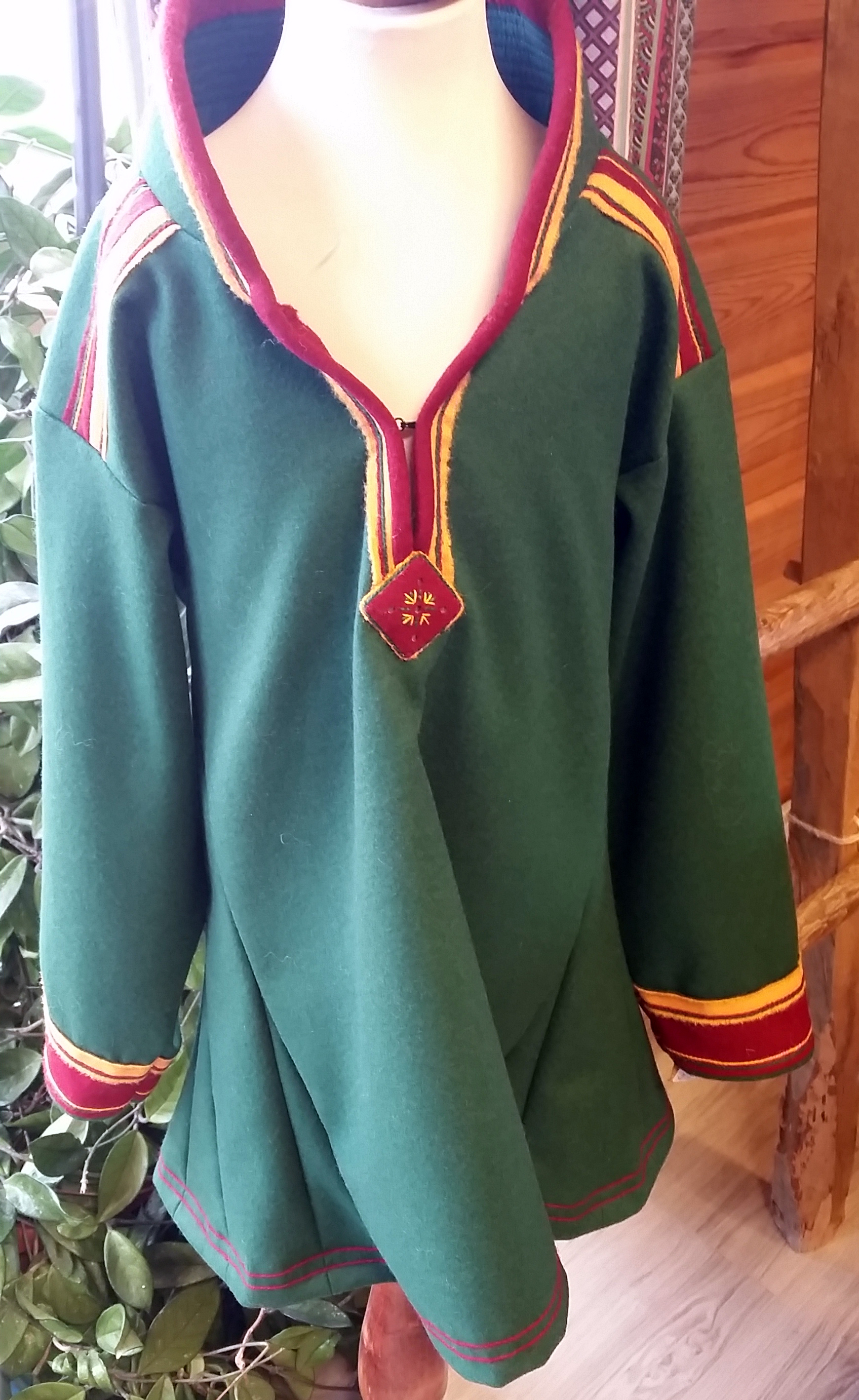
SamitunicOne of the classes offered to the participants of the 2015 textile study tour at the Manndalen Husflidslag was the use of mica as a decorative element in the Sami folk costume. The materials used were felt, mica, wool yarn and fabric, and embroidery floss. First we used a leather punch to cut holes in a piece of fulled wool fabric backed with an interlining. I later cut mine to form a cloverleaf shape. The mica was taped to the back over the holes and then we sewed that piece onto a piece of hard felt. I then embroidered the piece, though others did the embroidery earlier. I sewed a piece of wool yarn around the clover leaf shape then covered it with the shinier embroidery floss.

myembroideryThe instructor, Gunn Isaksen, had some wonderful and very complex examples of this kind of applique and embroidery used in Sami folk costumes. After getting home I was able to find sources for buying mica online. I also came across a blog with amazing photographs, Folk Costume & Embroidery, that included an article on the Sami. As far as I could tell the Skolt and Kola Sami seemed to make the most use of mica. (I emailed the man who writes this great blog but haven’t heard back from him.)

SamiembroideryWith no plans to make a Sami folk costume or any part of one, it occurred to me that mica could be used in contemporary textile art to good effect. Its smoky color (and you can get amber as well as silver mica) and irregular surfaces are quite beautiful and interesting. Imagine incorporating mica in a felted piece with some embroidery. Perhaps a landscape where mica represents running water and then trees or reindeer are embroidered. Some of the simplified designs I saw used in contemporary art reminded me of the rock art we saw at Alta. There are lots of possibilities to explore with this technique.
Samibelt

Meredith Bennett worked in the publications department of the Institute of Textile Technology in Charlottesville, Virginia. She has been a weaver since the early 1970s, specializing in boundweave techniques.


Petrine’s Quilt: A Remembrance from America

By Katherine Larson
Vefsn Museum, Mosjøen. Photo: Vefsn Museum.

Vefsn Museum, Mosjøen. Photo: Vefsn Museum.

Do you ever wonder what will become of the textiles you create? Will the enthusiasm you pour into your work today be reflected in the faces of those who receive it tomorrow, next year, 10 years from now? What about in one hundred years?

On a recent trip to north Norway I was shown a beautifully embroidered crazy quilt that had traveled far from the hands of its maker. It was made in the early 1900s, a gift sent to Norway by a woman who had emigrated over 25 years earlier. The seamstress, Petrine Almli, embroidered her name into the quilt, as well as the names of many family members on both sides of the Atlantic, a testimony in stitches to the ties that bind a family together. But time and distance eventually dimmed those memories, and while the quilt was carefully preserved through the years (and finally found its way into a museum collection), the family members in Norway no longer remembered its story.

Where did the quilt come from? Certainly it originated somewhere in the United States, where the linen cupboards of many families (my own included) hold an old crazy quilt or two. But unlike most textiles that are doomed to remain anonymous, this quilt held clues that begged to be followed. And, piece by piece, the story of Petrine and her family emerged: a small chapter in the immigrant experience that began over a century ago with the efforts of a woman and her embroidery needle.

Finding PetrinePart I

I was shown the Almli quilt at Vefsn Museum in the town of Mosjøen. Curator Rønnaug Tuven brought out the accession page from 1981, which records the original owner of the quilt (Henrikke, Petrine’s sister), the name of the seamstress, and the fact that she died in the United States in 1940. From the Vefsn community history book, Tuven could further determine that Petrine and her husband, Johan Berg Gullesson, left Norway in 1881: “utvandret til Amerika.”[i] The book listed Petrine’s parents and siblings on the Almli farm, all of whose names are embroidered on the quilt. But there the information stopped. Was it possible that I could find where Petrine and her husband had settled when they immigrated to the United States?

2aAccession page 1

Accession record for the Almli quilt, 1981. The quilt originally belonged to Henrikke Arntsen Dalbu, a gift from her sister in America. Vefsn Museum, Mosjøen. Photo: K. Larson.

Accession record for the Almli quilt, 1981. The quilt originally belonged to Henrikke Arntsen Dalbu, a gift from her sister in America. Vefsn Museum, Mosjøen. Photo: K. Larson.

I have always loved crazy quilts, and was thrilled to discover one in a Norwegian museum. Having spent years studying Norwegian textiles, many of which were brought to America, here was the reverse: a thoroughly American textile that had returned to Norway. I was delighted to offer my help in finding this seamstress! After all, given the amount of information online and the somewhat unusual farm name, this would be an easy task. A few clicks and I would find a cluster of family members in the Midwest, or a descendant searching out their family history, done and done.

This confident attitude evaporated in short order. Yes, the Almli (or more commonly Almlie) name appeared in several states, yet nothing connected these family groupings with Petrine and Johan. But, I had volunteered to find Petrine, and in any case I was getting curious…she sent this quilt to Norway from somewhere. It was time to seek out professional assistance.

During a visit to Madison, Wisconsin, I contacted the Norwegian American Genealogical Center with this little mystery.[ii] Not surprisingly, they, too, were stumped at first (“Let’s see, you don’t know what surname this couple used, and you don’t know what state they settled in…”). They tactfully did not mention needles or haystacks, and soon discovered information in Norwegian records indicating that husband Johan was also from the Almlie farm, or rather another division of that farm (Austgard, or East Farm; Petrine was from Utigard, or Outer Farm). Helpfully, Johan’s several possible surnames were all listed in the Norwegian departure registry: Johan Berg Gullesson Almlie. After following several false leads generated by this uncertainty, the genealogists finally located a grave marker for Petrine and Johan Almlie, in Willmar, Minnesota. It seemed they had found them! But no, although this was definitely their grave, Petrine and her husband were a little more elusive than that.

Almlie grave marker, Eagle Lake Lutheran Church Cemetery, Willmar, MN. Photo: Maggie P., Find a Grave #29219848.

Almlie grave marker, Eagle Lake Lutheran Church Cemetery, Willmar, MN. Photo: Maggie P., Find a Grave #29219848.

The Almlie grave lies in a part of Eagle Lake Cemetery associated with a senior center, and while it seemed likely that Petrine and Johan retired to that center after living somewhere in the vicinity, I had already failed to find them among several Almlie families in Minnesota. I next turned to the Kandiyohi County Historical Society Archives in Willmar, hoping to find Petrine’s obituary. This document was duly located but unfortunately held no clues. However, the Archives also happened to have the Bethesda Senior Center records for temporary study, and this finally provided the missing piece to the puzzle. Registration information revealed that Petrine and Johan were not from Willmar at all, but from a town that was over 200 miles away and in another state, Cumberland, in northwestern Wisconsin. The couple listed no children, possibly explaining why they retired so far from home, however they both did give names for next of kin in America: for Petrine, Anna Almlie and Harold Almlie in different parts of California, and for Johan, Pauline (Almlie) Hagen in Cumberland, Wisconsin. Although I was not able to pin down where Petrine and Johan actually farmed in Cumberland, township census records for 1905 do indeed show Petrine (or rather “Retrine,” a mis-transcription in digital archives) and Johan Almlie, as well as Petrine’s brother, Olaf Almlie (and son Harold), and Johan’s sister and her husband, Pauline and Thomas Hagen.

At last I had found Petrine. But now that I knew where she had settled, surely I could find a little more, perhaps about the quilt itself, or maybe even about Petrine?

A Norwegian-American quilt with Wisconsin roots

Quilts are a well-known part of the American textile tradition and, according to Laurann Gilbertson, Chief Curator at Vesterheim Museum, the American “fancy work” known as crazy quilting became popular among immigrants as they adapted to their new home. In an article on Norwegian-American women, Gilbertson cites a letter from the Museum’s collection, in which an Iowa woman describes this popular type of needlework to her sister-in-law in Norway: “…of course I must do crazy work, since every body else does so.”[iii]

Petrine’s quilt is a distinctive combination of crazy patches, profuse embroidery and formal lettering. It is comprised of 20 blocks, in four columns and five rows. Each block has a center of white cloth on which a name is embroidered, except for the lower right block, where the year (1908) is entered. Most of the fabric pieces are unpatterned wool or cotton, although there are a few plaids, stripes and prints. Seams between the pieces are richly embellished in typical fashion, with an anchor embroidered beneath two names, and flowers added to several other blocks. The Almli family names are embroidered in cross-stitch with rose-colored floss, and the letters are in a variant of Old English script that lends an air of dignity to the otherwise fanciful stitchery.

Petrine’s quilt, 1908. Vefsn Museum, Mosjøen. Photo: Vefsn Museum.

Petrine’s quilt, 1908. Vefsn Museum, Mosjøen. Photo: Vefsn Museum.

How common was the practice of including names in a quilt? A review of the Wisconsin Historical Museum’s online collections reveals quilts in several categories, including crazy quilts and a type known as signature quilts. The latter were often made as fundraisers by women’s church or social organizations, and were inscribed with supporters’ names in either ink or embroidery. No quilts that combine both the crazy style with signatures are part of this museum’s collection, but I was able to find a beautiful example of a “crazy signature quilt” in Ellen Kort and Maggi M. Gordon’s Wisconsin Quilts: History in the Stitches. This textile, associated with members of the Women’s Christian Temperance Union, has names or initials embroidered in the center of each block. A “family and friendship crazy” is also described by Kort and Gordon, using the example of an irregular patchwork quilt that reflects the efforts of several generations of one family. They further identify the “autograph or album” quilt, often inscribed with names and even verses, usually given as a remembrance to someone leaving a community.[iv] Petrine’s quilt is not a precise match for any of these categories, perhaps an indication that quilts can be as different as the individuals who make them. Instead of assigning Petrine’s quilt to a category, then, we might say that she stitched a distinctive family album quilt that includes elements of departure and kinship, emotions she expressed in the textile language of her new home.

The embroidered names in Petrine’s quilt are quite striking, with both upper and lower case letters that total over two thirds of the letters in the alphabet. Where would Petrine have gotten the patterns for letters in such a formal style? I posed this question to Lou Cabeen, Associate Professor of Art at the University of Washington. Cabeen, whose expertise includes both embroidery and textile history, noted that women’s periodicals were popular sources for patterns in the 19th and early 20th centuries, and gave the well-known example of Godey’s Ladies Book.[v] This journal was published between 1830 and 1898, and thus no longer available at the time Petrine made her quilt, but other women’s journals certainly were. (Godey’s can be viewed online, although I urge caution before doing so—hours can easily be lost. For example, I wonder what hard-working farm women thought of the following advice, found on page 112 of the July 1896 issue: “A celebrated English beauty insists that nothing is so important in preserving the freshness of the complexion as absolute rest; this lady, although a great society woman, remains one entire day out of ten in bed, and emerges from her chamber looking young and lovely.”)[vi]

In my own family collection I have sewing materials from my Great Aunt Rosa, who grew up on her Norwegian-American family farm in Oakes, North Dakota. She was a young woman of about 20 when Petrine was finishing her quilt several hundred miles to the east, and Rosa, too, had an interest in American fancy work. Among Rosa’s things (which include a few unfinished crazy quilt pieces), I found several booklets and catalogs, such as Richardson’s American Beauty, offering embroidery instructions and patterns from the Richardson’s Silk Company of Chicago (1909), and New York Fashions, a catalog for “Made-to-measure Garments,” published by the National Cloak & Suit Company of New York (1907). The odds and ends of Rosa’s embroidery collection were stored in envelopes from these and other companies, including the “Embroidery Department” of another New York-based journal, Woman’s Home Companion.

5bNYFashionsCatalog

Catalogs from Rosa Peterson’s collection. Photo: K. Larson.

Catalogs from Rosa Peterson’s collection. Photo: K. Larson.

Rosa’s collection also included several methods for transferring embroidery patterns onto cloth. For use with perforated patterns, there was a small tin of Webber’s Stamping Material and a scrap of cotton cloth infused with blue dye (“Pour a little kerosene oil in a dish, take a roll of felt or cotton waste, saturate in oil and drub it over Stamping Material, then stamp”). Transfer patterns for use with an iron were another option (“Place Transfer with printed side down. Press lightly and quickly with a well-heated iron”), as well as paper infused with blue ink for imparting designs through tracing. Accompanying these materials was an envelope in which Rosa had saved an assortment of initials for tracing. Some were obviously ordered from embroidery suppliers, others were clipped from the pages of a newspaper, and one of her embroidery catalogs had a small square cut out of the cover, capturing what must have been a particularly attractive “a” from the center of “Richardson’s.” Three small letters in her collection (P, T and O) were of a size perfect for monograming a handkerchief, and they showed clear evidence of tracing. Perhaps they were applied to gifts for Rosa’s three brothers: Peter, Thorvald and Olav.

A tin of Webber’s Stamping Material and cotton waste, found in an envelope from Woman’s Home Companion. A perforated pattern on which the stamping material has been used (left) is labeled “Skirt Band” in Rosa’s handwriting. Photo: K. Larson.

A tin of Webber’s Stamping Material and cotton waste, found in an envelope from Woman’s Home Companion. A perforated pattern on which the stamping material has been used (left) is labeled “Skirt Band” in Rosa’s handwriting. Photo: K. Larson.

Initials and tracing paper from Rosa’s collection. Faint imprints of the letters O and P can be seen on the back of the scrap of tracing paper. Photo: K. Larson.

Initials and tracing paper from Rosa’s collection. Faint imprints of the letters O and P can be seen on the back of the scrap of tracing paper. Photo: K. Larson.

A family history in cross-stitch

The names in Petrine’s quilt record the story of the Almli family, verifiable in the Vefsn community history book, and their order of appearance confirms that the quilt was intended for Petrine’s sister, Henrikke. Central to the quilt, and to the family story, are Petrine’s parents, whose names are entered in the middle two blocks. On either side are their two eldest children (Petrine and her brother Ole), and the remaining children are listed in order below, with one exception. Henrikke’s name and that of her spouse are entered above the parents, and it appears that the names of their two sons are placed on either side (the only individuals in the quilt without last names). Rounding out Henrikke’s family connections in the top half of the quilt are the parents of her spouse (middle blocks, top row) and one of his sisters (top left), who also immigrated to Cumberland, Wisconsin. How the woman in the top right block might relate to Henrikke is unclear.

Petrine’s parents, center of the Almli quilt. Vefsn Museum, Mosjøen. Photo: Vefsn Museum.

Petrine’s parents, center of the Almli quilt. Vefsn Museum, Mosjøen. Photo: Vefsn Museum.

The Almli quilt faithfully records Petrine’s family, but beyond her expertise as a seamstress, it tells us little about Petrine herself. Because she and Johan had no children, memories of Petrine could only be found by looking for descendants of the couple’s immigrant siblings, the next logical step in this story.

Finding PetrinePart II

In listing their next of kin, Petrine and Johan revealed that they each had siblings in America (Anna and Olav for Petrine; Pauline for Johan). Oddly, Petrine’s brother, Olav, was not listed as an emigrant in the Vefsn community history book, even though her sister, Anna, was. U.S. census records may explain why: Olav’s wife died relatively young, and although sister Anna joined Olav after he was widowed (no doubt to help take care of the children), he apparently returned to Norway and is buried in Mosjøen. Given his son’s address in California, Olav’s family had likely dispersed by the time Petrine retired in the 1920s, and thus his descendants would be difficult to identify (sister Anna, also listed in California, never married). Johan’s siblings seemed to offer a more promising lead. Although a sister, Ellen, is listed as a member of Johan’s household in 1905, she apparently remained single. His sister Pauline, however, had ten children, and Pauline and Thomas Hagen were still living in Cumberland in 1930, along with four adult children. Prospects for finding a Hagen descendant thus seemed good. Actually finding the Hagens turned on a stroke of luck.

While investigating the history of quilting in Wisconsin, it occurred to me that a local guild might recognize the family-album type of crazy quilt made by Petrine. The closest guild appeared to be Apple River Quilt Guild in Amery, Wisconsin, about 30 miles southwest of Cumberland. I contacted them with my question and, without much hope of success, asked if there might be any Amlie or Hagen members in the guild. After their next meeting I got an immediate response: there was no knowledge of similar quilts in the area, but there were members who could connect me with the Cumberland Hagens.[vii] Not quite believing my good luck, I contacted Loretta, a granddaughter of Pauline Almlie Hagen. Although Loretta didn’t recall her Great Aunt Petrine, she remembered seeing a quilt with many embroidered names at a family gathering years before. She suggested I contact her cousin, Iris, who knew the family history and might remember something about that quilt.

Iris, another granddaughter of Pauline, did remember her great aunt, and although too young to have met her, Iris remembered a story from her own father that finally tells us something about Petrine. She related that when her father was a boy of 10, his aunt and uncle came to live with them to help out during the influenza epidemic of 1918. Aunt Petrine made quite an impression on the youngster, and for a very good reason—she made the best krina lefse. Krinalefse is a specialty from Nordland County, where the sisters-in-law Petrine and Pauline both grew up. With this childhood memory, passed down to the next generation, the picture of Petrine begins to take shape: beyond a fine seamstress adapting to the fashions of her new home, we find a caring member of an extended family, and a woman preserving the traditions of her homeland through her excellent pastries.[viii]

Iris further surprised me by saying, “of course” she remembered the quilt mentioned by her cousin, it was hers! She described it as a crazy quilt, made by Grandmother Pauline in 1905, and she sent me several photos, along with information about the family members represented. The names of eight of Pauline’s ten children (the last two were not yet born) are embroidered in the centers of eight out of sixteen blocks, with Pauline and her husband’s names appearing in two more; the year is entered under Pauline’s name. After searching unsuccessfully for other Wisconsin quilts of a type similar to Petrine’s, I had finally found a close match within her own extended family.

Pauline Almlie Hagen’s quilt, 1905. Photo: Iris Lambert.

Pauline Almlie Hagen’s quilt, 1905. Photo: Iris Lambert.

Pauline’s quilt looks a bit less formal than Petrine’s, perhaps due to its softer colors, or because the names are less regularly placed. Added to that, the children’s names in Pauline’s quilt are embroidered in a cursive script, using stem-stitch with white, rose, or blue-grey floss. However, Pauline used a different style to accentuate her own name and that of her husband: a cross-stitch in rose-colored floss for herself, red for her husband, in the identical Old English lettering that Petrine would use three years later (compare the first letter of their names—the Ps are identical, and in the same rose-colored floss). Was Petrine inspired by her sister-in-law’s quilt? Did the two women sew together? Share embroidery catalogs? Trade patterns, and perhaps a carefully saved assortment of initials for tracing? At the very least, Petrine and Pauline shared an interest in that quintessential American fancy work, crazy quilts.

10ErlingQuiltBlock

Two blocks from Pauline’s quilt, with a son’s name in stem-stitch, and her own in cross-stitch. Photos: Iris Lambert.

Two blocks from Pauline’s quilt, with a son’s name in stem-stitch, and her own in cross-stitch. Photos: Iris Lambert.

Towards the end of our conversation, Iris mentioned that she had some photos of her grandmother and her great aunt, would I be interested? Yes, indeed I would! After learning about the Almlie families, and having now discovering their matching quilts, how nice it would be to actually see pictures of the two women who made them.

Anna Almlie (left) and Petrine Almlie. Petrine had both a sister and a sister-in-law named Anna Almlie; it’s not clear which is pictured. Photo from the collection of Iris Lambert.

Anna Almlie (left) and Petrine Almlie. Petrine had both a sister and a sister-in-law named Anna Almlie; it’s not clear which is pictured. Photo from the collection of Iris Lambert.

Ellen Almlie (left) and her sister Pauline Almlie Hagen. Photo from the collection of Iris Lambert.

Ellen Almlie (left) and her sister Pauline Almlie Hagen. Photo from the collection of Iris Lambert.

Like most people photographed around the turn of the century, Petrine and Pauline gaze intently at the camera, and although their serious expressions tell us very little, simply seeing their faces somehow completes this story. I was introduced to these two women through their shared interest in embroidery and quilting, but of course their relationship was much deeper than that. Petrine was ten years older than Pauline, but they knew each other all of their lives. They grew up on neighboring farms on the shores of a small lake in Vesfn (Ømmervatnet), and became sisters-in-laws when their two families were united through marriage. They shared the pang of leaving parents and childhood homes, just as they shared the struggle of adapting to their new homes in America. But for all the hardships of leaving Norway, they did not really leave family behind. Like many immigrant families, the Almlie story is one of brothers and sisters who settled near one another. Petrine and Pauline each had a brother and a sister who joined them in Wisconsin, a fact underscored by the sisters in these photographs.

In setting out to find Petrine, I was seeking the woman behind the Almli quilt. What I found instead was an extended Norwegian-American family that included four Almlie women: neighbors, family, and friends since childhood. Petrine was no longer a lone seamstress somewhere in the American West, but part of a network of women who supported each other in their new home in Wisconsin.

One hundred years later

Looking at Petrine’s quilt today, we see a piece of American textile history that is representative of its time and place. We see an example of skilled needlework created by an excellent Norwegian-American seamstress. And we see the record of a Norwegian family separated by the tides of immigration. But what did Petrine see as she plied her needle, embroidering one fanciful line of stitches after another? Thoughts of her parents and brothers and sisters must have been present as she carefully stitched their names into place. Perhaps she was chatting with Pauline, or Anna, or Ellen as she selected colorful pieces of fabric and pieced them together to complete each block. And no doubt she could picture how appreciative her sister, Henrikke, would be upon receiving such a beautiful and unusual gift, something new and different from America!

Petrine’s quilt must have served its original purpose admirably well, taking its place as one of many small strands that firmly held her family together. Did Petrine ever wonder what would become of her creation as it was passed down to the next generation? Perhaps, but what she could not see was her quilt’s power to serve yet another purpose over a century later. For although treasured by her family in Norway, and carefully preserved by Vefsn Museum, when Petrine’s quilt came adrift from its story, it became a curiosity, a puzzle that invited inquiry. And who could guess that solving the puzzle of Petrine’s quilt would ultimately shine a light back on its creator, bringing forth a small part of this Norwegian-American woman’s story.

A block from Petrine’s quilt. Vefsn Museum, Mosjøen. Photo: Vefsn Museum.

A block from Petrine’s quilt. Vefsn Museum, Mosjøen. Photo: Vefsn Museum.

Katherine Larson, PhD, is an Affiliate Assistant Professor in the Department of Scandinavian Studies, University of Washington, Seattle. She is the author of The Woven Coverlets of Norway (University of Washington Press, 2001).

kllarson@uw.edu

[i] Andresen, E. (2006). Gardshistorie for Vefsn – Vefsn Bygdebok Særbind VII a. (pp. 190–227). Mosjøen: Vefsn bygdeboknemnd. I would like to thank Curator Rønnaug Tuven of Vefsn Museum for introducing me to the Almli quilt, and for her assistance in providing essential background information, including this reference.

[ii] I would like to thank Senior Researcher Carol Culbertson and Translator/Library Specialist Solveig Quinney at the Norwegian American Genealogical Center & Naeseth Library for their help in tracing Petrine and Johan Almlie.

[iii] Gertrude Smith, letter to Anne Bugge, 20 Jan. 1885, Gertrude Smith Collection, Vesterheim. As cited in L. Gilbertson (2011). Textile Production in Norwegian America. In B. A. Bergland and L. A. Lahlum (Eds.), Norwegian American Women: Migration, Communities, and Identities (pp. 157–180, see p. 165). St. Paul, MN: Minnesota Historical Society Press. For more on Norwegian-American quilts, see L. Gilbertson (2006). Patterns of the New World: Quiltmaking Among Norwegian Americans. In J. E. Evans (ed.) Uncoverings 2006: Vol. 27 of the Research Papers of the American Quilt Study Group (pp. 157–186). Lincoln, NE: American Quilt Study Group.

[iv] Kort, E. and M. M. Gordon (2008). Wisconsin Quilts: History in the Stitches (2nd ed.) (pp. 28, 128, 160). Iola, WI: Krause Publications.

[v] Personal communication, December 15, 2014.

[vi] http://catalog.hathitrust.org/Record/000050287

[vii] I would like to thank Nancy Drake and members of the Apple River Quilt Guild for their help in connecting me with the Hagen family.

[viii] I would like to thank Loretta Kummerfeldt and Iris Lambert for generously sharing stories and photos of their family.