This time a textile article is because of a great celebration, with Norway in the World Cup for the first time in 28 years. It’s all over social media, this modern-day Viking invasion, especially the photos taken by David Yarrow with the players dressed up in Viking garb.
Live Vedeler Nilsen, a podcaster from the Nasjonalbiblioteket [the Norwegian National Library], took the opportunity to highlight materials from the library for an article in the series, “Stories from the Collections.” Now you can enjoy her story, too: “Did the Vikings Really Look Like That?”
There is a photo in the article comparing a photo of Fridtjof Nansen with Martin Ødegaard, showing a similar stance of confidence.
And just as a textile aside, last year I attended the Väv conference in Sweden and stopped this young man with a beautiful jacket. It’s a Fridtjof Nansen jacket, he told me.
God sommar! Robbie LaFleur
Thank you to everyone who helps support the Norwegian Textile Letter with donations to cover expenses. Your financial support is crucial and much appreciated. Thank you for being a subscriber!
Click on the image for easy Paypal donation. To send a check, the address is here. Thank you! Robbie LaFleur
If you look carefully at the long, horizontal banner for this issue, you might be able to see the abstracted eyes and nose of a dog, from Swedish artist Emelie Röndahl’s monumental, wall-sized homage to her pet. Lisa Anne Bauch wrote about Handwoven: Between Chaos and Order, a major exhibit on view through June 7, 2026 at the American Swedish Institute (ASI) in Minneapolis, Minnesota. See the article for the whole dog image and many more: “The Tragicomic Everyday: Emelie Röndahl’s Rya.
Other articles carry us across time and place: Norwegian cradle looms and their American adaptations; evolving Scandinavian immigrant footwear traditions; and a review of Vovne Skattar, a richly illustrated book of woven bands from the Åmli region, where named makers and places reconnect us to the past. Norwegian Cradle Looms Is the Old Shoemaker Still with You? Vovne Skattar – A Book of Woven Treasures
And there is more to join in with: an international Flesberg weave-along invites participation, while Nordic News and Notes: Spring 2026 gathers essays, projects, and film to continue the exploration. International Flesberg Weave-Along. Nordic News and Notes: Spring 2026.
Thank you to everyone who helps support the Norwegian Textile Letter with donations to cover expenses. Your financial support is crucial and very much appreciated. Thank you for being a subscriber!
Click on the image for easy Paypal donation. Thank you! Robbie LaFleur To send a check, the address is here.
I asked Norma Smayda to write about her life in weaving, one with deep roots in Norwegian weaving. I knew of Norma’s weaving and teaching for years, but it was through a “Textiles and Tea” interview from the Handweavers Guild of America that I realized how much energy she has and how much she has contributed to teaching weaving in the Norwegian tradition in the U.S. She related that her whole weaving career may have started by seeing a beautiful wool blanket in Norway, that said, “Handmade by…” Read: Norma Smayda: Sixty Years a Weaver.
ATR Issue 60 (December 1, 2018) Note: This issue had a special focus on knitwork.
The church cap and the crypt cap: Early modern knitted fragments found in Denmark, Maj Ringgaard
Knitted fragments of clothes excavated from the Swedish 17th century flagship Kronan, Helena Lundin
Fashioning the Viking Age, Ulla Mannering
I love tapestry mysteries, and it was very fun to solve the puzzle of the backward-riding horseman on a Baldishol Tapestry reproduction. Read: Solving the Mystery of the Backwards Baldishol .
This year is the 200th anniversary of Norwegian Immigration to the U.S., and one celebration involved an exhibit of tapestries by Anne Tiedemand-Johannessen Møller in Eau Claire, Wisconsin. Read: The American Debut of “This is Norway”.
Visitors to Norway appreciate traditional textiles at Husflid stores. Jane Addams relates the history of how women began to produce goods for sale outside their homes. Read the reprint of this interesting history from Vesterheim Magazine: Husfliden: A Herstory.
Gerhard Munthe, Designer. Ragna Breivik, Weaver. “The Third Hall,” 1931. Photo: Robbie LaFleur
Minnesota printmaker Amy Sands aims to elevate the work of women in her art, and finds inspiration in bobbin lace and historical Norwegian textiles, like the breastplates of bunads found in the Osterøy Museum north of Bergen. Read: Trådar/Threads.
Amy Sands in front of the American Swedish Institute in Minneapolis, Minnesota.
Have a happy holiday season. I feel like I have received many gifts already, with the generous help of all the authors and editors who have contributed to this issue. And — send me a photo if you make your own Christmas basket!
Robbie LaFleur
Help support wonderful articles on Scandinavian textiles with a donation to the Norwegian Textile Letter. This warbler is chirping his thanks! Tusen takk
Read stories about the use of indigo in the works of three artists: Frida Hansen, Hannah Ryggen, and Veslemøy Lilleengen. “What’s in that Potte-blå?“
Frida Hansen. Røde roser [Red Roses], 1902. Photo courtesy of the Stavanger Kunstmuseum. Photo: Dag Myrestrand.
Enjoy! I was tempted to post even more of the articles in the queue now, but you can look forward to a great Fall issue at the end of October. Robbie LaFleur
Help support wonderful articles on Scandinavian textiles with a donation to the Norwegian Textile Letter. Thank you! Tusen takk!
I added an article to the spring issue of the Norwegian Textile Letter, especially aimed at those of you who might be able to make a trip to Stavanger, Norway, this summer. Recommended!
By Robbie LaFleur
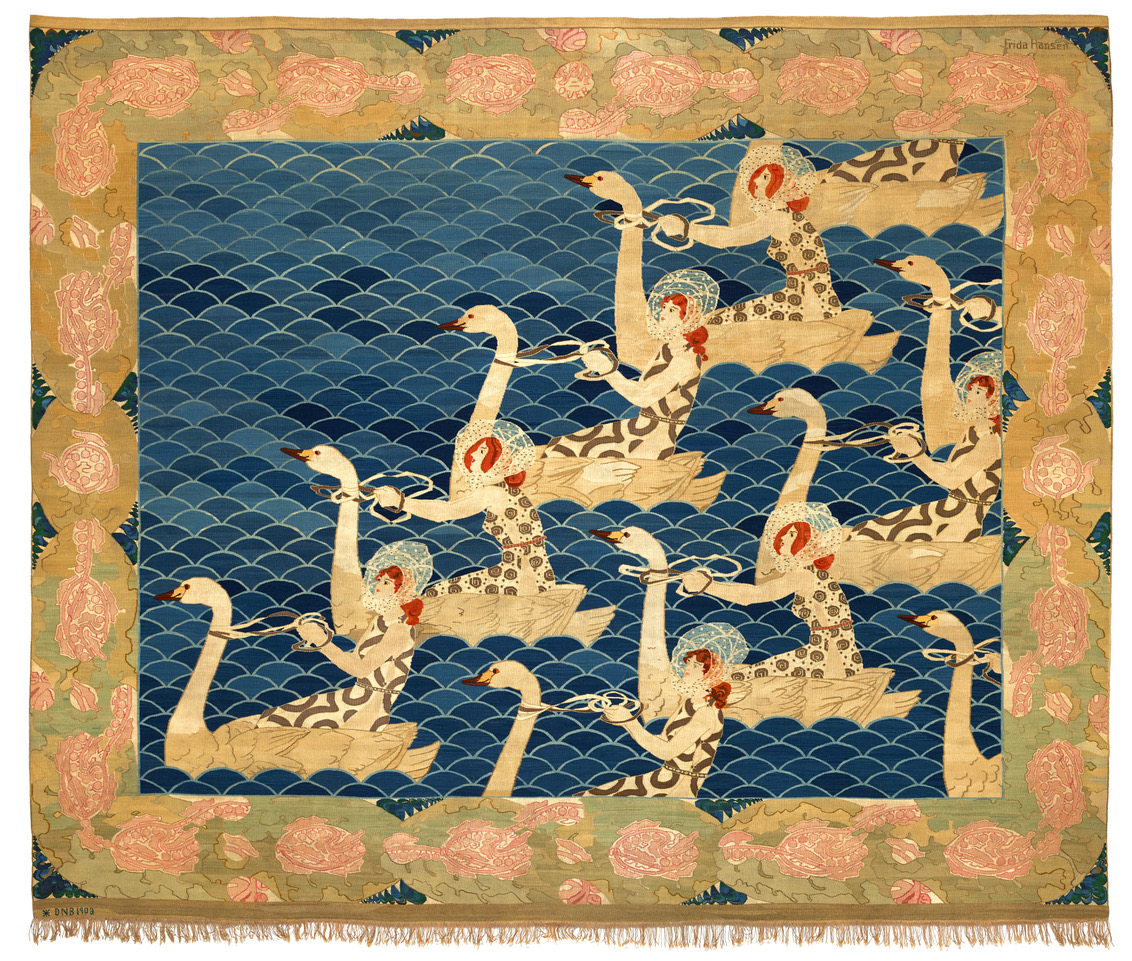
Maidens riding swans are forever moving through blue fan-shaped waves in Frida Hansen’s monumental tapestry, Sørover [Southward], 1903. Perhaps that is appropriate for such a well-traveled work of art?
Frida Hansen. Sørover (Southward), 1903. Photo: Peter Pap
Southward was barely cut from the loom of Frida Hansen before spending decades on exhibit in many American states.
1903. Berthea Aske Bergh, a New York Norwegian-American socialite, weaving teacher, and pupil of Frida Hansen, bought Southward from Frida Hansen and brought it to the U.S.
1903-1931. Southward was exhibited in more than 25 U.S. venues, including New York City and Brooklyn, New York; Rochester, New York; Washington D.C.; St. Louis, Missouri; Baltimore, Maryland; Toledo, Ohio; Burlington, Vermont; and Minneapolis, Minnesota. (Read more: “Southward on Display.”)
In particular, tens of thousands of Norwegian-Americans visited the Norse-American Centennial celebration held at the Minnesota State Fairgrounds on June 6–9, 1925. Thousands of the visitors must have seen Southward hanging in the Exhibition hall.
Southward hung prominently at the Norse-American Centennial. Photo: Vesterheim Norwegian-American Museum
1961 — Southward is sold at the estate auction of Norman Bergh, son of Berthea Aske Bergh, but there is no record of who bought it or how much was paid. (Read more: “More Provenance Puzzle Pieces are in Place.”)
19?? (1970s?) — David McInnis, a rug dealer from Keene, New Hampshire, acquired Southward and stored it carefully.
2021 — After the death of David McInnis, Rug Dealer Peter Pap rediscovered the tapestry, many decades after it was last publicized, folded in a bin. (Read more: “Frida Hansen’s Sørover.”)
2022-2023 — After cleaning, Southward was once again exhibited in two venues. It was part of Scandinavian Design and the United States, 1890-1980at LACMA, the Los Angeles Museum of Art (Oct. 9, 2022-Feb. 5, 2023), and the Milwaukee Museum of Art (March 24-July 23, 2023).
Imagine all the times Southward has been rolled, unrolled, and moved. Here is a photo of the tapestry in Peter Pap‘s studio in Dublin, New Hampshire, being rolled for shipping to Stavanger.
Think of all the types of vehicles that were used to transport the tapestry to various venues. It came by boat from Norway in 1903. It was most likely moved by horse-drawn carriage during the first decade of the 1900s, and then by gasoline-powered trucks and cars. It was sent between the Toledo Museum of Art and the Brooklynn Museum of Art in 1931 with American Railway. It will not be sent back to Norway by boat.
Through the diligent work of Berthea Aske Bergh, the owner of Southward, the tapestry itself was a vehicle in the United States for promoting Norwegian tapestry and Frida Hansen’s talent. Bergh received the St. Olav’s Medal from Norway’s King Haakon the Seventh for her promotion of Norwegian art. I think she would be happy that the tapestry she bought from Frida Hansen’s loom is still admired by new generations.
“The Honorable Erling E. Bent, Consul General of Norway presenting Mrs. Berthea Aske Bergh with the St. Olav’s Medal. Sent from King Haakon the Seventh of Norway for her many years work for Norway Arts and Industries at a party held for Mrs. Bergh in the Norwegian (Seamen’s?) Hotel, December 10, 1948. Brooklyn, NY”
Thousands of Americans have had the opportunity to admire Southward. After 122 years in America, it seems high time to bring it back to Norway for a blockbuster exhibit.
This issue of the Norwegian Textile Letter features several articles about the Scandinavian Weavers Study Group of the Weavers Guild of Minnesota, or by members of our group. There is currently a retrospective exhibit at Norway House in Minneapolis, Vibrant Tradition: Scandinavian Weaving in the Midwest, so this is an appropriate moment to celebrate the group’s more than thirty years of weaving in Scandinavian techniques.
Lisa Torvik wrote about the Scandinavian Weavers’ rosepath group project, inspired by the Swedish author Anna Östlund. That technique will always remind them of the pandemic. Read A Rainbow of Rosepath.
Lisa Torvik wrote about Anne Holden, an interesting weaver she met on a trip to Norway last fall. Holden didn’t know how to weave when she came to Norway to ski as a young woman. Now she is known for weaving deeply traditional plaid fabrics for national costumes. Read Scotland is not the only Place for Plaids!
Lisa Torvik also wrote about a remarkable tapestry she noticed at a friend’s home. What does foot surgery have to do with a superstar Norwegian tapestry weaver? I’ll bet some readers will recognize who wove this before even reading the article. Read Finding Unexpected Treasure in a Familiar Place.
Mary Skoy’s great-grandfather received a monogrammed blanket for a wedding gift 1n 1880. 150 years later she wove a new family heirloom. Read A Treasured 1880 Wedding Blanket, Reinterpreted.
Wendy J. Johnson of Saga Hill Studio has an infectious passion for flax and a deep interest in Scandinavian textiles. She grows, spins, knits and weaves linen in Minnesota. Read Linen Flax in Norway—Past, Present, Future.
Fans of band weaving will want to sign up for two free classes coming up from Vesterheim Norwegian-American Museum. They are listed in this issue’s Nordic News and Notes.
Sally Yerkovich, Director of Educational Exchange & Special Projects for the American-Scandinavian Foundation, introduces a new exhibit, Nordic Echoes: Tradition in Contemporary Art, opening in New York City on April 6. After you see the article, you’ll understand this comment…shouldn’t someone bring a guinea pig to the exhibit? Read Nordic Echoes: A Journey Curating a Celebration of Contemporary Nordic Traditions.
Krokbragd hasn’t only crossed the ocean to American weaving fans. British author Angie Parker has added her signature vibrant color palette to the technique. Minnesota weaver Jan Mostrom wrote a review of Parker’s new book, “Krokbragd: Contemporary Weaving with Colour” .
Thank you everyone for reading and sharing! The Norwegian Textile Letter was first published in 1994, forty years ago. I just completed ten full years of publishing the newsletter online. It could not be done without the unflagging help of generous contributing authors, and the team of talented friends who edit and proofread the articles. Special thanks for this issue go to Mary Skoy, Lisa-Anne Bauch, and Carol Colburn.
Looking forward to future issues, there’s still so much to share. Please let me know if there are topics you would like to see covered.
Robbie LaFleur
Help support wonderful articles on Scandinavian textiles (and the publisher’s upcoming research in Norway) with a donation to the Norwegian Textile Letter. This warbler is chirping his thanks! Tusen takk
The message you received a short while ago was an unintended teaser! I am formatting the articles for the new issue (out March 31!). I did not realize that when I switched to the block-editing style in WordPress, that a message would go out when I saved an article in password-protected format. That’s how I send a formatted article to the author and proofreader.
You will see the really interesting article on flax soon, and several more articles, soon!
Until then, if you are not aware of the wonderful weaving exhibit now up at Norway House in Minneapolis, you can read about it in these two articles.
A Christmas-themed article has been added to the current issue of the Norwegian Textile Letter, “God Jul! (Norwegian Textile Style.” It highlights the great collection of the Norsk Folkemuseum, and of course, some wonderful textiles in their collection. The museum celebrates the holiday season sensationally. There is a whole section of their website, “Juletradisjoner gjennom 1000 år” [Christmas Traditions Throughout 1000 Years]. I wish I could visit the rooms personally this month.
This is the 1905 reconstructed apartment, my favorite.
Did you hear about the recent addition of “Traditional costumes in Norway, craftsmanship and social practice” to UNESCO’s representative list of Intangible Cultural Heritage of Humanity? (Note: the site takes FOREVER to load.) It just happened on December 5, and there was a great celebration by bunad fans all over the country on December 6. The event was carried live on Facebook. If you can speak Norwegian, you might want to check out the replay here, here.
Thank you for your ongoing interest in the Norwegian Textile Letter. The newsletter is a labor of love for me. My goal is to publish new articles and translated older articles about Scandinavian textiles that will be available to interested readers now and researchers of the future. There will be lots of great textile articles in 2025!
Happy holidays,
Robbie LaFleur
Help support wonderful articles on Scandinavian textiles with a donation to the Norwegian Textile Letter. Thank you! Tusen takk!
Today, the only thing more annoying than sending out a post in which all the links acquired a mysterious arrow in the coding and didn’t work is listening to the squirrels playing chase games inside our eaves. Here are two charming weaving patterns with squirrels that I saw in the archives of the Norsk Folkemuseum last month. I will not be weaving these squirrels. And I apologize for the inconvenience of broken links. For sure the links work on the issue main page – norwegiantextileletter.com.
Viking Weaving on Minnesota’s North Shore. Holly Hildebrandt is enthusiastic about a class at North House Folk School from Melba Granlund. She made her own warp-weighted loom.
From WOW! to HOW?: Weaving at the Karin Larsson Exhibit. This summer and fall, volunteers from the Weavers Guild of Minnesota demonstrated rag rug weaving at the American Swedish Institute during the run of the Karin Larsson “Let the Hand be Seen” exhibit. They drew inspiration from Karin Larsson’s beautiful textiles and an unusual rug 14 meter long rug in the ASI collection.
Tribute to Anne Kjellberg, 1945 – 2024. Norway’s museum community lost a leading figure in the world of textiles, costume and textile history with the passing of Anne Kjellberg in July of 2024.
Thanks for reading! Please share comments and questions and article ideas with me, at lafleur1801@me.com.
Robbie LaFleur
Help support wonderful articles on Scandinavian textiles with a donation to the Norwegian Textile Letter. Thank you for all your appreciation along the way. Tusen takk!
This issue would not be possible without the generous work of several authors–and weavers.
The Red Thread: A Monumental Tapestry by Else Marie Jakobsen. If you travel to Bergen, Norway, you should visit the Science Building at the University of Bergen to see the monumental two-story high tapestry by Else Marie Jakobsen. Thank you to Janne Leithe, who gave permission for her description of the tapestry, taken from her book on the life and work of Else Marie Jakobsen, Levd Liv, VevdLiv (Woven Life.)
“Solstol”, by Hilde Opedal Nordby, shows rutevev used in a contemporary way.
Primstav and Textile Production in Scandinavia. Thank you to Lisa Torvik for taking us out of our high-tech daily lives, to think about the a whole different sort of calendar–and the importance of textile production in the lives who used the wooden stick versions.
And tusen takk to those who donate to the ongoing production of The Norwegian Textile Letter. You are all part of the ongoing availablity of original and translated articles. Thank you!
It is easy to support the ongoing work of the newsletter via this PayPal button (or mail a check). Thank you!