By Robbie LaFleur
Southward: Swans, Maidens, and a Transatlantic Journey
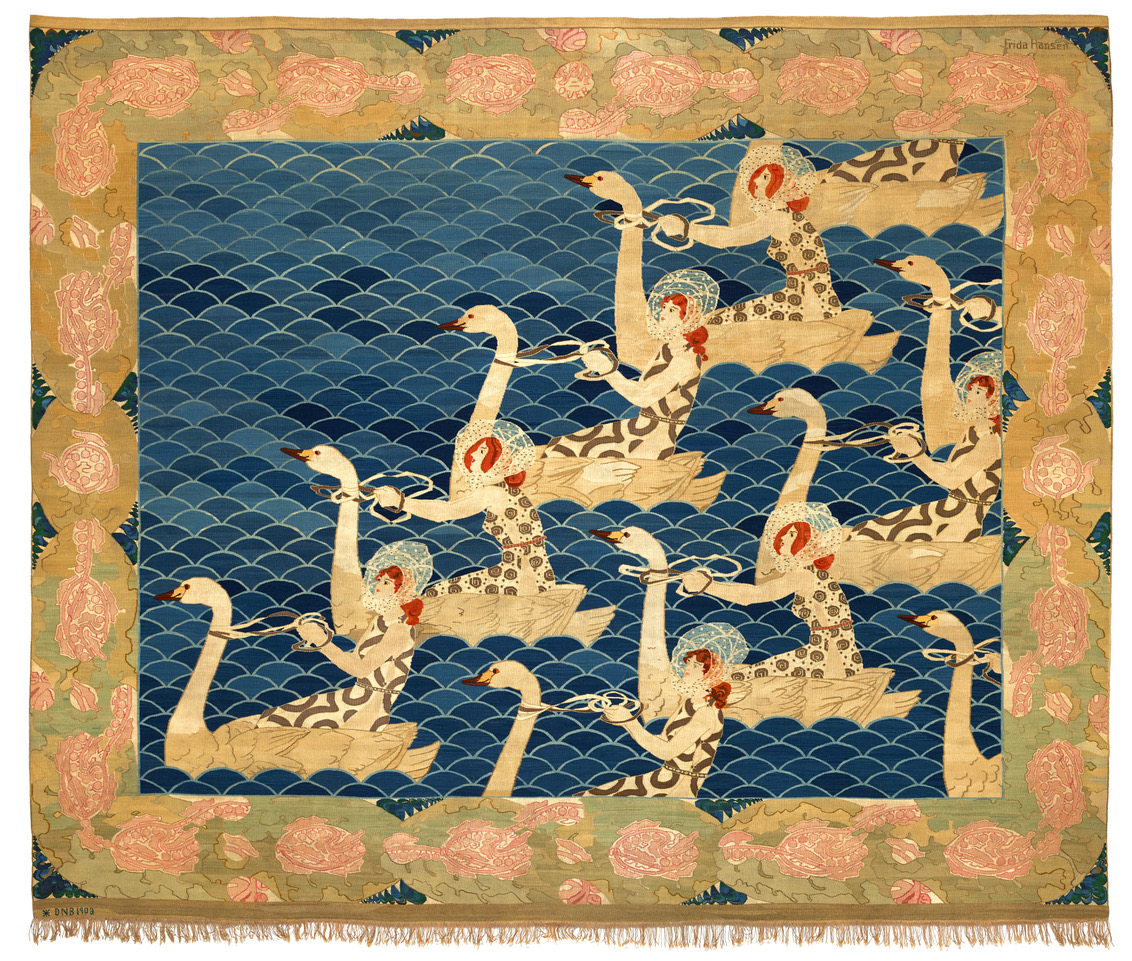
At the turn of the twentieth century, the Norwegian artist Frida Hansen (1855–1931) was internationally recognized for her innovative wool tapestries. Her work combined deep knowledge of Norwegian materials and dye traditions with a distinctly modern, Art Nouveau sensibility—characterized by flowing lines, stylized flowers, and luminous color.
Hansen played a central role in the revival of tapestry weaving in Norway in the 1890s. Through her studio, Den Norske Billedvæveri, she trained weavers, developed new designs, and refined her distinctive “transparent tapestry” technique, in which areas of open warp interact with densely woven forms. Her international breakthrough came at the Exposition Universelle (1900), where she was awarded a gold medal. Works such as Melkeveien (The Milky Way, 1898) established her reputation across Europe and beyond.

Hansen’s tapestries were acquired by museums and private collectors in several countries, including the United States. Berthea Aske Bergh (1867-1954) was a Norwegian-American socialite in Brooklyn, New York. She was originally from Frida Hansen’s home town of Stavanger and studied tapestry with the famous weaver. Bergh was the first teacher of Norwegian billedvev (tapestry) in the U.S, and a strong promoter of Norwegian handcraft. To prove the eminence of Norway in tapestry tradition, Bergh traveled to Norway in 1903 to purchase weavings. An article in House Beautiful in 1929 described:
“Straight to Mrs. Hansen’s studio she went where the magnificent tapestry Southward stood on the loom nearing completion. To Mrs. Hansen she said, “I must have that tapestry to take back to America.” Mrs. Hanson demurred because practically all her tapestries are sold on the loom and true artist that she is, she does not duplicate work. But so insistent was Mrs. Berg that Mrs. Hansen yielded to her entreaties and Southward was destined for America.” (“An Old Art for the New World,” by Miriam Ott Munson, House Beautiful, July 1929, p. 42+)
The story of the swans and maidens tapestry is documented in a series of Norwegian Textile Letter articles: the numerous times it was exhibited in galleries, museums and at public events to thousands of Americans; the mystery of its disappearance for decades; its rediscovery by antique rug expert Peter Pap; and its return to Norway in 2025, more than 120 years after it arrived in New York.

But Southward was not the only Frida Hansen tapestry to vanish from view in America. What follows is not a definitive accounting, but a series of case studies: works that were once exhibited, sold, or documented in the United States, and whose present locations remain unknown.
Case Study 1: King Sigurd’s Entrance into the Holy Port
Berthea Aske Bergh purchased two additional works woven by Frida Hansen as part of her effort to introduce Norwegian tapestry to American audiences. One was a replica of a tapestry designed by Gerhard Munthe and woven in Hansen’s studio: Intoget I Myklegaard (King Sigurd’s Entrance into the Holy Port).(2) According to the House Beautiful article, “King Oscar the Second of Norway, who possessed the original, was unable to withstand Mrs. Bergh’s entreaties.”
The Sigurd tapestry, purchased by Bergh and brought to the United States, was a replica of one of two works designed by Munthe known as the Rikstepper (National Tapestries). These were woven under Hansen’s direction and displayed in the Royal Palace in Oslo for nearly a century before being removed for conservation.

The National Tapestries are now a central feature of the exhibition Tråder i tid (“Threads in Time”) at Queen Sonja Art Stable in Oslo, Norway, where both the tapestries and Munthe’s original cartoons are displayed as part of a broader presentation of works from the Royal Collection (1890–1955).(3)
The earliest reference I have found to the Sigurd tapestry in the United States places it at the Mechanics Institute in Rochester, New York, in 1907 (now Rochester Institute of Technology). While the exhibition included jewelry and metalwork, it was the Norwegian tapestries that drew particular praise for their materials and craftsmanship. One account noted: “Another piece, remarkable for rich colors and the perspective it shows at a distance, represents crusaders entering Jerusalem. It is priced at $300.” (“Wrought as in Centuries Ago: Beautiful Tapestries at Mechanics Institute,” Rochester Democrat and Chronicle, March 19, 1907)
The tapestry continued to circulate widely. It was exhibited alongside Southward at major institutions including the Smithsonian Institution, the Brooklyn Museum, and the Toledo Museum of Art. Thousands of visitors also saw it at the Norse-American Centennial in Minnesota in 1925.
In April 1927, the Sigurd tapestry was shown at the National Arts Club. A review in The American-Scandinavian Review (Vol. 15, Issue 6, 1927) described it as follows: “Frida Hansen first attracted European attention by the great tapestry Sigurd the Crusader Enters Jerusalem, woven after the design of Gerhard Munthe and exhibited in Paris in 1900… [She] made a replica of the upper part of it… for Mrs. Bergh.”
Two points in this account warrant caution. Hansen’s international recognition at the 1900 Paris Exposition rested not only on the Sigurd tapestry but equally on her own original designs. In addition, while most sources describe the American Sigurd tapestry as a full replica, this review specifies that only the upper portion was reproduced. The original was 14′ x 11′, but the exact dimensions of the replica in the U.S. are unknown.

Bergh sold the Sigurd tapestry before her death. Her obituary (Nordisk Tidende, Norwegian Times, Brooklyn, July 8, 1954) notes that it had been sold “a few years ago” to Mr. Carver of the firm Baker, Carver & Morrell—likely Amos or Clifford Carver. A possible lead was the Carver Collection at the Penobscot Marine Museum, but no record of the tapestry has been found there.
Its current whereabouts remain unknown.
Case Study 2: Pond Lilies, a Set of Transparent Tapestries
Berthea Aske Bergh also acquired a set of transparent tapestries titled Vanliljer (Pond Lilies, 1904), which were exhibited in the United States under the English title Pond Lilies. These works were shown alongside Southward and the Sigurd tapestry in multiple American venues.
The design is frequently noted in contemporary sources as one also purchased by Crown Prince Gustaf of Sweden for Queen Sophie. In an effort to trace that version, I contacted a curator associated with the Swedish Royal Collections. No definitive record of the transparencies could be confirmed. As the curator noted, works acquired for domestic use rather than as part of a formal collection can be particularly difficult to track over time.
The Pond Lilies transparencies were well received when exhibited at the Brooklyn Museum in 1925. A contemporary account observed:
“Especially noteworthy are the hand-woven transparent wall rugs woven by Mme. Frieda [sic] Hansen and loaned by Mrs. Oscar Bergh. These rugs, while appearing to be perfectly solid when seen against a wall, are, when shown against a window, seen to be of a transparent background through which the light shines, the figures forming the solid opaque portions. The color is in the familiar pale blues and pinks, which characterize much of the best modern Scandinavian art.” (News and Views on Current Art,” Brooklyn Daily Eagle, Sunday, October 18, 1925)
This photo, taken from Frida Hansen’s catalog of works compiled by Anniken Thue (1973), shows a detail of a replica woven by Fanny Stephansen.

I have located a photograph from a 1913 exhibition that shows a version of this design, installed at the far left of the display. The missing transparent tapestries would have similar large-scale pond lily blossoms. Their exact dimensions are unknown, but each panel is likely 5′ wide by 9′ tall.

Despite their documented exhibition history and distinctive design, no confirmed location for the Pond Lilies transparencies acquired by Bergh has yet been identified.
Their present whereabouts remain unknown.
Case Study 3: Mermaids and Swans (1893), the Columbian Exposition Tapestry
When Frida Hansen wove Southward in 1903, it wasn’t the first time she depicted swans swimming in fan-shaped waves. Ten years before Southward was finished and whisked off to America by Berthea Aske Bergh, Hansen wove Havfruer og svaner (Mermaids and Swans, 1893). This first mermaid tapestry traveled to the World’s Columbian Exposition of 1893 in Chicago. According to a contemporary newspaper account, it was then sold to a Californian. No further documentation of its ownership or location has yet been identified.
When the Norwegian Home Craft Association (Husflid) decided to exhibit Norwegian women’s work in the Woman’s Building at the 1893 World’s Columbian Exhibition in Chicago, Frida Hansen was chosen to design and oversee the weaving of the tapestries. Most were in traditional Norwegian geometric designs, but Hansen’s Mermaids and Swans was an exception. In this tapestry she added naturalistic elements in a way that built on, yet moved beyond, traditional Norwegian weaving. It is 8′ wide x 11′ high.

While most of the Norwegian tapestries were exhibited in the Woman’s Building, Frida Hansen’s Mermaids and Swans was part of an exhibit in the separate Norway Building, in an exhibit of varied crafts.(1) The Norway building was a reproduction of a stave church and it is now in Orkdal, Norway.
Despite its prominence at the exposition and its early sale, no confirmed record of this tapestry has surfaced since the 1890s.
Its present whereabouts remain unknown.
Case Study 4: The Little Mermaid (1925)—From Honolulu to Nowhere
Den Lille Havfrue (The Little Mermaid), woven in 1925, was sold to the Honolulu Academy of Art in 1927. A photograph of the tapestry survives through a family archive, providing visual confirmation of the work and its design.

Museum records indicate that the tapestry was deaccessioned in 1954 and sold in October of that year to a local buyer. For privacy reasons, the identity of the purchaser is not publicly available.
No subsequent record of the tapestry has been identified. It is possible that the work remains in a private collection in Hawaii, unrecognized as a work by Hansen.
Its present whereabouts remain unknown.
Case Study 5: A Pair of Transparent Portieres, Honolulu
In addition to The Little Mermaid, the Honolulu Academy of Art acquired a pair of tapestry portieres in 1927. Museum records describe them as: “Pair. Wool. Colors: coral, rose, purple, yellowish-brown, red-brown and white. Repeat pattern of triangular-shaped vases holding conventionalized flowers, in tapestry weave, with background of white warp threads. Border of conventionalized scroll pattern. Fringe of warp threads on each end.” No size was listed, but a usual size for each panel would be 5′ x 9′.
The reference to a “background of white warp threads” suggests that these works were executed in Hansen’s transparent tapestry technique.
Despite the descriptive detail, I haven’t matched this record definitively to a known Hansen design. The portieres were deaccessioned and sold to a local buyer on April 20, 1954, the same year as The Little Mermaid.
As with that work, no further documentation of their ownership or location has been identified.
Their present whereabouts remain unknown.
An Invitation to Continue the Search
The cases presented here don’t represent a complete accounting of Frida Hansen’s works in the United States, but rather a set of documented traces—objects that were exhibited, sold, and admired, yet have since slipped from view.
Some may remain in private homes, passed down without full knowledge of their origin. Others may reappear through estate sales, auctions, or museum deaccessions. In several instances, only fragmentary records survive, leaving open questions about attribution, condition, and location.
By gathering these references in one place, I hope to make future identifications more likely. A photograph, a family history, or a remembered object may provide the missing link.
If you have encountered a tapestry resembling those described here—or have knowledge of related works—please let me know. This research is ongoing, and each new clue has the potential to bring another of Frida Hansen’s lost works back into view.
Footnotes
(1) The Montana Posten (July 20, 1893), a Norwegian-American newspaper from Helena, Montana, described items in the Norway Building, including Hansen’s tapestry. “The handcrafted objects included many delightful wooden carvings: bowls, drinking horns, boxes and spoons, as well as handwoven tapestries. Mrs, Frida Hansen has a beautiful tapestry with swans and fish in the old style…[translation mine]”.
(2) Indtoget i Myklegard, the title of the tapestry, had various English translations in newspapers and exhibits, including King Sigurd’s Entrance into the Holy Port and King Sigurd, The Crusader.
(3) A discussion of the images in the National Tapestries can be found in: Gjesvik, Torild. “Weaving the Nation: Sigurd the Crusader and the Norwegian National Tapestries.” Chapter 28 of the book Tracing the Jerusalem Code, The Promised Land Christian Cultures in Scandinavia (ca 1750-1920). Edited by Ragnhild J. Zorgati and Anna Bohlin. Berlin/Boston : Walter De Gruyter, 2021.Volume 3: The Promised LandChristian Cultures in Modern Scandinavia(ca. 1750–ca. 1920)Edited byRagnhild J. Zorgati and Anna Bohlin

Thank you to everyone who helps support the Norwegian Textile Letter with donations to cover expenses. Your financial support is crucial and much appreciated. Thank you for being a subscriber!
Click on the image for easy Paypal donation. To send a check, the address is here. Thank you! Robbie LaFleur