Archives

A Travelogue from the Weaving Symposium in Tromsø

By Hilde Opedal Nordby, Handweaver and Weaving Instructor

On November 1-3, 2019, I attended the Norges Husflidslag (Norwegian Folk Art and Craft  Association) Weaving Symposium, held every three years, this time in Tromsø. Around 150 people assembled for three eventful days. Norges Husflidslag is a cultural and interest organization that is a leading actor in the preservation of culture and traditional handcrafts in Norway. The organization was founded in 1910 and has 24,000 members throughout the country.  Weaving is a central focus, and the organization has its own council for weaving. There is a great deal of weaving activity in Husflid groups around the country where over 1000 people participate in courses annually. 

The Weaving Symposium was held at the Tromsø University Museum with opening ceremonies at the Tromsø Library.  The University Museum is situated in a beautiful spot on the southern tip of Tromsøya [the island on which the city lies]. The library is in the center of Tromsø and is a popular city meeting place.  Many passers-by had a chance to participate in the opening, showing weaving to great advantage. It snowed each day and darkness approached with a magical dark blue shimmer around 4 pm, so our days were spent inside. 

Rigid heddle bands with beautiful end finishing.

The theme of the symposium was boundless diversity–in techniques, expression, and mingling with others. In Tromsø I was nearer to Finland, Sweden, and Russia than in the more southerly areas of Norway, and the northern counties have traditionally had closer relations to these countries. To come closer to the Sami legacy was wonderful and exciting to a “southerner” who has learned little about Sami culture. “Boundless diversity” in techniques was reflected in a variety of band weaving methods: the border of a weaving on a warp-weighted loom, rigid heddle-woven bands in a sea of variation, and bands woven on a round stick from Archangelsk were inspiring. The “boundless diversity” in expression was reflected in the presenters, who focused on everything from art weaving to weaving as a profession, textile research, reconstruction and a historical focus on the Sami heritage and their handcraft – douidji. I’ll list some of the high points of the symposium.

Rigid heddle woven band, Russian (left) and Norwegian (right). From the Saturday workshop where participants got to try things out.

One of the most rewarding sessions for me was Sonja Vangen’s lecture on grene weaving; she is a living tradition-bearer with knowledge in her hands. Grene weaving is a tradition that has continued for centuries in Manndal, east of Tromsø. A grene is a thick, warm blanket woven on a grene loom [a warp-weighted loom]. A grene loom consists of two posts that lean against a wall, with a crosswise beam to which the warp is attached by sewing, with stones as weights. In contrast to other warp-weighted looms, plain stones are used as weights, not the typical warp weights in soapstone. Sonja told of collecting stones for a loom as a child, and the trick was to find stones of an equal weight which at the same time had an oblong form that were easy to attach with knots. The warp was wound by weaving with a heddle in a separate warping frame, where the weft becomes the warp for the grene loom. Every other thread is threaded through a half-heddle on a pick-up stick. Both the warp and weft are hand-spun. On Saturday Sonja Vangen demonstrated how a grene is woven. She learned to weave grene from her mother; everyone did when she was young. “You just had to,” she said. The weft should be thick and soft, traditionally spun on a spindle. The weft is still hand-spun, but now on a spinning wheel. Grene weavings functioned as blankets for the nomadic Sami and as tent coverings. The background color was always natural sheep white, with natural sheep dark color stripes; grey also appears. The use of color mirrored the coastal Sami’s flocks of sheep and the colors that naturally occurred. Only in more recent years has it become typical to include other colors in a grene. “Steinbittenner [Atlantic wolffish teeth] (a pattern in pick and pick technique) is commonly used in the bands.

A grene loom in miniature with natural stones as weights and a detail of a grene with, among others, the steinbittenner pick-and-pick pattern.

Preparing warp for a grene

Preparing warp for a grene

Charlotte Engstad was another inspiring woman. She runs Stellaria and told what it is like to live as a hand weaver–the challenges she faces, what she weaves, and her attitude toward handwork. She holds a doctorate in biology, trained later as an adult and is now a master handweaver, one of the few so designated in Norway. She weaves bunad [folk costume] fabric, scarves, and interior textiles. She is the only one I know who weaves with a flying shuttle. Visit her website and be inspired! 

Åsa Elstad gave a presentation about a special textile find from Skjoldehamn on Andøya [the northernmost island in the Vesterålen archipelago, situated about 190 mi inside the Arctic circle]. A well-preserved costume dated from 1050-1100 was found in a bog; today it is Norway’s oldest textile. The costume consists of a jacket with a hat, shirt, pants, belt, and shoes. Who wore it, since it was too large for the skeleton with which it was found? Was the wearer Sami? A man or woman? We know nothing definitive. Kim Holte, a staff handworker at the Lofotr Viking Museum, holds courses in weaving a rigid heddle band from the costume.  At the symposium opening she wore her handsewn pants, which were a reconstruction of the pants from Skjoldehamn–and they worked remarkably well in a modern context. [Read more about the costume here.]

As a continuation on the theme of clothing traditions in the north, Torunn Sedolfsen lectured on weaving traditions in Troms. We were able to leaf through fantastic notebooks with her reconstructed fabrics from two fabric sample collections in the Tromsø Museum. It was a wonderful collection of clothing fabric, bed textiles, and everyday textiles produced in homes in Berg and Torsken on the island of Senja, representing a good deal of women’s history. This work is on its way to becoming a book. 

 From the presentation by Ellen Kjellmo on boat rya.

Ellen Kjellmo spoke engagingly on båtrya [boat ryas]. She has also written a book, Båtrya: I Gammel og Ny Tid, which I most highly recommend–a substantial book with technical terms, informative photos, and well-documented handwork knowledge. During the short half-hour she had at her disposal she delved deep into coastal Norway’s traditions of weaving warm rya coverlets that fishermen used in their boats. A rya is called a sheepskin imitation, which is a fitting description–a solid weaving with durable guard hair in the warp, and with napp of soft and insulating inner-wool that together imitates a sheep fleece. A rya has the advantage of remaining pliable and holding its warming qualities even if it gets wet.  A regular sheep fleece would become stiff and unusable from salt water. 

On the second floor of the museum was a pop-up boutique with handwoven products for sale, woven bands from Archangelsk, blankets and shawls from Stellaria, books and weaving equipment from Norges Husflidslag. Kåfjorddalen Ullkarderi, operated by third generation wool carders who now focus on their own spinnery, sold carded wool as batts and roving. They card their wool without washing which means that the lanolin is preserved and the best characteristics of the wool come out. The museum shop was disappointing with its assortment of machine-woven shawls and souvenir products produced abroad. Why not focus more on local handwork? 

Sergei Klykov from Arkhangelsk demonstrates band weaving with a round stick.

The only thing I missed with the Weaving Symposium was an exhibition of traditional textiles from the northern counties, both historical and newly-produced textiles. I also wish we had more time to mingle; the days were so fully packed with programs that we had little time to talk with the other attendees and create new friends. I’ll finish my travelogue with a poem by Rolf Jacobsen. 

North

Look North more often

Go against the wind, you’ll get ruddy cheeks.

Find the rough path. Keep to it. 

It’s shorter. 

North is best. 

Winter’s flaming sky, summer

night’s sun miracle.

Go against the wind. Climb mountains.

Look north.

More often.

This land is long

Most is north.

Translation by Robbie LaFleur and Kay Larson.
Hilde Opedal Nordby is an Norwegian textile artist working with traditional weaving techniques, as well as contemporary and digital weaving. She is based in Sundsvall in Sweden and is working as a teacher in the weaving department at Sätergläntan Institute of Crafts in Insjön, Sweden. She also has her own company offering courses and weaving services as well as hand woven textiles such as interior textiles and textiles for clothing.

A Forgotten Artist Remembered: The Tapestry Weaving of Pauline Fjelde

Editor’s note: This article appeared in 2004, when The Norwegian Textile Letter was only published in print–in black and white. (Vol. XI, No. 1, November 2004). To celebrate the end of the first quarter-century of the newsletter, it is appropriate to revisit this article by Lila Nelson. Lila was the long-time Textile Curator at the Vesterheim Norwegian-American Museum, one of the founders of The Norwegian Textile Letter, and a mentor to many weavers in the Scandinavian tradition. Lila would love the fact that her words can now be accompanied by many inspiring photos.

By Lila Nelson

Pauline Fjelde. Circa 1900. Photo from the Minnesota Historical Society. 

Pauline Fjelde (1861-1923) deserves recognition and remembrance beyond the circle of family and friends who recall her with love and admiration. Her strength, kindness, and generosity alone make her a special human being. But, in addition, her skill and artistry in embroidery and weaving were of the highest level. Unlike her talented brother Jakob, however, a sculptor whose works are recognized even beyond the Norwegian-American community, Pauline has been largely forgotten. Many Minnesotans know Jakob’s bronze statue on the grounds of Minnehaha Park in Minneapolis, for which he won a medal at the 1893 Columbian Exposition. But very few know that at the same exposition Pauline and her sister Thomane were similarly honored for the first embroidered depiction of the Minnesota State Flag.

Minnesota’s first state flag, embroidered by the Fjelde sisters. Photo from the Minnesota Historical Society. http://collections.mnhs.org/cms/display?irn=10335604

Norwegians in America, published in 2002, for example, mentions Jakob as well as his talented son Paul, but ignores Pauline and Thomane. Attention should be given to the significant production of the Fjelde sisters, who from around 1890 to 1918 supplied the important families of Minneapolis with exquisitely embroidered domestic linens of every kind.

Fjelde Sisters receipt. Photo provided by Charlotte Nordstrom.

They also produced many banners for Norwegian organizations as well as regimental and state flags.

The Luren Singing Society, which is North-America’s oldest male singing society, was formed in 1868. Owned by, and photo provided by, the Vesterheim Norwegian-American Museum.

And they taught their skills to niece Amy, who continued an embroidery shop in downtown Minneapolis until 1959. This article, however, will focus its concerns on the weaving of Pauline, with the re-entry of Thomane as a partner who, near the end of Pauline’s life, completed a final section of her sister’s most famous work.

A number of factors in Pauline Fjelde’s early life were important to her future development. The role of her family was significant. The sixth child of Paul and Claudine Fjelde, she grew up in a modest but comfortable home near Aalesund, Norway, supported by her father’s furniture business. Known as an accomplished cabinetmaker and wood carver, he must have set a high standard of craftsmanship for all his progeny. Pauline showed an early interest in drawing and painting taught in her grammar school, and she liked working with bright colored yarns while learning handwork from her mother. The family appears to have remained close-knit even as an ocean divided it when emigration to America began.

From left:  Mrs. Claudine Fjelde (wife of Paul, Pauline’s mother); Herman Fjelde; Pauline Fjelde (back); Jakob Fjelde, and Thomane B. Fjelde Hansen (front). Date: ca. 1890. From the Minnesota Historical Society. http://collections.mnhs.org/cms/display?irn=10783197

Another factor, unfortunate in itself, affected Pauline’s early life. Around the age of twelve she caught what the family called a “crippling disease” that spread through her home valley. The result was a permanent curvature of the spine and a general physical frailty that made drawing, painting, and embroidery likely interests for her to develop.

The family began dividing in 1871, when the oldest son Oswald left for America, followed shortly by father Paul, who hoped to relocate his furniture business. But his death in 1873 from smallpox left a wife and seven children in Norway. Oswald remained in the United States, moving to Minneapolis in 1881. Prior to this time, the talented fourth son Jakob left to study in Oslo and then at Copenhagen’s Academy of Fine Arts. During his Copenhagen study, he helped establish Pauline as a needlework instructor in Copenhagen and met his future wife Margarethe Madsen. In 1887, after Jakob had studied in Rome and Pauline had probably returned to Aalesund, the two immigrated to Minneapolis, Minnesota, preceded slightly earlier by Henry, another brother. And a year later, they were followed by sister Thomane, brother Herman, and mother Claudine.

Minneapolis, a rapidly growing city with a Norwegian population of over 12,000, was becoming a cultural center for Norwegian-Americans. Already in 1888 Pauline was listed in the City Directory as an embroidress for a Mrs. Emma Snodgrass, where Thomane also worked while brother Herman attended the University of Minnesota. Only two brothers, Thomas and Klaus, remained in Norway; but regular letters kept them in close touch.

Fjelde Sisters business card. Photo provided by Charlotte Nordstrom.

These ongoing family connections were undoubtedly significant throughout Pauline’s life. In 1890, sister Thomane and Pauline began an embroidery business that continued in various locations until 1918. From about 1910, however, much of the work was done by their niece Amy Fjelde, daughter of brother Oswald. Amy took over the business around 1918, maintaining a shop in downtown Minneapolis until 1959. Other nieces at ages eleven and sixteen, Pauline C. and Fredrikke Fjelde, lived with “Tanta Paula” when their father Herman died. Recollections by the children are of a kind and loving person who was also intelligent, well read, and lively. Her generous nature evidently extended beyond the family, however, because she welcomed others into her home and had a wide varied circle of friends. It appears likely that the family connections must have been invaluable when Pauline began her more and more consuming interest in tapestry.

To begin the story of that development, I would like to quote directly from Gail Aanenson’s unpublished 1971 masters thesis on Pauline Fjelde (Chapter 2, Pgs 17-18):

In December of 1910, Pauline Fjelde returned to Europe again. A writer in the Minnesota Posten in 1965 states that Pauline Fjelde went to Europe at that time to study weaving. She had two aims: one was to create a monument to the American Indian and the other was to begin an arts and crafts movement among the Norwegian-American people comparable to the one in Norway. 34 (“Famous Minneapolis Tapestry at Norweg. Museum for Harald’s Visit,” Minnesota Posten, November 18, 1965)

Miss Fjelde wrote in a Norwegian-America publication, Kvindens Magasin, that for a long time she had wanted to make a large tapestry. She went to Copenhagen where she gave the Danish painter Hans Andersen Brendekilde the assignment of making a preliminary sketch of the tapestry which was based on a theme from Longfellow’s poem, “Hiawatha.” She had earlier embroidered figures of Hiawatha and Minnehaha. 35 (Pauline Fjelde, “Kunstvavning,” Kvindens Magasin, 6:3 March 1915).

In Denmark, she saw the Gobelin weaving made for the Ridersalon in the palace at Fredriksborg and immediately set out to study this weaving in Copenhagen. Later she went to Paris to inspect the weaving at the Gobelin factories where she studied with a Mr. Gabriel Gonnet. She was particularly impressed by the tapestry “Vertumne and Pomone” done by Gorguet which she saw at the Luxembourg Palace. 36 (ibid.)

While in France, she ordered from the Gobelin factory all the yarns she needed for the Hiawatha tapestry. Miss Fjelde had sent to Minneapolis over 500 shades of yarn to be used for the work.37 (Gudrun Hansen, personal interview, Minneapolis, November 1969; Pauline Fjelde Pratt, personal interview, Grandin, North Dakota, April 1970; Florence Fjelde, personal interview, Minneapolis, April 1970)

After studying Gobelin weaving, Miss Fjelde traveled to Norway to learn Norwegian billedvavning (Picture Weaving) techniques. It is not clear where or with whom she studied, but she made reference to Frida Hansen, a Miss Christensen and Karen Meidal in the article written for Kvindens Magasin. 38 (Pauline Fjelde, “Kunstvavning,” Kvindens Magasin, 6:4, March, 1915) From Norway also she had a loom and large quantities of yarn sent to the United States. 39 (Pauline Fjelde Pratt, personal interview, Grandin, North Dakota, May 1970)

Miss Fjelde’s stay in Europe was one and one half years. When she returned to Minneapolis she immediately began weaving.

Pauline’s years of work with embroidery undoubtedly were helpful when she turned to weaving. Even so, her progress in an area requiring different tools, materials, and techniques was impressive. (A 1994 article about the Hiawatha Tapestry in the April Sons of Norway Viking mentions in passing that Fjelde studied “embroidery and weaving” in Copenhagen when living there in the 1880s, but there are no indications that she was weaving at that time.) Within a couple of years of her return from Europe she had produced several worthy pieces and possibly had already warped her large upright loom for her most ambitious work.

We know of two weavings which probably preceded the Hiawatha Tapestry, but we do not
know on what loom they were woven. The first, reproduced in a black and white photo (Figure
54, p. 65) in Gail Aanesen’s thesis, (18-14” x 26-1/8” with fringes on the long sides) appears to be a table runner or possibly simply a study in the type of traditional Norwegian tapestry weaving
sometimes called “rutevev” or square weave, popular especially along Norway’s west coast for
coverlets in various geometric designs. Colors were joined through various ways of interlocking, producing sturdy and often reversible objects. Typical designs were variations of crosses, diamonds, squares, and eight-pointed stars. Whereas many of the older pieces had an all-over design, Pauline, who may have originated her motif, chose a central focus, mirror-imaged on either side. It appears from the photograph as if joins are in double or single interlock.

Photo from the Minnesota Historical Society, “Interior of Pauline Fjelde’s home, 4715 Fifteenth Avenue South, Minneapolis.” No date given. Perhaps the square weave piece on the chair to the front right is the piece described? The cartoon of Hiawatha by Brendekilde can be seen on the far wall and Pauline’s loom to the left of it. http://collections.mnhs.org/cms/display?irn=10704164

The “Eider Duck” tapestry (55-1/2” x 69-1/2”) was designed by the Norwegian artist Thorolf Holmboe, and marked a turn from the traditional rutevev to the “billedvev” (picture weaving) tradition, which introduced other techniques to solve new problems. (Aanenson thesis, Figures
59, 60, 61, pages 71-73) Non-geometric designs could not be woven across the loom but had to
be built up in specific areas, making other types of color joins essential. The Eider Duck does have a woven “frame” which would have necessitated an interlock or sewn join along the sides where the frame joined the central motif. All other lines, however, are exuberantly curvilinear and probably were executed by the Gobelin slit technique. The printed photographs give evidence of slits. Whereabouts of this tapestry are unknown, but it had in the 1970s
showed evidence of damage from dry cleaning and exposure to light.

“The Eider Duck.” Photo provided by Charlotte Nordstrom.

The materials for the previous two tapestries, which I have not seen, are described by Aanenson as linen and wool. My own recent examination of Fjelde’s later works reveal warps of “fiskegarn,” the tightly spun seine cotton used for this purpose by some tapestry weavers in Norway since the 1900s and possibly earlier. The wefts, about which I will go into detail later, are a fine two-ply wool, which Fjelde combined in three strands for rich color variations.

If the Hiawatha Tapestry was begun in 1912, the Animal Kingdom and the Nisser tapestries,
supposedly woven about 1913 and 1915 respectively, must have been done on another perhaps smaller loom. There is no mention in any sources, however, of other looms. (Claudia Pratt, a descendant of Pauline Fjelde’s brother Herman, owns an upright loom given her by her grandmother Pauline Claudine Henchen Fjelde Pratt, who died in 1978; but it probably dates from the thirties and, according to Claudia, was too small for executing the Hiawatha tapestry.) Both of these were designed by others, the Animal Kingdom by Thorold Holmboe and the Nisser by an unknown Norwegian painter; and both incorporate billedvev as well as Gobelin weaving techniques.

Nisser Tapestry

The Nisser tapestry (36” high plus 4” fringes each side, and 25” wide) was woven as seen, from bottom to top. [The tapestry is owned by the Vesterheim Norwegian-American Museum, cataloged as “The Elves.”] Warp is 12/9 “fiskegarn” [seine twine] set about 10 ends per inch and tied off with overhand knots. The weft is a fine two-ply wool, used usually in three strands, with about 17 picks per inch. All ends have been needled back into the work, so the tapestry is reversible; in fact, the reversed woven initials of the weaver indicate that the side viewed as the front at present was originally the back. Perhaps the extensive fading of colors on the “right” side was the reason for this change.

Photo from the Vesterheim Norwegian-American Museum.

The Nisser has a childlike appeal, depicting twoof the tiny Norwegian beings who guard the
family farm but resort to mischief if not provided with bowls of porridge. Here the magpie is
taunting them by stealing the spoon from their bowl. The flat background gives way to an impression of perspective and depth, and the large areas of snow are more in evidence than the usual stylized design elements in billedvev. However, the dark outlining of all major objects is typical of billedvev. This outlining, as well as the woven side borders, is achieved through single interlock. Short slits are also used as design elements. While an effective use of color and outlining and a general competence is alrendy evident, some exposed warps and slight
awkwardness in facial delineation makes me surmise that this might have been one of Fjelde’s
earliest tapestries.

Animal Kingdom Tapestry

This detail from “Animal Kingdom” shows a charming fox. Photo provided by Charlotte Nordstrom.

“The Animal Kingdom” (67” high with 6” fringes, 55 ‘4” wide, sett about 10 ends per inch, about 17 picks per inch) portrays whimsical and almost childlike animal figures–a fox, a resting bear and a monumental owl–in a realistic fashion but set against a flat ground filled with stylized mushrooms, flowers, and trees. [The tapestry is owned by the Vesterheim Norwegian-American Museum; the record is here.) The colors, now very faded, were once bright and warm. These elements relate to billedvev, but they are rendered in primarily Gobelin techniques. There appears to be no evidence of the dovetailing or broad hatching techniques typical of billedvev. Like The Nisser, however, weaving is vertical with top and bottom knotted warp fringes and is completely reversible. Brief slits are much in evidence, but longer joins are single interlocked, as is the occasional dark outlining of motifs.

Photo from the Vesterheim Norwegian-American Museum.

Of particular and previously unmentioned interest in “The Animal Kingdom” are, along the
lower border, its two woven signatures. To the left are the familiar joined P and F of Pauline
Fjelde. But on the right are a T joined to a lower H, and these must surely identify Thomane Fjelde, married in 1894 to J. Martin Hansen. This makes much more plausible the family’s
information that Thomane completed a final unfinished portion of The Hiawatha tapestry either before or after Pauline’s death in 1923. The skill required for that complex work could hardly have been developed without some considerable prior experience.

Both the Nisser and Animal Kingdom tapestries are in the collection of Vesterheim, the Norwegian-American Museum in Decorah, Iowa.

The Hiawatha Tapestry

While a few Norwegian immigrant women were weaving tapestries during the arts and crafts
movement at the turn of the 20th century, most were in the style and techniques of geometric designs as found on earlier rural Norwegian coverlets. Fjelde instead expressed her interest
in the American Indian through a pictorial tapestry which combined elements of both the
Gobelin and billedvev traditions. Her subject, based on Henry Wadsworth Longfellow’s poem
The Song of Hiawatha, depicts the young warrior returning to the wigwam of Nokomis and his
beloved Minnehaha with a slain deer over his shoulders.

Photo from the Minnesota Historical Society.

Pauline Fjelde’s bobbins. Photo provided by Charlotte Nordstrom.

The 8 1/2 x 10 foot tapestry is woven with a warp of 12/9 fiskegarn sett at 13 ends per inch and a weft of fine 2 ply wool used in three strands on standard pointed wood bobbins. The warp is very likely to be of Norwegian origin, but the source of the weft is as yet undetermined.

When the Scottish weaver Archie Brennan, once director of the Edinburgh Tapestry Company, examined a sample of the yam in March 2003, he speculated that it might be from Gobelin because it was similar to yarn from that source used in Edinburgh. Attempts are being made to follow up on his suggestion. Family members have indicated a palette of 500 weft colors, which seems somewhat dubious until one recognizes the mathematical possibilities for mixing of initial colors were even fifty or less. Woven on a high warp loom in the typical side to side continental fashion, the weft becomes the vertical hanging element. It is not known if Fjelde wove with the front or the back facing her, nor do we know the nature of the cartoon supplied by the designer Brendekilde. Ends are cut short on the back; some are knotted and others are carried as far as two inches from one motif to another. Border warp fringes on the sides are secured with overhand knots. The piece has two signatures in the lower right, the woven letters “PF” and the embroidered full name “Pauline Fjelde.”

Photo provided by Charlotte Nordstrom.

The style of the main subject is realistic and painterly, faithfully and expertly reproduced in
yarn by the weaver. The sun and shade dappled forest background is achieved through subtle color blending, hatching, and effective line emphasis through open slits. Awareness of perspective is evident in the large figure of Hiawatha, right foreground, turned toward the small figures of the women before their wigwam, and the muted colored Minnehaha Falls behind
them.

The strong four-sided, six-inch wide woven border of the tapestry adds immeasurably to its total effect. It consists of 43 vignettes depicting in stylized silhouetted shapes scenes from the
everyday life of the Indian. All are in a soft grayed brown against a lighter ground with simplified uncluttered forms, giving a sense of ritual importance to each. Seemingly simple in execution, they are framed by narrow single-interlocked borders on each side plus an additional border of stepped diagonals.

Photo provided by Charlotte Nordstrom.

Further, the scene is identified by the expertly woven words from Longfellow’s poem:

Photo provided by Charlotte Nordstrom.

Through their thoughts they heard a footstep,
Heard a rustling in the branches,

And with glowing cheek and forehead,
With the deer upon his shoulders,
Suddenly from out the woodlands,

Hiawatha stood before them.

Reverse of “Hiawatha,” provided by the Minnesota Historical Society. Curator Sondra Reierson wrote, ” The reverse was most useful for establishing true color – fading from light exposure is limited, but noticeable in direct comparison.”

Leg detail; photo provided by the Minnesota Historical Society.

Displayed numerous times in Midwestern museums, including the Minneapolis Institute of Arts and the Walker Museum as well as Vesterheim in Decorah, lowa, Marion Nelson also considered the Hiawatha Tapestry a perfect work for his NORSK I AMERIKA exhibition in Hamar, Norway, in 1988. “It represents,” he said, “Norwegian craftsmanship applied to a distinctly American subject. It is truly Norwegian-American.

As we recognize the broad renewal of appreciation and respect for tapestry weaving in much of our world today, we can also laud Pauline Fjelde for her mastery of the traditions of medieval Europe as well as the billedvev tradition of Norway and for skillfully making them both her own.

Editor’s Addendum:

Special thanks to Sondra Reierson, curator at the Minnesota Historical Society; Charlotte Pratt Nordstrom; and Vesterheim Norwegian-American Museum for the photos in this reprint.

The Hiawatha Tapestry has been acquired and conserved by the Minnesota Historical Society with funds from the Paul D. F. Pratt and Marguerite Olson Pratt Fund at InFaith Foundation. Paul Douglas Fjelde Pratt was Pauline G. Fjelde’s great nephew, Pauline C. Fjelde Pratt’s son, and Charlotte Pratt Nordstrom’s father.

Charlotte Pratt Nordstrom, a relative of Pauline Fjelde, added information that reinforces the challenge of this huge tapestry. “Pauline worked on her tapestry for 10 years, from 1913 to 1923, and passed away just before it was completed in 1923. Her sister, Thomane, completed the unfinished portion of the border.” 

Information on the Hiawatha Tapestry will be available on the website of the Minnesota Historical Society via Collections Online in the coming months (item 2018.73.1). It is not on view currently.

William Becker wrote an article highlighting Pauline Fjelde in Minnesota History:A Theory: The Origin of the Minnesota State Flag,” Spring 1992, p. 3+. There aren’t definitive answers to why the design of the state flag was chosen, but it is undisputed as to who embroidered it. “…flag was created for the Chicago World’s Fair, where it apparently “adorned the platform of the Woman’s Building, [and] was admired by all.” In fact, its silk embroidery brought a gold medal to Norwegian immigrant sisters Pauline and Thomane Fjelde of Minneapolis, who had been commissioned to make it.”

On the Road With Vesterheim: Appreciating the Simple Loop

By Kate Martinson

In the early 70s, when I began my real love affair with fibers, I thought that weaving and spinning were the end-all, but as the decades flip by I find ever more techniques to be delighted by. The Vesterheim Norwegian-American Museum has been a great asset and support in my explorations and research.  The 2019 Vesterheim Textile Tour was an overflow repeat of the 2017 itinerary, with a variety of visits in Denmark and Southwest Norway.  The experience literally “threw me for a loop.”

Loop History

Simple blanket stitch from “A Stitch in Time” (link below).

I will wager that for many of us, one of our first textile experiences included simple embroidery. I recall the blanket stitch as part of my first attempts with a needle and thread. I am not alone in this entry experience. Little did we know we were using one of the oldest textile techniques humans created—the blanket stitch, a form of simple looping. This basic stitch predated even the invention of the needle, which archaeologists suggest was at least 61,000 years ago and was discovered in Sibudu Cave, South Africa. That first blanket stitch, probably done using fingers and fiber strands or sinew, has a whole family of variants.  It was surprising to me to see all the simple looping that kept showing up as we traveled across Southern Scandinavia.

Textile specialists and curators alike define looping using Irene Emery’s book The Primary Structure of Fabrics.  Looping is a single element thread. Emery states that looping is “a technique that has a ‘curved enclosing boundary.’ It is an active element which doubles back on itself to form a complete closed loop.” The single element, or thread, goes through a loop by means of sewing or netting and continuing on to create and sew through adjacent loops. It includes a variety of categories from half hitch in rope work to the blanket stitch used to edge woven fabrics, from a sewn edging for warps while on the loom to simple and complex cutwork embroidery lace in Asia and Europe. This stitch is a global work-horse.

If you are in need of a quick but good review, take a look at “A Stitch in Time: The Buttonhole Stitch and Blanket Stitch.”

Inspiration from Ancient Textiles

Our first full day on the trip found us in Copenhagen at the National Museum of Denmark, at the Viking and Middle Age textile exhibitions. We were introduced to a variety of clothing pieces, jewelry, etc. in two separate galleries. One of the pieces given special note was the Viking Mammen Mantle. 

We were able to take a peek at the fiber strips from a key burial find from the winter of 970 to 971 AD. The high status owner wore these strips either as decorative bands or as a form of headwear.  Discovered in 1868, there has yet to be consensus about use but materials are principally silk and silver and gold thread, and techniques include cardweaving and nålebinding, in Danish. This flexible and complex looping technique is more advanced than the simple looping of blanket stitch, as the needle passes in a variety of directions in the work. The fabric can be made more dense, variously shaped, thin but strong, and flexible with these sorts of variations. Since there were others on the trip who practice this complex looping technique to create items such as hats, mittens, cowls and socks, it was exciting for many of us to see this important and high status archeological find. For those aware of nålbinding, the “mammen stitch” in current nålbinding is named for the work on these strips on display in Copenhagen.

In the late 1980s I was able to study these and other nålbinding items at this museum but because of rarity, these treasures are behind glass and impossible to photograph.  The easiest way to see these pieces up close and to learn more is on the National Museum website.

Looping at the Greve Museum

The courtyard of the Greve Museum…many years ago.

After adventures in Copenhagen, we headed into the countryside and the Greve  Museum, notable for its collection of Hedebosom. This white on white embroidered cutwork is special to the rich farming area of Hedebo. The group toured the farmstead and its extensive and varied collection of the local cutwork. We also had an option to participate in an introductory class with a local teacher. Having the opportunity to study a variety of examples up close and to try our hands at the technique reinforced that looping appears in a variety of forms and uses. In one piece the looping might hold together the decoratively strands of cut fabric, and in another the loops are connected to look like lace.

Hedebo lace from the Greve Museum

Edi Thorstensson, a participant on the 2017 Vesterheim trip to Denmark, wrote about her time at the Greve Museum for the Norwegian Textile Letter.  To learn more about Hedebosom, see her article on the collection and class at the museum with Laila Glienke, “Hedebosyning at Greve Museum.”

Going Back in Time

The Vikings used looping along seams.

Getting off the bus, who knew that in a few hours we would travel back in time through rural 18th century Denmark, to Viking times, and to Iron age living and the mysteries of the stone age?  We did all that at Sagnlandet Lejre, Land of Legends—and with time out for lunch!

This museum-like park is developed as a place to explore experimental archeology, especially in the workshops, including a pottery, textile workshop, and smithy.  There trained staff strive to study, experiment and reproduce handcraft from the past. No surprise that our group enjoyed the various historical clusters of houses and farms. However, the real treat for us was time spent in and around the textile workshop.  

Reconstructed Viking skirt with looping along the seams

We entered when the workshop was very busy, among other things, outfitting some teens in Viking garb for their stay at the park. In my quest for looping, I asked the staff at work around a big welcoming table. One excited specialist led me to shelving along one wall of the busy workshop where samples were arranged to illustrate basic joining techniques used from Viking times onward. The handspun cloth pieces included different applications for the blanket stitch and its loop cousins to create neat, firm, sometimes elastic, and often visually pleasing seams. Imagine finding such interesting uses of simple looping when I had hardly hoped for it!

To get more of the flavor of Sagnlandet, refer to Solveig Pollei’s article, “Sagnlandet Lejre – the Land of Legends (and Textiles).” 

End of Year at Skals

Before leaving Denmark our group had an inspiring experience at the year-end celebration at Skals Design og Håndarbejdsskolethe High School for Design and Handwork, in the small town of Skals.  The day-long celebration included a student fashion show, an outdoor craft fair for local artists, tours of studios, and displays of student work.  We spent hours soaking up the fine design and technical work of these proud students and craftspeople.  While the fashion show was avant garde, much of the student work represented techniques easy to identify from our own fiber work and exploration. Where to start? Weaving of all sorts, knitting, dyeing, printing, spinning, and embroidery were on display. The items were well made, using mostly traditional practices, with a focus on good design.  We were inspired by the work of these mostly young students. As for looping, it was wonderfully represented in a variety of elegant nålbinding articles.  In addition, various forms of embroidery, both plain and cutwork of loops and regular stitches, were on display, looking fresh and new. For those wondering about the future of folk art and handcrafts, this visit was an inspiration.

On to Norway for Hands-On Classes 

Taking the ferry to Norway signaled the second part of the trip and the adventures ahead. Our Norwegian  adventures included an optional half day of ‘hands-on’ work on the 17th of May.  To miss as few of the festivities as possible, early in the day a number of us gathered to attend mini classes organized by our leader, Laurann Gilbertson. Finger woven bands, Singlada balls and Hardanger embroidery classes were offered.  Two of the three options were based on the use of loops, although a quick look at the balls or embroidery would not automatically make the association with a needle formed loop.  

Vesterheim Curator Laurann Gilbertson tries her hand at Hardangersom.

Barbara Berg led the intrepid Hardanger class. Though the technique carries a place name from Norway, its origin comes from much farther south, from India and Persia to Italy, where it evolved into Reticella and Venetian Lacework, Dutch and Danish cutwork, Ruskin Work and many more—including the famous Norwegian drawn work, Hardanger embroidery. Among the many stitches and techniques included in Hardangersom, the classic and important single loop is seen. One of the most important stitches in cutwork is a buttonhole stitch, which keeps the cut edges from raveling. It can also help by filling in the shapes that have been removed with a lace-like look. As in Hedebosom and other techniques in this family, the thread closely stitched in this way also adds texture and shine to the pattern.

Making Singlada balls was another choice.  In northern Europe and southern Scandinavia, the ancient detached blanket stitch was used to cover handfuls of yarn scraps to create a toy ball for a child. A needle and scrap yarn are employed to make a covering for the ball, usually employing decorative geometric patterns. The detached blanket stitch was used in the same manner American natives used when constructing the bottoms of arrow quivers, and prehistoric folks used to make bags to carry their belongings. Medieval English over-decorated clothing with this same technique in silk gold and silver threads. Making a singlada ball is one of a wealth of applications of the simple loop. That day I taught them to squeeze thrums into balls, wrap and tack their ball shapes with scrap yarn and add colorful yarns using the detached blanket stitch needle-looped into a fabric coverings for their balls. Our group, while trying a new technique, were helping to protect and popularize this tradition and become familiar with new textile options.   

While two classes involved looping in some form, the third class worked on finger-woven sock garters, hosebånd, with Ingeborg Monson, our Norwegian tour leader. While no loops were involved in that project, note the book mentioned last on the information list below, for a great compendium of using loops and other sewn stitching in woven projects.

Factory Time

Our stop at the Sjølingstad Uldvarefabrik in Mandal allowed a tour of a living history textile factory.  Built in 1894, in it its day this mill spun yarn, dyed wool, wove cloth and finished that fabric in a variety of ways. It still carries on many of those same activities,  but it cannot exist with that revenue alone. It has been designated as a national monument for the textile industry in Norway. In a spinning and weaving mill one does not expect ‘exotic’ textiles like simple loops—so I thought.  However, around one corner in the finishing department were hung decorative blankets that had been spun, dyed and woven. Before it would be a soft, warm, long lasting item two additional steps were needed. The blankets had to be finished or “fulled” by brushing with teasel heads and lastly, the edges of the fuzzy fabric needed to be treated for longer wear. A sturdy looped blanket stitch is sewn on as the last step before sale and use in a fortunate home.  

Oleana!

The Oleana factory is also a mecca for those who love color.

A Norwegian ‘mecca’ for those who love good design and high quality fibers, The Oleana factory at Ytre Arna was an important stop on our journey.  What is the connection to looping? Well, naturally, knitted garments are made with loops. However, as most of us are aware, knitting and crochet have structures wherein one loop is pulled through another. On the other hand, simple looping passes a thread, rope, wire, agave fiber, etc. through a loop and on to an adjacent loop with fingers or a needle. Knitting ravels, looping does not. Knitting uses long lengths of fiber but simple looping has shorter lengths because the entire length passes through each loop. Many on the tour purchased irresistible machine-knitted garments while at the shop. They may eventually find themselves wearing their garments while using an eyed needle, looped techniques and short yarn ends to create or embellish a piece of fiber work.   Thus they will be connecting the earliest f techniques with the most current methods of fiber work. 

Time Flies By

One of our last adventures found us traveling to the Osterøy Museum, which included a beautiful bus ride out of Bergen into rural Norway. This folk museum is a busy place with a contemporary building for classes and a large hall for events as well as storage, offices etc. We had coffee and the local sweet, stompekakad, and then enjoyed a presentation by Marta Kløve Juuhl on the museum, and on teaching and writing about the warp weighted loom.  (A few tour group members returned a few days later for a class on warp weighted weaving.)

Looped blanket stitches on a blanket at Osterøy.

The museum has collected a number of buildings from the island and arranged them into an open air section that illustrates architecture from different eras. Tour members enjoyed walking through these old, restored buildings, and discovering what life might have been like in this place.  As I entered an upstairs bedroom of a wealthier farmhouse, I heard another loop-wise tour member exclaim “Look, FINALLY, blanket stitch is being used in a real bed!”  In the corner was a beautifully painted built-in bed with stone age loops strengthening and decorating the edge of the bedding it contained. It is one of my favorite memories of the trip, during which many of us became ever more aware and appreciative of simple loops in our textile work and lives.

In Conclusion

Readers can imagine how much of the excellent tour has not been included because of space. It is impossible to express all that was learned, the places visited, conversations shared, food enjoyed, landscape admired and people cherished. 

The loop is a device to organize and make items useful.  So are travel and learning when well done. Readers have missed the tour experience itself, but now have a chance to be more aware of and excited about the history and potential for the simple loop.

Participants in the 2019 Vesterheim Textile Tour

Kate Martinson’s tea cozy in nålbinding.

Kate Martinson is Professor Emerita of Art at Luther College in Decorah, Iowa, where she taught  weaving and a variety of Scandinavian fiber techniques. In addition, she taught bookmaking, papermaking, and art education, and developed study abroad experiences.  She has taught spinning and other textile-related classes throughout the United States and in Norway at Rauland Academy, and is known for introducing nålbinding to many American fiber artists. Kate is an enthusiastic supporter of Vesterheim Museum.

Additional Information:

Collingwood, Peter. The Maker’s Hand: Close Look at Textile Structures. 1987 (various editions).

Emery, Irene. The Primary Structures of Fabrics: An Illustrated Classification. Thames & Hudson; 2nd edition, 2009.

Hald, Margrethe. Ancient Danish Textiles from Bogs and Burials: A Comparative Study of Costume and Iron Age Textiles. Copenhagen : National Museum of Denmark, 1980.

Hoskins, Nancy Arthur. Universal Stitches for Weaving, Embroidery and other Fiber Arts. Atglen, PA : Schiffer Pub. Limited, 2013.

Lessons Learned From Weaving & Sailing A Wool Sail

By Martha Brummitt

Upon learning that the Vikings used wool sails, I wanted to see for myself what it would take to create one myself and then test it on the water and in the wind. My curiosity led to receiving a grant from the Minnesota State Arts Board in 2019 to weave a wool sail and to build a Norwegian pram. 

For some context and background leading up to sail-making component of this project, including a brief summary of building a wooden boat, click here to read an article from the February 2019 Norwegian Textile Letter, “Building a Norwegian Pram and Weaving a Wool Sail.” I would also like to point out that I received an immense amount of support, guidance and advice to complete this project and to maximize my learning.

In early 2019, Rach-Al-Paca Farms in Hastings, Minnesota, spun the wool to my specifications, which were based on research: z-twist warp and s-twist weft, both single ply, using long staple wool. I turned down an option to purchase wool from a Swedish farmer of Spelsau sheep, what was believed to dominate the wool used in sails during the Viking Age. In addition to a high price, the arrival time of the wool did not fit the constraints of the grant. The wool for the sail was sourced from a blend of long-fiber wool. After winding warp for a sample and for the sail at the Weavers Guild of Minnesota, I soon learned that not distinguishing the fibers between warp and weft was going to present some challenges. If I ever make a second wool sail, the warp must have long, strong guard hairs in it.

With the help of two experienced weavers, what might take two people about twenty minutes to beam the warp onto the loom took three of us multiple hours. The fine single ply yarn had ample twist energy and stuck to all of its neighboring warps. Over the course of many hours which turned into a few weeks, we forged ahead and threaded 392 warp ends on to the loom (14” wide, 28 ends per inch).

Wool warp and weft that did not want to separate

I wove only a few rows of weft until I had to stop. The sheds would not open well enough, warps stuck to each other and some broke. My options at this point were to: a) coat the warp with fish oil while on the loom in order to tame the “halo” or fuzz factor; b) bury the wool warp for a year in order to tame the twist energy and halo; c) a combination of a and b; or d) purchase commercial yarn that would weave nicely and full well. Options a, b and c were what the Vikings would have done, but I opted to not put a bunch of fish oil on the Toika loom I was renting and housing in my apartment, nor did I have the time to try option b. After considering many suggestions from other weavers, reviewing my notes and research, and consulting with my textile mentor Carol Colburn, I purchased double-ply cottolin (cotton and linen blend) yarn in about the same weight. Evidence shows the Vikings used linen and hemp to create sails, and I bet if they were around in today’s times, they would likely be sailing with dacron or the like. 

Tying on cottolin warp to the wool warp

Back at the warping reel, I wound enough cottolin for another sample and wove about a yard of fabric, using the original wool weft. The sample contained three variations: plain weave and 2/2 twill with single and double strands of weft. When deciding to forgo wool warp and weave with cottolin instead, much speculation arose about whether or not the fabric would full well. Fulling is like felting–the scales on the fibers bind together, shrinking the fabric and creating a more windproof cloth. With my sample in tow, I marched to my bathtub full of hot water and started stomping on the cloth. To my delight, the sample fulled and shrunk really well. The single-weft 2/2 twill was the finest and tightest of the three weaves. In other words, it was the lightest and most windproof.

Mentor Carol Colburn examining the fulled sample

At this point, more cottolin yarn was on its way, ready to become part of a wool/cotton/linen sail. With approximately one hundred cumulative hours of winding warp, warping the loom, and weaving samples under my belt (and under the belts of many volunteers), it was time to weave the sail. Ten people visited my apartment to help weave about ten yards of 34” wide sailcloth, some of whom were first-time weavers.

Sail weaving in process

Finished sail fabric at its full length

Many people have asked, “how long did it take to make the sail?” My best estimate for just weaving the final sailcloth is fifty hours, half the amount of time spent doing the prep work. I have never timed myself when making something, because if I did, I would not enjoy the process of making it.

After weaving, I cut the 70 square feet of sail fabric into three sections and sewed the recently cut edges to prevent unraveling. Then five volunteers spent an afternoon stomping on and rolling the wet sail cloth in order to full the fabric. The fabric shrunk more significantly along the warp (length) than it did along the weft (width). Once the fabric dried, the three sections were machine and hand stitched into the shape of a four-sided sail.

Fulling sail fabric with volunteers Carol Colburn, Kala Exworthy and Robbie LaFleur

Laying out three section to sew the sail

Throughout this entire time, my textile mentor and friend Carol Colburn remained in close touch to provide support while I made sure the project stayed on track. Working mostly remotely with some in-person visits, Carol provided lots of encouragement and advice on how to start, continue and finish the sail. Together with the help of one volunteer, we stitched the sail in one weekend. Using my late grandmother’s industrial sewing machine, we sewed false seams down the center of the 30” wide sail cloth to increase strength, minimize stretch, and mimic the appearance of a traditional sail. Each section was sewn together with a flat felled seam and the edges rolled and hand stitched. Finally, leather grommets sewn around reamed holes and a coating of a resin saturating the cloth made the sail seaworthy. 

Sewing the sail sections together

Sewing leather grommets

Sail sections partially coated in resin

The boat and wool sail have cruised around local Minneapolis lakes, and it fares well in medium winds. The simple rigging includes brass hardware and a combination of nylon and cotton lines. Although the boat was never intended to be a technical sailboat, it sails pretty well and can fit up to three adults while under sail or row. Thank you to everyone who supported my work and helped make this project possible.

Sailing on Lake Bde Maka Ska in Minneapolis, MN

Martha Brummitt grew up in Milwaukee, WI and was lucky to spend much of her childhood surrounded by craft projects, boats and water. Driven to understand how useful objects are sourced and made, she has tanned hides to sew leather moccasins, harvested trees to create baskets and snowshoes, and processed raw wool into a knitted sweater. Her professional work has included teaching youth how to sail, canoe, waterski and build wooden boats. She currently lives in Minneapolis, MN with her partner and plans to live on a sailboat someday.

This activity is made possible by the voters of Minnesota through a grant from the Minnesota State Arts Board, thanks to a legislative appropriation from the arts and cultural heritage fund.


National Exhibition of Folk Art in the Norwegian Tradition, 2019

Each year the ribbon-winning weavings are published in The Norwegian Textile Letter, for those not lucky enough to visit the National Exhibition of Folk Art in the Norwegian Tradition at the Vesterheim Norwegian-American Museum in Decorah, Iowa. 

Laura Demuth, Gold Medalist
Decorah, IA
Best in Show


This is a traditional Rutevev Wall Hanging. I simply love to sit in front of my loom with yarn in my hands creating a textile. Weaving rutevev is particularly pleasing, involving simple geometric patterns and an appealing rhythm. The weaving process offers a certain peace and structure to any day. I have been weaving and working with wool for over 40 years. I am especially drawn to traditional textiles. Although I am not Norwegian, I greatly appreciate Vesterheim’s textile collection as a continual source of inspiration. Laura Demuth

Wendy Stevens
Decorah, IA
People’s Choice


This is a 6-shaft danskbrogd weaving. I have been weaving since 1976. I have been fortunate to have taken numerous classes at Vesterheim including Jan Mostrom’s class in danskbrogd last fall. Renting an 8-harness loom at Vesterheim for the month of January allowed me to continue to experiment with this technique. Wendy Stevens

Lisa Torvik
St, Paul, MN
“Better than Lawn, My Garden”
White Ribbon


This contemporary wall hanging is done on a warp set up for traditional tavlebragd (monk’s belt) technique with traditional treading and untraditional use of inlay color.  This piece is inspired by a painting of our house done by my husband. When I sat down to work on this warp, I got the idea of weaving our yard, front to back. Starting at the bottom with the rain garden on our boulevard, through plantings of tulips, lilies, cone flowers, crabapple trees, various iris, coral bells—-well you get the idea. Then our tiny back lawn through the seasons and our back gardens with hosta just about everywhere. I am a native of Decorah, grew up running around the museum and was exposed there and elsewhere to traditional and contemporary textiles. I started weaving, knitting and sewing when I was young, took some classes here and studied weaving for a year in Norway. Now, finally, I have time to weave again. Lisa Torvik

Carol Culbertson
Evansville, WI
Honorable Mention


This traditional piece was woven to be a 32.5” x 16” table runner. This is an example of danskbrogd bound weave. The inspiration from this work came to me while taking a weaving class at Vesterheim in July 2018. One of the students had an example of Danskbrogd with her. I was instantly drawn to this technique. By the time I finished the class, it was time to make a table runner for the Christmas holidays. After experimenting with patterns from class and others I had seen at the museum, this piece emerged. My 4 year old great-granddaughter saw this weaving on the loom and excitedly announced “Christmas” so it is called “Grace’s Christmas” in her honor.  After weaving in the Navajo tradition for 10 years, I was introduced to weaving in the Norwegian tradition 4 years ago when given a wall hanging by a family member. Since then I have been driven to learn more about Norwegian traditional weaving techniques. Carol Culbertson

Carol Culbertson
Evansville, WI
Red ribbon


This piece was woven to be a 27” x 14.5” table runner. It is an example of krogbragd bound weave. My inspiration for this piece comes from weaving I have seen in the museum’s collection as well as weaving brought into classes by other weavers. It was an experiment on my part of using only three colors with single point krokbragd pattern elements. Several trials of a variety of patterns were tried before this sequence was determined. It was a challenging process turning the multicolored patterns into the three color runner I wanted. Carol Culbertson

Corwyn Knutson
Roseville, MN
Red ribbon


This contemporary handwoven, hand knotted rya is based on northern Norway Boat Rya Wall Hanging. I studied with Syvilla Bolson of Decorah and at College of Art and Design in Toronto. I’ve been weaving Norwegian textiles for 20 plus years. Corwyn Knutson

Helen Scherer
Shawnee, KS
White ribbon


This traditional woven wall hanging or åklæ, is in a single interlock square-weave tapestry technique known as rutevev. The overall design was created by arranging several major traditional motifs, including eight-petaled roses, knots, a lily, and crosses with a hint of overall diamond, plus rows of crosses (korsbord), lightning (lynild) and hag’s teeth (kjerringtenner). The motifs were described in Katherine Larson’s book, The Woven Coverlets of Norway, and other elements in written documentation by Lila Nelson. I took a Rutevev class as part of Vesterheim’s 2011 Textile Tour and having discovered how slow and frustrating it could be, wanted more practice and familiarity with the traditional elements. Weaving has been a hobby for over a decade, and weaving in the Norwegian tradition is a very pleasant way of remembering my mother, who was quite skilled in both weaving and knitting. Helen Scherer

Lisa-Anne Bauch
Bloomington, MN
Honorable mention


Nordic folk arts are simple, using basic materials found in the Northern environment. However, they are also complex including a thousand variations on traditional colors and materials, motifs and techniques. My goal in weaving “Colors of the North II” was to express both aspects. I chose three primary colors—red, blue, and yellow—found in folk arts throughout the North, including Scandinavia, Finland, and the lands of the Sami peoples. The colors are bold, cheerful, and almost childlike in their simplicity, but the small variations in the size of the stripes and placement of the colors hint at a potential complexity. Although woven in a contemporary style, this rug is my homage to the folk artists of old. I am a weaver whose work explores traditional Nordic weave structures in a contemporary color palette. I have studied traditional techniques at the Weavers Guild of Minnesota, where I am a member of the Scandinavian Weavers Study Group. Lisa-Anne Bauch

“Under the Skin of Those Old Weavers”: Helen Kelley’s ‘Renaissance’ Quilt

By Lisa-Anne Bauch

My mother is a dabbler. Too impatient to settle on one craft, she has tried her hand at many textile techniques over the years, including knitting, crochet, cross-stitch, quilting, and others. Recently, she has been de-cluttering her home in anticipation of moving to a senior apartment. (She jokes that she is “death-cleaning” in the Swedish fashion.) As a fellow textile enthusiast, I have been helping her sort through her stash, a treasure trove of buttons, knitting needles, embroidery hoops, sewing patterns, bits of lace, and other tempting items. 

One treasure was a copy of The Twentieth Century’s Best American Quilts: Celebrating 100 Years of the Art of Quiltmaking, a publication put out by the International Quilt Festival in 1999. Of the 100 outstanding quilts chosen by a panel of experts for the honor, one in particular caught my eye: ‘Renaissance’ by the late Helen Kelley. I immediately recognized the subject matter as a traditional Norwegian tapestry of the Adoration of the Magi, but depicted in the humble calico fabric of American quilting. 

Photo: Jason Onerheim, Minnesota Historical Society

Fascinated by this marriage of Norwegian and American textiles, I dug into the history of the quilt and its maker. I learned that Helen Kelley was a world-renowned master quilter as well as quilting teacher. (She taught more than 300 workshops in 35 of the 50 American states, as well as nine countries overseas.) A self-taught quilter who designed and stitched more than 150 quilts, Kelley was also a talented writer. She penned a regular column called “Loose Threads” for Quilters Newsletter Magazine, highlights of which were collected in three popular volumes. In 1978 Kelley was one of the founders and served as the first president of Minnesota Quilters, a non-profit organization, dedicated to celebrating the art of quiltmaking, which continues today with some 900 members. Shortly before her death in 2008, Kelley was inducted into the Quilters Hall of Fame, which called her “a major influence in the art of quiltmaking.” 

Although Kelley was modest and self-deprecating—she once referred to herself as “a pretty good sewer”—her quilts were vividly colored as well as ambitious in subject matter and technical skill. A perfectionist, Kelley often took years to complete a quilt, working in marathon sessions fueled by “pots and pots of coffee.” Neighbors were used to seeing the lights in Kelley’s home workshop burning late at night as she worked. “I am an impulsive sort of person,” she explained, “and I hurl myself into my work with abandon.”

In 1976, Kelley visited Norway, where she was disappointed to learn that Norway does not have a tradition of patchwork quilting. However, she was struck by the traditional weavings in museums, including tapestries such as the one depicting the Adoration. Although not of Norwegian heritage herself, Kelley created ‘Renaissance’ as a tribute to her mother-in-law, a Norwegian who had immigrated to America. Her goal was to create something that blended both textile traditions. 

For example, a distinct feature of Norwegian tapestries are the black outlines around individual design elements—in this case Mary, the baby Jesus, the three Wise Men, and their steeds, as well as a frieze of real and fantastical animals that surround the scene. Kelley translated this feature by using appliqué, a technique in which smaller pieces of fabric are layered, then stitched together. “Every image went on first in black and then the second image went on top,” she explained. “I just kind of got under the skin of those old weavers that did those pieces so I could understand what I was doing.”

A portion of the animal and bird frieze

‘Renaissance’ took seven years to complete and was exhibited in the Oslo Folk Museum. Eventually, the quilt was purchased by the Minnesota Historical Society, to be housed in its collection of more than 400 quilts. “Helen was always on our radar as a Minnesota quilter,” Curator Emeritus Linda McShannock explains, “so when she was looking for a permanent home for the quilt, we jumped at the chance to acquire it. After all, if we were going to document her art, we wanted the very best of her work.” 

Thanks to the staff of the Historical Society, I was privileged to see ‘Renaissance’ in person. Even in the subdued lighting of the archives, the colors of the quilt are as vivid as ever, including bright blue, red, and yellow fabrics, as well as black, white, brown, and cream. Up close, the details showcase Kelley’s exceptional technical skills, while the faces of the characters exhibit the lopsided charm of the original tapestries. In addition to the center illustrations and abstract border, the quilt is embellished with additional stitches in tiny swirls, flourishes, and curlicues. By melding two historical textile traditions, Kelley revealed what she called “the amazing possibilities that lie in simple shapes and colors and the miracles that our fingers can produce by putting them together.”

The eight-petaled rose and vine border is a common motif in Norwegian medieval tapestries. Here you see the quilted and a woven version.

Addendum: Helen Kelley wrote about her experience making the quilt in the December, 1983, issue of the Sons of Norway Viking magazine. Thank you, Sons of Norway, for allowing us to reprint that article here

Lisa-Anne Bauch is a Minnesota fiber artist who specializes in traditional Nordic weaving techniques in a contemporary palette.She is a member of the Scandinavian Weavers Study Group at the Weavers Guild of Minnesota.

Traditional Norwegian Weaving: A Long Distance Weaving Lecture

Rutevev from Sogn og Fjordane

Editor’s Note:

What are contemporary Norwegian students taught about traditional Norwegian weaving? Let’s peek at the notes from a weaving lecture by Hilde Opedal Nordby, when she taught a weaving course at Rauland Academy in Norway in the spring of 2017.  Her original notes appeared on her blog, “Vevportalen: Om tekstiler, vev, håndverk og tradisjonskunst” (The Weaving Portal: On Textiles, Weaving, Handwork, and Traditional Arts), and she graciously agreed to posting an English version in The Norwegian Textile Letter.  Reading her notes will make you wish you were there for the whole lecture and discussion. Translation by Robbie LaFleur and Lisa Torvik.

Studies in Culture and Tradition
Lecture #1: Traditional Weaving 

By Hilde Opedal Nordby

Weaving Course Module 5–Traditional Weaving

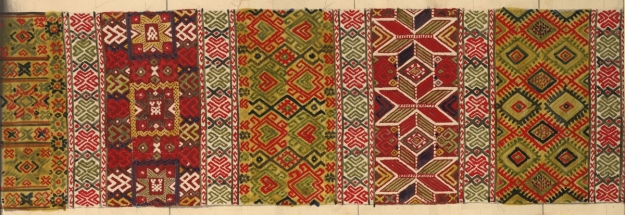
Rutevev, unknown origin

This lecture will not go in depth, but point out some local variations.  It is taken from the weaving draft booklets we will use in the course.

Some questions come to mind when working with traditional weaving: how should you weave based on old pieces–reconstruct them, re-create them, or create something new? Use copying as a work method? Is it a utilitarian weaving or decorative? We have different ways of using things because we live in another time. Weaving has moved from the bed to the wall.

What is traditional weaving? Why are some coverlet techniques seen as more traditional than others? Tradition is a dynamic concept.

Åkle (Coverlet) Weaving in Norway—Scratching the Surface

Åkle – a woven coverlet used to place on a bed. From the Old Norse áklæði which means bed covering.

Brotkvitlar and brautåkle. “Brot” which means edge or a break, or border–a coverlet that is put together of stripes and borders. Kvitel is used for bedding. Åkle is a catch-all word today (p. 49, Skinveit).  Brosse and rugge are other local names–are there more? 

Tjukkåkle (thick-åkle)–thick weft-faced coverlets such as ruteåkle (geometric square weave) and krokbragd. The weft is dominant; it covers the entire warp. 

Tynnåkle (thin-åkle)–Overshot coverlets woven on a ground of plain weave, such as skillbragd and tavelbragd (monk’s belt).  In Vestland they are often used for rituals such as baptisms, weddings, and funerals. In Trøndelag they are often sewn to the backside of a skinnfell (sheepskin)–a fellåkle. (p. 34, Skinveit).

Many coverlets are sewn together, and often several techniques are used in one coverlet. Many are woven of two pieces sewn together in the middle. The materials, patterns and colors are related to the area it was made and the environment. Technical improvements, industrialization, aniline dyes and the growing importation of cotton after 1850 allowed for many new variations. New working methods raised the possibility for new techniques, and new colors and materials opened the way for excellent compositions, which in turn gave new expressions to traditions. Easier access to materials and already-spun yarn freed up more time for weaving or other activities.

In discussing composition, were weavers motivated by a fear of blank spaces, or the need to create, or affected by the limits of the weaving technique? 

Local variations: what was found where, tendencies.


Vestlandet – Hordaland, Sogn and Fjordane – geometric square weave (rutevev).
Rogaland, Agder-fylkene – square weave (rutevev)
Buskerud – krokbragd (single and double), square weave (rutevev), skillbragd.
Sør-Trøndelag – skillbragd, tavlebragd, fellåklær, doubleweave, saumaåkle
Telemark – skillbragd
Nordland, Nord-Trøndelag and generally along the west coast
 – båtryer (boat ryas)
Vestfold – Vestfold technique (vestfoldtepper/vestfoldsmett), blokkvev

Inlay and Interlock Techniques

In these weavings, the pattern is plucked or laid in by hand, between the ground weave. The binding is either a weft-faced weave where the laid-in weft completely covers the warp, or a binding with a ground weave where the pattern threads are laid in on top of an open or tightly-woven plain weave ground.  

Kelim

With kelim you weave in separate yarn butterflies in the warp without interlocking them. Small openings grow between the colors and the weaving hangs together by shifting the pattern sideways.  The front and back are the same. (p. 108, Zetterman)

The technique is little used for coverlets in Norway, but was used for narrow bands in Telemark, saumabelte.

Square Weave — Rutevev / smettåkle (Norway), rölakan (Sweden)

Swedish Scanian rölakan has double interlocks, and there is a right and wrong side. Norwegian rutevev is a single interlock technique and is the same on both sides.  (p. 108, Zetterström). Rölakan is woven in two ways. Either you interlock the colors with each shot (double interlock) or interlock on every other shot (single interlock). The double interlock creates a right side and a wrong side, where there are raised ridges along the color changes. That type is especially used in Skåne and is called skånsk rölakan. The single interlock technique creates a reversible weaving, and is called norsk rölakan by Ulla Cyrus-Zetterström in her textbook on weaving. 

In rutevev butterflies are used to weave over a specific number of warp threads to result in squares, on an open shed with two shafts, and is woven wrong-side-up.  It can be woven on an warp-weighted loom, an upright loom or a floor loom.  On a floor loom it’s easy to get a distorted perspective and weave flattened squares; measure carefully. The ends per inch in the reed must be suitable to the weft yarn and the tightness; the weft should cover the warp completely. While weaving the yarn end is laid under a warp thread to secure it and is clipped off with 1 centimeter remaining on the wrong side (with double-interlock). The weft is laid in with even bubbles and beaten in the closed shed, after changing sheds. (Zetterstöm). 

In Hardanger the coverlets are called dokkåkle, or doll coverlets after the yarn-dolls (butterflies) they are woven with. In Sunnhordaland it’s called inlay-coverlet (smettåkle).  Ruteåkle, or square-weave coverlet, is the general name for the technique and tells us that the pattern is composed of squares. These coverlets have had high status. 

In Hardanger double-interlock is used the most, which means that the weaver interlocks the weft in both directions. With double-interlock the joins appear as vertical ribs on the wrong side. The coverlets are thicker and the right side is smoother than with single interlock, where the interlock join is woven when weaving in only one direction. The single interlock lies between the warp threads and the coverlet looks the same on both sides. 

In Hardanger square-weave coverlets are characterized by small squares and patterns. Typical weavings sold by traveling peddlers were the so-called “hardangeråkle.” Square-weave coverlets from Sogn had larger squares and patterns. In communities in Agder rhombuses dominated. 

Left: from Ullensvang, Kinsarvik, purchased 1895. Center: Sogn og Fjordane, Førde, purchased 1895. Right: Vest-Agder, Lindesnes, purchased 1896

Hotel Ullensvang in Lofthus (in the Hardanger region of Hordaland county) has a number of old coverlets hanging on its walls. 

“Solstol”, Hilde Opedal Nordby

“Solstol”, by Hilde Opedal Nordby, shows rutevev used in a contemporary way.

References: p. 106-107 Skintveit, p. 108-109 Zetterström

HV-technique

Handarbetets Vänners technique (Handarbetets Vänners is the Swedish Handcraft association)  is a simplified rölakan/billedvevsteknikk (tapestry technique) where the pattern is laid in in certain sections, while the ground weave is woven with a shuttle. The ground is a tight weft-based plain weave and the inlay thread is in the same shed is the ground weave. Weaving shifts between two inlay shots and two ground shots. (See diagram.) (p. 117, Zetterström).

MMF-teknikk

Märta Måås-Fjetterströms-technique (MMF) is woven in plain weave. The inlay pattern and the base weft are woven in the same shed.  It is used mostly for decorative weavings–draperies, curtains, and wall hangings. 

Vestfoldsmett (Norway) – Krabbasnår (Sweden)

Krabbasnår is a much-used technique in Sweden. Patterns placed with much space between them are typical for Norrland, and used extensively in Gästrikland og Hälsingland. In southern Sweden, however, the patterns are set so closely that the ground weave almost disappears.  It is reminiscent of smøyg (a form of embroidery), with similar pattern elements. 

Krabbasnår from Skåne

Krabbasnår from Småland

Krabbasnår from Dalarna

It was a popular technique for runners and pillows in the 1940s and 50s with new patterns and colors. 

A runner in new colors and designs

Vestfold inlay is woven with the wrong side up.  The pattern threads are plucked on a closed shed under a certain number of warp threads (often 3). Between every pattern thread the ground thread is thrown in plain weave, which gives the colored background for the pattern. The pattern inlay is moved one warp thread diagonally for every inlay. The warp is linen or cotton; the ground is woven with a single strand of wool and the pattern woven with doubled wool yarn. The number of ground shots must be chosen so that the inlay pattern threads are neither too close nor too far from each other, for example two,  three or four shots between each pattern inlay. The ends are fastened by laying the yarn end under a warp thread so the fastened end is hidden by the pattern float.  1 centimeter of the thread can remain on the wrong side. 

References: p. 216-217 Brodén & Wiklund; p.119 Zetterström

Vestfold Husflid organization research: There were 12 old coverlets found in Vestfold and one from Solum outside of Skien in Telemark. The oldest is dated 1708 and the latest, 1840. The coverlets received their name from the place they were found. Vestfold was on the rise at that time. Andebu, especially, is notable for many coverlets. At this time, many of the large farms in Norway were being divided.  These coverlets were special, and not owned by everyday citizens. In comparing the Vestfold coverlets, you see they are all composed of borders of varying sizes, separated by narrow borders in pick-and-pick or small pick-up designs. Many of the borders are symmetrical over a mid-horizontal line. 

They were originally used on beds, which were the living area’s finest pieces of furniture. Later they were hung on walls as decoration. 

It is not a typical Norwegian technique.  The Vestfold area had a lot of contact with foreign countries and little rural culture. Perhaps it was easier to access textiles to purchase?  It resembles the Swedish krabbasnår technique that is very common in Sweden, especially Skåne and Norrland.  Perhaps Norwegians adapted it to their area?

022wXzpgYbVp lily zickerman, skåne foto 1910
Teppe fra Skåne in Sweden

Else Poulsson from Husfliden (the handcraft store) in Oslo drew patterns based on coverlets.  They were displayed in Stockholm in 1939 at a Nordic handcraft meeting (Nordiske Husflidstinget). They were woven in new colors popular then–rust, green, beige, sheep-black (a deep brownish-black), and gold. It became popular to weave the patterns, often combined with rosepath, in coverlets, runners, and pillows.

Examples of “new” Vestfold designs

Blokkvev (Norway) – halvkrabba (Sweden)

Block-weave draft

Blokkvev (block-weave) was used mostly in combination with other techniques, especially Vestfold. The pattern threads are laid under two warp threads (or 3-4 threads) and shifting to the side is always done over the same number of threads to give a checkerboard pattern. Each square has the same number of pattern threads. Block-weave is usually woven from the back, and the pattern shed is picked. One or two ground shots are woven between each pattern shot, and enough pattern shots should be woven to made the design square. 

References: p. 216-217 Brodén & Wiklund; p.119 Zetterström


Sjonbragd (Norway) – Dukagång (Sweden)

The pattern is characterized by lines along the warp direction.  The pattern threads always float over the same number of warp threads, bound by an even space between. Common divisions are over two and under one warp thread, or over three and under one warp thread as in the example below. In the first instance you thread 1,2,3,2,1,4.  Here it is shown with the right side up. 

Left: over two threads, under one; right: over three threads, under one

Sjonbragd is woven with the back side up so that when the pattern weft is picked in different colors, it is easier to manage the butterflies. If the pattern weft is woven in the same color across the whole width, the pattern weft can be inserted with a shuttle and can be woven right side up. 

In Sweden the technique is most used in Skåne and nearby areas. It has been used in decorative weavings, combined with other techniques in clothing fabric, and woven in both wool and linen. 

References: p. 119-120 Zetterström; p. 241 Brodén & Wiklund

Pile Weaves – båtryer og andre ryer

From the book Båtrya i gammel og ny tid (Boat Ryas in the Past and Present), by Ellen Kjellmo, Orkana forlag, 1996.

To the highest degree, the båtrya was a practical item and served its purpose–to keep fishermen warm in cold and wet conditions. Important characteristics were insulation, ventilation, humidity-absorbing abilities, suppleness, and elasticity.  The båtrya acted like a sheepskin, which was the common coverlet inland–but a sheepskin would become stiff and heavy when wet. 

Ryas are known from various parts of Norway back to 1500.  Ryas from inland were used as bed  coverings or in sleds. In Nord-Norge (Northern Norway) ryas were commonly used as equipments in boats, fisherman’s shanties, and beds. They were especially found in the Lofoten islands, Vesterålen, as well as the coast of Helgeland (more richly decorated the farther south you go). Ryas lost their popularity around 1900. Aside from one rya from the Grytøya community, there are no known preserved ryas from Troms or Finnmark–probably because most were lost during the Second World War (p. 22, Kjellmo). 

A single båtrye could weigh up to 1 vog, or 17.95 kilos (almost 44 pounds). They were from 130-170 centimeters wide (51-67″) and 180-200 centimeters long (71-79″). Two or more woven strips were sewn together. 

The smooth side was often woven with symmetrical stripes or squares. The knots were not visible on the smooth side, to protect the backs of the knots from wear. They were woven in three- or four-shaft warp-faced twill. The warp was quite closely set, with 50-90 threads per ten centimeters (approximately 12-22 ends per inch), depending on the thickness of the yarn. The warp yarn needed to be strong, even, and smooth, often left-twisted yarn, always two- or three-ply. It was spun of the guard hair of the wild sheep (utegangersau). The under hair was used for the knots. The weft is spun from the coarser hair of the belly and leg. It could have been twisted in the opposite direction of the warp yarn, but most often the warp and the weft were both left-twisted. The weft was not packed so hard, from 3-6 shots per centimeter (approximately 7-15 shots per inch). (pages 62-77, Kjellmo)

The pile side is the “noppasiden.” The pile length varied from 5-9 centimeters (approximately 2-3.6″). The pile side was meant as the back side and was often without pattern. The wool pile yarn was often supplemented with rag strips. It varied between 1-2 centimeters (.4-.8″) between each knot. The pile was cut beforehand in double lengths, often with the use of a “noppakjevle” (a “noppa-pin,”  or rolling-pin sort of implement).

Knots are tied on an open shed. 

The knot is the Smyrna knot or the gjordes knotknown from Turkish, Caucasian, and some Persian rugs. It is tight and is not visible on the back side. It was the most often used knot in Norway and in båtryer. It can be knotted with short ends or with one strand over a ruler. 

The Senné knot is used in central and east-Asian, in Egyptian and in Persian rugs. This knot is easier to pull out and the back of the knot is not completely hidden on the smooth side. 

The Berber knot, or soumac, is a variation of the smyrna knot.  It gives a rougher look.  (page 101, Kjellmo). 

Pile has been used in many decorative textiles, different from the båtrya’s useful and practical function. 

Pile was used in combination with knitting and as edging of various garments.

Primstav and Textile Production in Scandinavia

By Lisa Torvik

It is easy to forget that appointments, schedules and drop-dead deadlines did not begin with the modern industrial age, not with wall calendars, Daytimers and certainly not with Palm Pilots or Blackberries and other relics of the near past.

Textile enthusiasts of today, especially those exploring spinning, dyeing, weaving, knitting, and other hand arts and the growing, cultivation and gathering of fiber and dye sources, realize what an enormous amount of work went into covering bodies and “civilizing” homes with various cloths in the not-so-distant past.  Both the Norwegian proverb “need teaches a naked woman to spin” and our English version “necessity is the mother of invention” acknowledge and imply a female bent to innovation for everyday requirements.  An appealing thought for those of us who try to carry on such traditional work.  

And things that must be done today to secure a need of tomorrow are the essence of the agricultural year, everywhere in the traditional world.  We will look today at accounts of how people, in this case in Scandinavia and particularly using some Norwegian artifacts, marked time and met their needs by heeding age-old traditions related to textile production within each passing year.

One related relic is called a primstav in Norway and Denmark, in some parts of Norway known as a ringstav and in Sweden as a runstav.  It is generally a flat stick, held in the hand, on which every day is marked with a notch and special days also marked with a related symbol.  The primstav as it exists dates only from about the 1200s and is directly tied to the spread of Christianity in Scandinavia, a development much later there than elsewhere in Europe.  No older instruments have survived but the stick calendar tradition likely carried over from pagan times.  Holy Days that had to be observed were many and even into the Protestant era Catholic saints’ days were noted on the stick and often associated with seasonal work long after their religious affiliation was forgotten.

This primstav, from 1566, is from the collection of the Vesterheim Norwegian-American Museum. See: https://collections.vesterheim.org/virtual_galleries/calendar-stick-lc0291/

Detail of the Vesterheim primstav.

A common interpretation of the name primstav is that it comes from the Latin prima meaning “first” and the Norwegian word stav meaning “stick.”  In old Norse, prim also meant “new moon.” The stick had a winter side and a summer side, each half year turning at the October 14 and April 14 notch.  These were traditionally the days on which rural business such the start or change dates for hired help on farms went in effect.  In pagan times, those dates were two of the three major dates of great sacrifices, the third being January 14, midwinter.  Local conditions would necessarily dictate slight variations in adherence to the traditions, but generally all surviving examples appear to record the same dates of observance.

A few dates on the stick stand out because they are associated with agricultural year and our main interest – textile production.  They are the dates to sow, till and harvest and the dates to shear.  In Scandinavia, that would mean sowing flax along with edible grains, and shearing sheep, the main source of wool fiber.  We can acknowledge the importance of cotton and silk elsewhere in the world in traditional cultures, but they were and are still imported fibers in Scandinavia, and were associated with wealth and status.  Those fibers, now commonly used in making festive national dress, i.e. bunad in Norway, folkdräkt in Sweden and stadsdragt in Danish, were not widely available there before the late 19th century. 

Symbols marking the pre-Christian and Catholic feast days are the special feature of the primstav and here are ones of particular interest, along with their traditional associations. The accompanying sketches are taken from three sources, and show marvelous variation. In each box, the left-hand symbol is from Alfred Miller’s The Primstav Explanations, Norwegian Legend Lore & History; the center sketches are from F. E. Ekstrand’s The Ancient Norwegian Calendar Stick (primstav), and the right-hand images from Einar Haugen’s “A Norwegian Calendar Stick in Wisconsin.” (Full citations are at the end of the article.) 

April 14 – First Day of Summer.  Hired help could renew their obligations to the farmer.  Shepherds refrained from eating meat as it was thought that would harm their flocks.

April 16 – St. Magnus’ Day. Time to begin cultivating the fields.

May 3 – Mass of the Holy Cross. Time to shear the sheep.

May 15 – St. Hallvard’s Wake. If grain not planted by this date, could not expect it to ripen before the first frost.

May 22 – St. Bernard’s Wake.  Also known as “Bear Wake.” All seed must be in the ground.


June 24 – St. John’s Wake known as “Sankt Hans.
” Time to gather herbs.  All plant dye stuffs would be picked throughout the summer at their peak for that purpose.

July 2 – St. Swithin’s Wake known as “Syftesok.” Weeding of the fields began.  St. Swithin was the patron saint of Stavanger.

July 8 – St. Sunniva’s Day. Haymaking begins.  St. Sunniva was the patron saint of Bergen.July 22 – St. Magdalene’s Day. Time to put up the (first) hay.  Depending on the weather, another round of haying usually followed in August.August 24 – St. Bartholomew’s Wake. Time to slaughter the rams.

September 8 – Nativity of the Virgin Mary. With the rams slaughtered, time to shear the rest of the sheep.  Harvest occurred as different crops matured.

October 14 – Winter Day , the first day of Winter. Hiring of new servants or change of service in rural areas.October 21 – St. Ursula’s Day. No work should be done on any implement that turns, such as a spinning wheel or mill.

November 25 – St. Catherine’s Day. The symbol for this day is thought to be a wool carder and St. Catherine was often depicted at a spinning wheel.  This day the spinning of wool for winter’s clothing production was begun.

No work could be done on part or all of feast days, or especially throughout the Christmas season.  With the late summer, fall and early winter used to prepare flax and wool, weaving would commence after Christmas and continue with other handwork until spring came again, with its many outdoor chores.

Source List

The Primstav Explanations, Norwegian Legend Lore & History © 2006 by Alfred Miller, Middlebury, CT 06762  [Note:  Though acknowledging assistance for research and proofreading, Mr. Miller does not cite any particular sources.  Some of his text is identical, however, to text found in The Ancient Norwegian Calendar Stick, see below.  Miller’s pamphlet is sold by Vesterheim in their Gift Shop.]

The Ancient Norwegian Calendar Stick (primstav) © [no date] by F. E. Ekstrand, Welcome Press, Seattle, WA 98109

“A Norwegian Calendar Stick in Wisconsin”, by Einar Haugen, Wisconsin Magazine of History, Vol. 31, Nr. 2, December 1947, pp. 145-167.

Bondeliv, Samrødor og song etter Ragndi Moen, Gamal Valdres-Kultur II, by Knut Hermundstad, Norsk Folkeminnelag, Oslo, Norway, 1940.  

Ættararv, Gamal Valdres-Kultur IV, by Knut Hermundstad, Norsk Folkeminnelag, Oslo, Norway, 1950..

Addendum: A Modern Primstav at the Vesterheim Norwegian-American Museum

A most vivid modern interpretation of the primstav exists today.  Norwegian artist Sigmund Aarseth’s modern rendition graces the Gathering Room of the Amdal-Odland Heritage Center at Vesterheim in Decorah, Iowa.  Working with fellow rosemaler Sallie Haugen DeReus, Aarseth turned the room’s walls into a continuous depiction of the seasons of the year, marking certain dates of the primstav and illustrating them with images and related proverbs from various parts of Norway.  Kathleen Stokker has written a wonderful description of this work and history of the primstav in her book, Marking Time: The Primstav Murals of Sigmund Aarseth. (See also this YouTube video: “Vesterheim’s Gathering Room: Primstav Murals.”)

Lisa Torvik credits early influences of her mother, grandmothers, aunts and friends in Norway for her knitting, sewing, embroidery and weaving interests.  She spent a year in her youth studying weaving at Valdres Husflidsskule in Fagernes, Norway and now focuses on projects in traditional Norwegian techniques and more contemporary applications.

The Red Thread: A Monumental Tapestry by Else Marie Jakobsen

Excerpted by the book Levd Liv, Vevd Liv (Woven Life) by Janne Leithe.

Translated by Robbie LaFleur.

Translator’s note:  A two-story-high tapestry, “The Red Thread” by Else Marie Jakobsen, hangs in the Science Building at the University of Bergen. Weavers will no doubt want to peer closely at the surface, and examine the thick warp threads weighted at the bottom with small stones. You should! I’ve managed to set off the alarm both times I visited this monumental tapestry, by getting too close. 

Else Marie Jakobsen was born in 1927, lived in Kristiansand, and died in 2012. Luckily, author Janne Leithe was able to interview Jakobsen extensively near the end of her life, allowing us to know a great deal about her thoughts behind many of her tapestries. This excerpt is used with permission. 

The Science Building at the University of Bergen (Realsfagbygget), built in concrete in 1977, was designed by architect Harald Ramm Østgaard.  The architectural style was called brutalism because the use of unfinished concrete gives a massive and brutal effect. Jacobsen won a closed competition for the decoration of the vestibule in the science building with her piece “Den Røde Tråd” (The Red Thread).  She always embraced the context and took it into consideration when designing her sketches. In the 1970s the sciences were a masculine and technical milieu. She felt that the masculine-dominated environment needed something soft, warm, and earthy. She chose to give women and women’s work a central place, and chose tapestry as her point of departure; to paraphrase, women who are woven and women who weave. In the huge tapestry there are repeated references to the unknown and little-known weavers who were overlooked and undervalued in their time. She created a collage of various motifs from various eras, divided in three sections. These are taken from the Middle Ages and in the years up to her own time. Else Marie Jakobsen used “The Red Thread” to create and draw a picture of all the women who have been important transmitters of our history through their work at the loom. 

The challenge of this project was working with the very prominent ramp that winds up three stories in the massive building. The ramp dominates the entrance, and Else Marie Jakobsen had a gray granite wall at her disposal, circled with steel and concrete. The wall that “The Red Thread” would inhabit had marked divisions, a problem Jacobsen solved by creating the tapestry in three sections, each six meters high and four meters wide.  

It’s difficult to get a photo of the entire piece. Jan Mostrom standing on the ramp gives an idea of the scale. Photo: Robbie LaFleur

She used the ramp’s zig-zag form as inspiration and let the form of the tapestry create a fishnet pattern.  The dominant ramp prevents the public from seeing the tapestry in its entirety; therefore, she chose fragments of art and textile history that can be read independently. The tapestry can be read in this way, whether or not the viewers understand its entirety or have previous knowledge.  Those in the art world will recognize motifs, and others will see glimpses of an important and partially hidden textile art history. According to Hjørdis Danbolt, the unwoven sections of warp (devoid of motifs) are important indicators of the parts of textile art history and tapestry history that are missing. That history is fragmented, as depicted in “The Red Thread.” Here the viewers themselves must participate and contribute to bring out The Red Thread’s unwritten and unwoven history. 

The fragments are assembled in a collage of varying styles and expression in the fishnet pattern.  To unify the tapestry and at the same time show a clear message, she brought it together with a distinct color palette. Red and pink are dominant, contrasted with black, gray, blue, and white.  The cotton warp was dyed gray, and natural-colored linen was used. This work required a great deal of planning. 250 kilos of yarn was wound and dyed. The Red Thread used handspun spelsau wool, silk, nylon, and clipped lengths of seine twine for variation in the surface. Tightly woven sections of the fishnet pattern mixed with unwoven areas of warp. To get the weaving to hang in place, Jakobsen chose stones with holes in the middle, tied at the bottom of the warp. She picked the stones herself on the beaches in Møns Klint in Denmark. 

“…Here there is not only tradition, but also a renewal. What a brilliant idea has been carried out,” wrote the historian Hjørdis Danbolt in her report on “The Red Thread” in Bergens Tidende on June 17, 1982.  She meant that the ingenious thing Jakobsen had done was to weave the history of the forgotten women, and that the history was finally told. Textile history had been visually depicted, and strategically placed in a public setting. The history could have been placed on a dusty bookshelf, but it was now visible to hundreds of people. The unknown weavers finally found a place in history through Jakobsen’s commitment and creation. 

In the first tapestry Else Marie Jakobsen began by showing the women who wove images of men from Viking times, the Middle Ages, and up to 1650. War, weapons, and men on horses were repeated images. Stories from the early Middle Ages were depicted on meters-long pieces, made with both embroidery and tapestry. Jakobsen chose motifs from 800-1700, including the Baldisholteppet, dated from around 1150. The section she chose of that tapestry, found in 1879, shows a rider in armor and a man with a crown, possibly a king.

She also chose motifs from traditional woven coverlets (åkletepper), generally abstract and geometric patterns.

This section echos rutevev, or square weave coverlets.

In the lower right corner is a “virgin” from the Wise and Foolish Virgins tapestries, which Jakobsen also referenced in another of her tapestries, “Elsk din Neste.”

She finished the tapestry with the initials of the unknown weaver. By writing them down, she gives identity to the anonymous. Other well-known textiles she references are the weavings from the Oseberg Viking ship, found in 1903. The weaving fragments are from a pictorial frieze and dated around 820, among the oldest found in Norway. She also used these as inspiration the following year when she wove “Fortidsminner” (Historical Memories) for Sen Rådhus (City Hall) in Tønsberg. Jacobsen also used a motif from the Sandsvaer antipendium from 1625, showing Christ’s crucifixion. 

Christ on the cross, from the Sandsvaer antipendium

In the center section she weaves motifs taken from the artists Hannah Ryggen and Frida Hansen. She admired them both greatly, and they served as sources of inspiration. In these thirty square meters, she praises her sources.

She also took a small detail from Gerhard Munthe. He painted cartoons for tapestries, for which he was best known in his time. But Munthe didn’t have the same connection with the materials of tapestry, as he had others weave for him. Jacobsen said that this could be noted in his tapestries, that they were a bit stiff in character.

Frida Hansen (1855-1931) was best known for her Art Nouveau style.  She received a gold medal for her tapestry “Melkeveien,” (Milky Way) in Paris in 1900, the highest honor an artist could receive at that time. Still, Hansen had problems being accepted as an artist in her own country, at that time or afterwards. Much of this had to do with the wave of National Romantic sentiment in Norway at the turn of the century. Norwegian critics felt that her style was too European. Frida Hansen’s work was primarily acquired by applied art museums in Central Europe, where her work was more right for the times. Wild roses and stylized flowers are characteristic of her tapestries. Jacobsen used her characteristic motifs and flowers in a collage-like manner. She also includes details from Hansen’s works, “Flyvende Villender” (Flying Wild Geese) and “Juni” (June), curtains in transparency technique from 1918. Hansen developed a transparency technique, in which she left portions of the warp threads unwoven. In “The Red Thread,” Jakobsen was directly inspired by that technique. 

A clear homage to Frida Hansen

Hannah Ryggen (1894-1970) was the artist for whom Else Marie Jakobsen had the most admiration and respect.  Hannah Ryggen was Swedish but settled in Ørland in Trøndelag with her Norwegian husband, Hans Ryggen. She was revolutionary in that she changed tapestry weaving from the creation of decorative textiles to a form of art. She is best known for her political images, especially those critical of Nazism and facism.  As the first artist to have a tapestry accepted for the Høstutstilling, (The Fall Exhibition, a prominent annual Norwegian exhibit), in 1964, she paved the way for textile art and tapestry.  In the same year she was Norway’s first female artist in the Venice Biennial, one of the word’s most important annual exhibitions. In 2012 several of her tapestries were included in Dokumenta, which is held every five years in Kassel, Germany. Hannah Ryggen’s art has had a renaissance in contemporary art. She donated several of her tapestries to the Nordenfjeldske Kunstindustrimuseum in Trondheim, where they are a part of the permanent exhibit. Jacobsen chose details from “Mors Hjerte” (Mother’s Heart), which depicts a mother’s concern for her sick child, and “Kaj Munk,” which is a homage to the poet and priest Kaj Munk, who was killed by Nazis. She also chose details from the tapestry “Karsten i Vevehimmelen” (Karsten in Weaving Heaven). Ryggen was a great admirer of the painter Ludvig Karsten. To finish Else Marie Jakobsen “signed” Frida Hansen’s and Hannah Ryggen’s signatures clearly where she repeated their motifs. 

Left: Else Marie Jakobsen paid homage to Hannah Ryggen’s tapestry, “Mor’s Hjerte” (Mother’s heart). Right: A detail of Ryggen’s “Mor’s Hjerte.”

The last section is in praise and recognition of her own weaving colleagues. She chose a dozen artists from her own time who are reproduced in the final 30 square meters. Jakobsen reproduced a motif from each of the artists, and wove in their initials so that it is easier to recognize them. She began with Synnove Anker Aurdal, who was a leader in Norwegian abstract art.

Synnøve Aurdal’s initials are at the top left.

She also chose motifs from the artists Elise Jakkheln (EJ), Brit Fuglevaag (BF), Ann Sønju (US), Ingunn Skogholt (IS), Kjellaug Hølaas (KH), Nina Gjestland (NG), Eli Marie Johnsen (EMJ), Eli Nordbø (EN), Karin Sunday (KS), Sidsel Karlsen (SK), Bodil Cappelen (BC), Tove Pedersen (TP), Inger Johanne Brauteset (IJB), and herself. She displays them chronologically—the eldest reference to the left—and finished with her close colleague Eli Nordbø. Nordbø was Jakobsens assistant in weaving “The Red Thread.” It took two years, with assistants, to complete Norway’s largest tapestry. 

Jakobsen’s assistant, Eli Nordbø, is commemorated on the lower right hand side of the final panel.