
By Robbie LaFleur
Maria Mundal (1893-1974) grew up in Sogn on the West Coast of Norway, and couldn’t remember a time when she didn’t know how to weave. As a young girl, Maria wove a beautiful, large traditional rutevev or smettvev, [geometric square weave tapestry]. Her own description was, “Old Pattern from Sognefjord My first try at Aakle veaving (sic). Ca. 1905. Maria Mundal, 13 years old.” It is now in the collection of Vesterheim Norwegian-American Museum. (62″ L, 27.5″ W)


She learned to weave from her mother, Nilsina Mundal (1861-1952), who also wove her whole life. Maria treasured a square-weave coverlet her mother made when she was only twelve. It was displayed in at least two news articles about Maria. That coverlet is also owned by Vesterheim; see a color photo here.
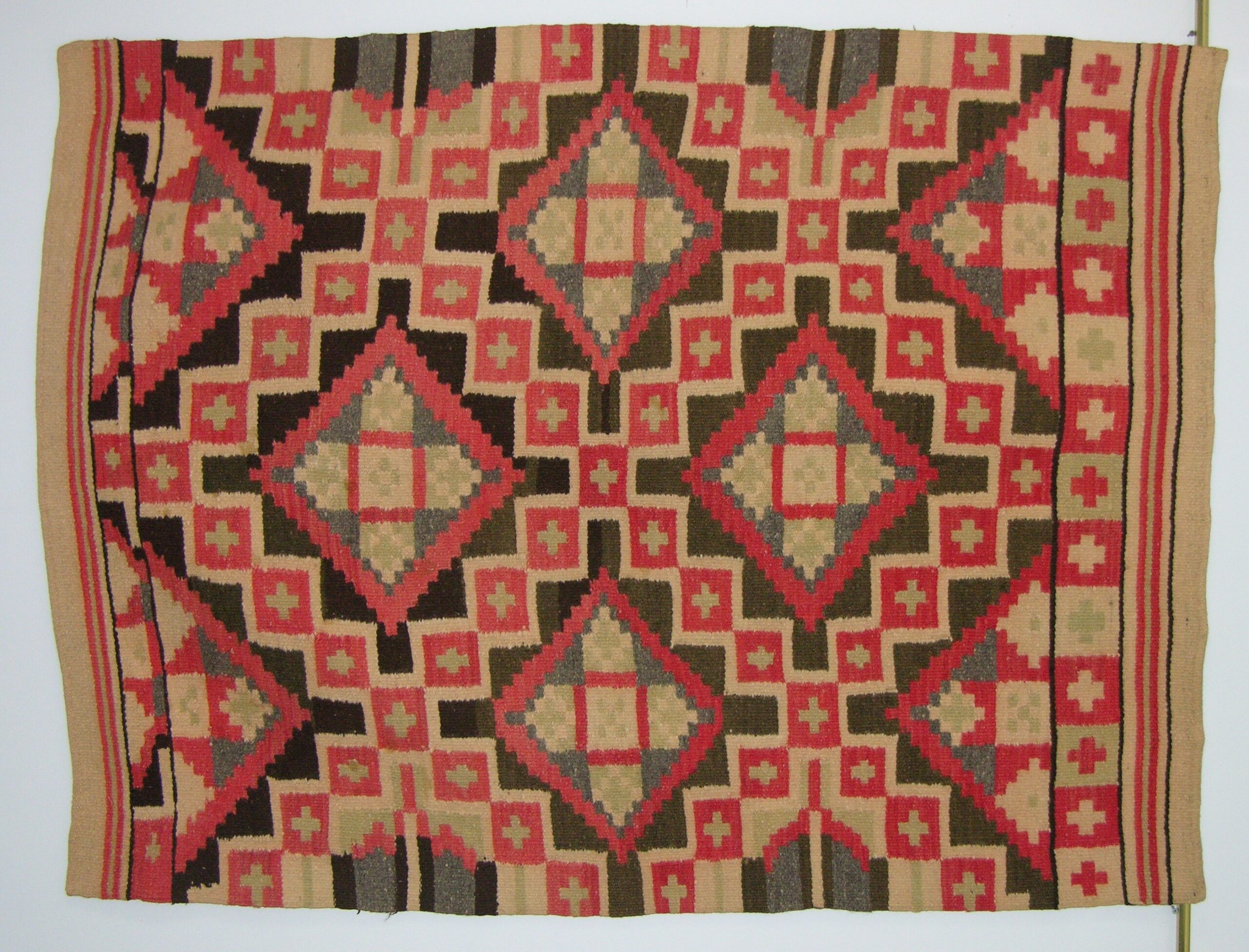

Maria studied with Sunni Mundal (1887-1953, her sister) at her school of weaving in Oslo from 1919-1920, and also at a school run by her aunt, Britta Dahle at the Hotell Mundal in Sognefjord, Norway. She completed her weaving studies with Kristi Sexe Meland from Hardanger in 1925-26. Meland was the weaver who was commissioned by a group of Norwegian-American women to weave a replica of the Baldishol Tapestry that was presented to President and Mrs. Coolidge one year after the Coolidges visited the 1925 Centennial celebration of Norwegian immigration to the U.S.(1)
Maria Mundal married the noted Norwegian artist Mons Breivik (1881-1950) on April 14, 1924, and they lived in the U.S. for several years. Mons returned to Norway in 1936. He longed for home, didn’t thrive in the city. Years of struggle in Depression-era New York strained their marriage. Mons was sometimes without work and Maria was forced to take housework, often far from their home. (2) At the same time, they moved in artistic circles; they were listed as guests at an opening at the Brooklyn Museum in 1932. In 1936 Mons returned to Norway, and Maria remained in the U.S. Their divorce became final in 1936 or shortly thereafter.

During WWII she worked as a “canteen mother” at Camp Norway, a military training facility for Norwegians in Lunenburg, Novia Scotia, Canada. “But then I received my papers and came south from Canada in 1943. If I could manage there, then I could manage to weave for a living.” (Reported in Nordisk Tidende, August 14, 1969)
One source listing the opening of her NYC Studio was a letter with a poem she sent to Eleanor Roosevelt after the death of Franklin Roosevelt, on June 12, 1946. “I have now opened a studio for handwoven material and scarfs, and have already had the pleasure of seeing my work well received.”
For the following decades, until her death at 81 in 1974, Maria taught and wove. She had a studio in her home in Manhattan, until moving to Baltimore in 1970, and then to Alexandria, Virginia in 1971. Over the years she taught weaving in her own studio, at the Chautauqua Institution, and in outside studios. She was active in weaving organizations and in Scandinavian-American groups, including the Norwegian Art and Craft Club of Brooklyn and the Bay Ridge Norwegian Art and Crafts Club. Her resume, updated in 1973, just months before her death, lists extensive lecture topics, shows, teaching venues, and affiliations.
Her tapestry subjects included mythology and astrology. Vesterheim Norwegian-American Museum owns a Capricorn tapestry. In 1958 she began a series of tapestries based on the story of Per Gynt.

She spoke passionately about her love for weaving and her faith. “When you are creating something beautiful, you feel closer to your creator.” (Quoted in Anne Hannan, “Weaver Spins a Folk Tale of Scandinavia,” Newsday, Suffolk Ed, Feb, 7, 1958, p. 37) For her “Study in Crosses,” she spent time at the Cathedral of St. John the Divine in Manhattan, making sketches of a wide variety of crosses.

Another of her religious tapestries depicts the moment of Christ’s death. She wrote, “It pictures the Crucifixion, just at the time when the man dies and the bird flies up. I don’t think most people realize that the Bible says that a darkness fell over the earth at the time.” (Lucy Acten, “Weaver Finds Kindred Element in Tapestry, Poetry, City’s Hills. Baltimore Sun, Thursday, October 1, 1970) Another article about Mundal elaborates on the theme of darkness.
Among her most dramatic works is Crucifixion — simple and original in composition and color. She said that she began the tapestry to loosen an inner depression that had taken hold, and her own therapy had the desired outcome. [translation mine] (“Norsk billedveverske Maria Mundal – Poet I farger,” Nordisk Tidende, October 4, 1973.)

She lived a long life, but had a tragic end before she was able to finish the tapestry she long planned to complete, a faithful, full-sized reproduction of the Baldishol Tapestry. A Norwegian-American newspaper reported her death.
The renowned art weaver Maria Mundal died at Ullevaal Hospital in Oslo on June 11. She had been living in Alexandria, Virginia, and had earlier this summer traveled on vacation to Norway after a 40 year absence from her homeland. She turned 80 in October 1973.
After a visit to the Munch Museum she was hit by a car and broke her collarbone. She was taken to the hospital. She developed complications and her life could not be saved. She died on June 11 and was buried in Vegårdshei in Aust-Agder, where her mother is also buried. (Nordisk Tidende, June 27, 1974. “Art Weaver Maria Mundal is Dead”)
Maria Mundal traded views of mountains for the tall buildings of Manhattan, but never lost her strong ties to Norwegian weaving traditions. She was active in the vibrant East Coast Norwegian-American community. Many of her weavings are preserved at Vesterheim Norwegian-American Museum, and soon the collection will include the replica of the Baldishol Tapestry she began before her death. See the companion article, “Solving the Mystery of the Backwards Baldishol.”
November 2025
(1) Read more about the Baldishol commissioned for President and Mrs. Coolidge: Robbie LaFleur, “The Baldishol Tapestry–The White House Replica and Others,” Norwegian Textile Letter, March 2019, Updated April 2024. And Hermund Kleppa, “The Baldishol Tapestry in the White House,” Norwegian Textile Letter, March 2019.
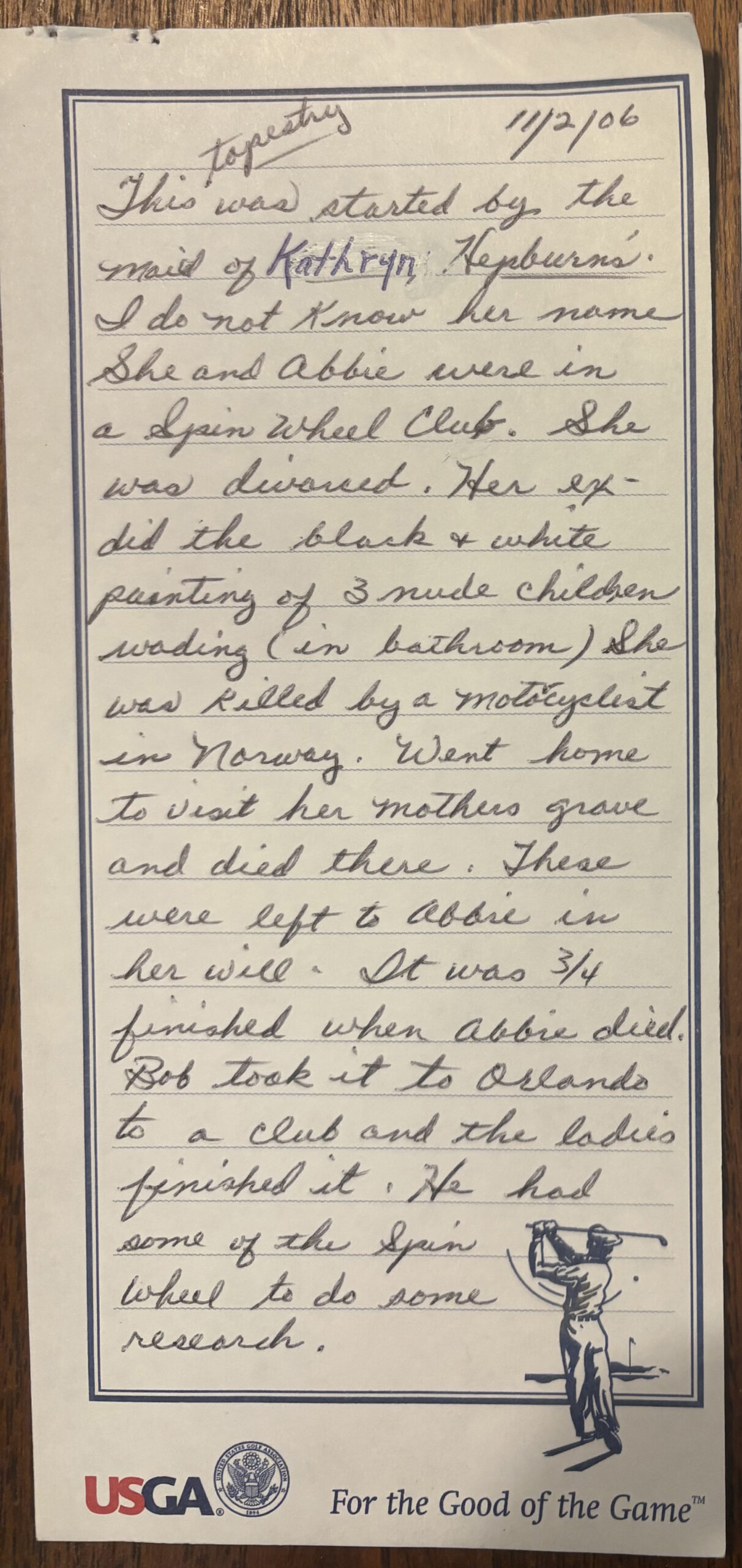
(2) According to family lore, perhaps Maria worked as a maid for Kathryn Hepburn. A note was found with Mundal’s Baldishol replica, written by the daughter of the woman who married Abbie Wetzel’s husband after Abbie’s death. It is interesting that Abbie Wetzel’s husband, who died the year the note was written, didn’t remember Maria Mundal’s name, but characterized her as a “maid for Kathryn [sic] Hepburn.”

Help support wonderful articles on Scandinavian textiles with a donation to the Norwegian Textile Letter. This warbler is chirping his thanks! Tusen takk