Archives

Weaving the Art Weaves of Skåne

By Jan Mostrom

Eight excited American weavers traveled to Landskrona for a class in Skåne Art Weaves taught by Gunvor Johansson.  We could not have had a more lovely or qualified instructor.  Gunvor has been honored by Sweden as a master weaver and has written the definitive book, Heirlooms of Skåne : Weaving Techniques.  Åsa Stentoft from Skåne Hemslöjd was our gracious hostess and helped us with any questions we may have had, acted as translator if needed, and treated us to her baking skills for fika.  

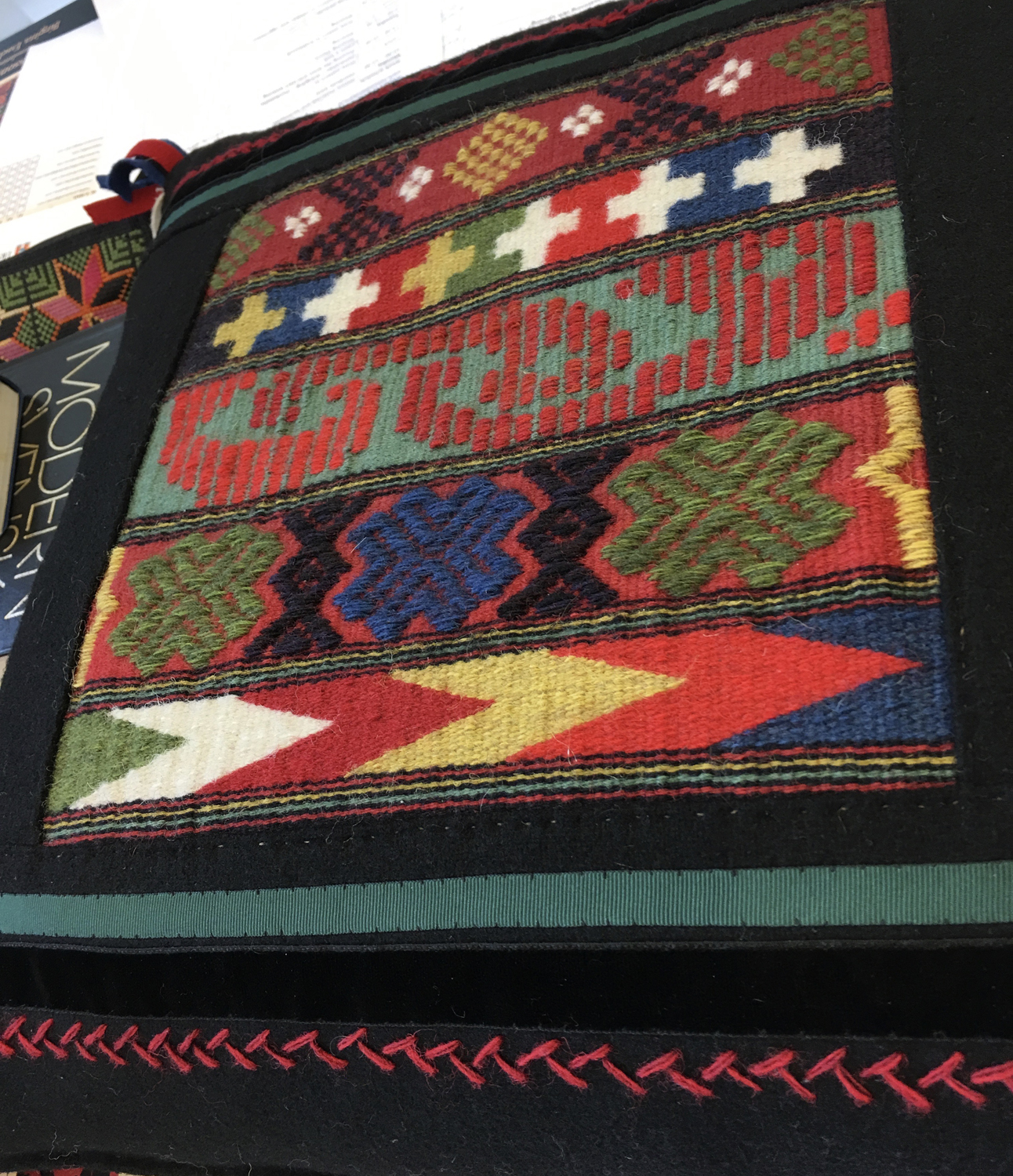
Instruction included rölakan, krabbasnår, halvkrabba and dukagång, woven on the same warp to create a sampler of techniques.  All of these weaves are woven upside down.  Rölakan is geometric tapestry that is woven with a double interlock.  The other three techniques are woven with inlay butterflies against a weft face ground but each creates a unique pattern.  Dukagång creates columns of color.  Halvkrabba  design is made up of squares resembling a checkerboard.  Krabbasnår makes designs with the inlay moving in diagonal steps.

A sample in the class to illustrate techniques

A sample in the class to illustrate techniques

Gunvor encouraged us to graph out our pattern choice on graph paper so we would understand the way the patterns were built and moved.  We had an abundance of inspiration from antique weavings and reproductions, books, and Gunvor’s weaving to draw from.  We also had a booklet of graphed designs that was part of our class handouts.  

All looms had a linen warp, but the warps and setts were not all the same.  Gunvor wanted us to be able to see and compare the look of the different setts.  8/2 linen was set at 35/10cm and at 40/10.  16/3 linen was sett at 40/10 and 45/10.  20/3 linen was sett at 45/10 and 50/10.  At all setts, we used a single wool yarn, either Klippans Fårö or Rauma prydvev tapestry single ply to weave the weft face ground.  The inlay butterlies were made up of three strands of the single ply or one two-ply strand of prydvev or Klippans Brage combined with one strand of the single ply yarn.  Colors could be combined in a butterfly; for instance two or three shades of red could be used in one butterfly.   At the 35/10 sett, a two ply thread or two singles could be woven as the weft and 4 single stands of singles could be used for inlay, depending on the look you liked.  Three picks of weft were woven between pattern inlays.  One of the weavers chose to weave inlay monksbelt motifs and trensa flossa, which is a short flossa that does not cover the whole ground, for her sampler instead of the other techniques.

Patterns were woven upside down, that is, with the back side facing the weaver.

In addition to the art weaves, Gunvor taught us finishing techniques, including a warp finish, tassels of ribbon and fabric strips, two ways to make fringe or kavelfrans, fabric balls–both plain and covered with stitching–to attach to pillow corners, and explained how to make our sample into a pillow or bag.  

The student weaving varied in color and techniques chosen: in columns top to bottom going from left to right, Liz Hunter;  Janis Aune, Sharon Marquardt and Melba Granlund; Mary Skoy and Mary Erickson; Jan Mostrom and Edi Thorstenson.

Jan Mostrom, a weaver and instructor from Minnesota, will be teaching a class on Swedish art weaves at the Weavers Guild of Minnesota in the spring of 2018.  Details are herealthough it is already filled. Jan has a great passion and love for researching and teaching weaving, and is a frequent contributor of articles on weaving techniques to the Norwegian Textile Letter

Buy Now ButtonThe annual notice: Help keep the newsletter free to readers around the world and show your support. Any amount, now and each year, is appreciated. Thank you!
To send a check, the address is here.

Inspiration, Outreach, and Connection

By Melba Granlund

This adventure in weaving began a couple of years ago when the Weavers Guild of Minnesota’s  Scandinavian Weavers study group chose to focus on Swedish art weaves.   I and many others in the group had never personally studied or done this type of weaving, although some of the patterns resembled Norwegian patterns we knew.  At or about the same time, I had been “gifted” several pieces from southern Sweden woven in this fashion from the late 19th or early 20th century, so we had examples to study up close and personal.  However, we needed to find out more about what these Swedish “art weaves” were all about, and I looked forward to the challenge.

I was aware of the Swedish weaving school Vävstuga in western Massachusetts, operated by Becky Ashenden, as I had taken the “Beginners” class there a few years earlier.  While looking at Vävstuga’s website and pondering whether to return there for further instruction on “Swedish classics,” I remembered that while studying at Vävstuga I had purchased a book on the subject, written in Swedish by Gunvor Johansson.   I now saw that the book was available in English.  Wanting to know more about Gunvor, I continued to dig deeper on the internet and discovered that she was teaching Swedish art weaves through the Skåne Hemslöjd in southern Sweden and had done so during the month of June for at least the last couple of years.  It seemed to me that if I wanted to learn from the best, then being taught by the person who taught Becky many years earlier at Sätergläntan made the most sense.  Being the frugal person I am, the cost of instruction was the next thing to consider.  I found that traveling to Sweden for a class was almost the same as going to western Massachusetts. In fact, it was almost cheaper.  

That was it.   I needed to go to Sweden.  So, I sent an email to Hemslöjden i Skåne to inquire about classes in 2016.   As it turned out, while the class was being offered again during the same week in June, it was eventually canceled for lack of interest.  While I was disappointed, I was happy that I hadn’t already booked my flight and hotel room.  Having thought that further instruction would not be possible – at least in Sweden – I then received news about Vesterheim’s 2017 Textile Study Tour.  The itinerary showed that the tour was at or about the same time as the class in Sweden and that we would be traveling nearby while in Denmark.  So, I contacted the Hemslöjd once again. This time I dug a little deeper and inquired how a person might “guarantee” not having the weaving class canceled for lack of participants.  I was told that they would be happy to host a “private” class for us “English speakers” if we had enough students.   One thing led to another (email upon email) and, finally, there were eight of us who wanted to take the class.  Liz Hunter in our group made our hotel reservations and also tracked down flight info.  Edi Thorstensson handled train reservations.  I took care of class registrations.  The Hemslöjd was thrilled.  We were thrilled.  It was actually going to happen.  Hooray!   Our class even became a post on the Hemslöjd’s Facebook page as they prepared the looms for us. 

Landskrona turned out to be a storybook town.  17th and 18th century buildings and cobblestone streets everywhere – each block had a different type of stone and pattern.  Our hotel was only a couple blocks from the North Sea and only a few blocks from the Hemslöjd, which had been relocated to the former Landskrona train station which, in itself, was an architectural beauty.  

Arriving at our classroom the first morning, we were greeted by Åsa Stenoft who had been the person I communicated with in scheduling our class.  She could not have been a more gracious host and supplied us each day with freshly baked coffee cakes and treats (freshly brewed coffee was always at hand).  Her knowledge of weaving was also very helpful during class time and she helped translate for Gunvor, which turned out to be almost never. 

Gunvor Johansson

Gunvor Johansson

A little bit of background on our teacher, Gunvor Johansson, and the Skåne Hemslöjd.  The Swedish hemslöjd, or handicraft, movement was first developed in 1899 by Lilli Zickerman who sought to encourage self-supporting artists working in their homes while at the same time preserving Swedish folk art traditions.   Lilli traveled around Sweden to map and document the textiles and their makers.  

Since the mid 1980s, Gunvor has continued to study and expand the documentation of the Skånsk textiles based on the Stiftelsen Skånsk Hemslöjd (Skåne Handicrafts Foundation) archives collection in Landskrona, with textiles dating from the 17th century forward.  This work culminated in the publication of her book, Väv Skånska Allmogevävnader, translated into English by Birgitta Esselius Peterson as Heirlooms of Skåne: Weaving Techniques.  In her studies, Gunvor researched the colors of the original yarns, drew up the patterns and developed suitable yarns currently available for replication of these beautiful pieces.  She has taught the weaving techniques rosengång, halvkrabba, dukagång, munkabelt, krabbasnår, rölakan, viggrölakan, and trensaflossa to students in classes at Sätergläntan and continues to teach through the Hemslöjd organization in Skåne. With Kristina Lindkvist, Gunvor co-owns the company Kyrkotextil i Syd, creating liturgical textiles for use in churches.  In 2005, in connection with Hemslöjden Malmöhus’s 100th anniversary, she received the Swedish Hemslöjdsföreningarnas Riksförbund’s Royal Silver Medal for her work on the documentation of Skåne’s art weaves, her work for the handicraft movement since the mid-1980s, as well as for her outstanding contributions to ecclesiastical textile art.   Hemslöjdsföreningarnas Riksförbund is the national umbrella organization.  Therefore, its Silver Medal is a very high distinction.

From the Hemslöjden Skåne website:    

We use natural materials, reuse and keep the knowledge of how to manufacture long-lasting items. The slöjd helps us solve problems with our own power.  It gives a sense of context, belonging and roots; inter alia by building on the long tradition of doing things by hand. In addition, it fills people’s everyday lives with well-being, beauty and creativity.

Beauties actually change the world. And we do it with only our hands.

Hemslöjden – Our hands shape the future

For a sustainable world created by our hands

 What a great philosophy!

Melba Granlund is a Swedish folk artist and fiber art instructor focused on weaving, spinning, felting, nålbinding, wire jewelry-making, sewing, embroidery and natural dyeing. She enjoys traveling and studying the historical aspects of Scandinavian textiles and handcrafts. As a life-long learner, she has received instruction from masters of these handcrafts in the U.S., as well as in Sweden, Norway and Finland. Her purpose in practicing and teaching Scandinavian handcrafts is to keep these folk art traditions alive for future generations.

Buy Now ButtonThe annual notice: Help keep the newsletter free to readers around the world and show your support. Any amount, now and each year, is appreciated. Thank you!

Gunvor Johansson’s Exhibit at Bosjökloster

By Mary Erickson

Gunvor Johansson

As with most weaving classes, I tend to focus on weaving and finishing the project.  So I was somewhat reluctant to be “pulled away” from the loom to go on an excursion.  As it turned out, an invitation such as this gave me a rare opportunity for an understanding of place and history of weaving that I could not have experienced on my own.  

Gunvor invited us to view an exhibit of her work called “HISTORICAL THREADS :  Scanian Art Weavery & Church Textiles” at the Bosjökloster Castle and Gardens.  She and her husband both drove cars to transport us and, as we traveled through the countryside, we passed farmsteads and field after field of crops, which gave us a sense of the landscape.

Bosjökloster originally was a Benedictine abbey, founded in 1080, and remained so until the Reformation.  Today the site is privately owned and open to the public.  Gunvor’s weavings were displayed in two rooms of the Bosjökloster  Castle.  The extensive exhibit included traditional weave structures we had been studying and liturgical weaving. 

The liturgical textiles on display were examples of Gunvor’s work, designed and created through a business she co-owns, Kyrkotextil i Syd (Church Textiles in the South).  Below are examples of Gunvor’s beautiful liturgical textiles. 

Janis Aune inspects a beautiful robe.

More information and images can be found at: www.kyrkotextilisyd.com.

Mary Erickson lives on the Mesabi Iron Range and is interested in the cultural connections found in weaving traditions.   She recently retired as an exhibit researcher at the Minnesota Discovery Center in Chisholm, MN and is currently a fiber artist focusing on the influence of landscape and place in our lives.  Mary holds a  Bachelor of Science Degree in Art Education from Bemidji State University and a Master of Art Degree from the University of Wisconsin, Superior.

Fika and the Joy of Lingonberry Cake

By Mary Skoy

In the midst of all the pattern graphing, yarn selection, bobbin winding, and loom preparation, in the midst of all the intense weaving energy, Åsa interrupted us to tell us that it was time for Fika.

What?  Time for a coffee break, when we had so much to do, so much to learn?  Well, it didn’t seem to be an option.  Åsa had made a special cake for our first fika and had coffee ready.

Most of us were familiar with this Swedish word that loosely translates as “coffee break,” but I, for one, had no idea of how much fika is a part of everyday life.  In Sweden, it seems, fika is something to look forward to, not a grab-and-go and on-to-the-next-thing moment.  Instead, it’s a time when everything else stops, and we took a breath, sitting together around a big tale within sight of our looms but slightly around the corner from them so we could truly slow down.  We admired the woven samples surrounding us on the walls.  We took time to examine the seat cushions, “jynne”, on our chairs.  Each of these everyday cushions was different, and each beautiful.

Fika became a welcome daily habit.  And, after finishing Åsa’s cake, we shared cookies or chocolate from the grocery store across the street and fresh picked strawberries from the strawberry seller parked nearby.

We knew our looms were waiting for us, providing opportunities for more intense weaving and learning.  And, after fika, we were ready.

Fika.  Left to right:  Sharon, Janis, Jan (hidden), Mary Skoy, Melba, Gunvor, Åsa, Mary Erickson

Åsa’s Lingonberry Cake

June 2017, Landskrona in Skåne, Sweden

This goes well with apples or currants and a little bit of coarsely crushed cardamom in the batter.

Ingredients:
2 eggs
1 ¼ C. flour
1 C. powdered sugar
1 stick butter
1 T. vanilla sugar
¼ C. frozen lingonberries or other berry

Toppings:
Chopped almonds or poppy seeds (Åsa used pumpkin seeds)

For serving:
Whipped cream

Preparation:
Stir together all ingredients. Pour into greased and floured pan. Sprinkle with almond slices. Bake at 450 degrees for about 20 minutes. Cool and serve with whipped cream or light sour cream (this might be crème fraiche).

Mary Skoy traces her fiber roots to her Norwegian/Irish mother who taught her to knit and further back to her Norwegian great aunt Sunniva Lønning, a weaver, spinner, teacher, and activist in mid twentieth century Norway. Scandinavian textiles are her weaving inspiration: contemporary functional weaving seen in shops, those seen in use in the homes of family in Norway; and historical pieces in museums.

Buy Now ButtonThe annual notice: Help keep the newsletter free to readers around the world and show your support. Any amount, now and each year, is appreciated. Thank you!
To send a check, the address is here.

Nettles – For Clothing and Much More

By Annemor Sundbø, June 18, 2017

Editor’s note: This article originally appeared in Lokalkulturen, a local culture blog produced by the newspaper Fædrelandsvennen, under the title “Brennesler – til tøy og mot utøy.”

Cultural Memories (Kulturminner) is a reflection on textile-related matters. Just now it concerns close contact with a plant that has deep roots both in the earth and in tradition.

‘Weeding out’ my thoughts about everyday things for the blog, Local Culture (Lokalkulturen.fvn.no), led me to the most common weed we have in Vest-Agder. Stinging nettle, a plant that truly makes itself felt by hours-long stinging and blistering when one brushes past them, as for example next to the steps to my shop in Ose, Setesdal.

Stinging nettles are nonetheless a diverse and important plant that has had great importance along Norway’s coast. The plant grows wild on hills and rocky areas where it is otherwise difficult to cultivate vegetables.

It is used both as a foodstuff and as medicine, as fertilizer and as a source of yellow dye.  In addition, it has been used as a fiber plant.

Nettles have also been very important as a forage plant for pigs, horses, cows and chickens. Pigs ate it fresh or boiled with flour and potatoes.  Horses especially liked nettle seeds blended with oats. Cows were given nettles dried or boiled into a broth.  This gave greater quantities of milk and increased fat content in sour cream and butter. Chickens were given seeds or a decoction, which made them lay eggs more frequently, with yolks that became golden yellow.

Nettles were also important in the daily diet. The plants have twice the nutritional value as carrots, and must have been an important source of vitamins.

Nettles have had great importance as medicine, especially against respiratory diseases and asthma.  On the island of Hidra in Vest-Agder, people whipped themselves with nettles as a treatment to cure arthritis, and a decoction was used as a treatment for scabies, according to Christiern Pedersen’s Medicine Book (Lægebog) from 1533:

“Take nettles, mash with a little salt and rub the scabby limbs”

In many places, a nettle decoction was also used for dandruff and itching, and among other things was recommended for hair loss in Randesund. Nettle leaves were laid on children’s impetigo sores, and for cattle they were blended with stale urine as a healing ointment.

In 1972 I lived in the Faroe Islands.  The purpose of this stay was to study the wool-working methods that allowed the Faroese to survive in this barren landscape with its harsh climate.

At one place on the islands there were nettles. They were outside the ruins of the Magnus Cathedral in Kirkjubøur.  It is likely that these plants were grown for food and medicine, but possibly also as fiber plants? I became quite curious about this after being inspired by H. C. Andersen’s fairytale, The Wild Swans.

The princess in the story had eleven brothers that had been bewitched into swans. She could free them from this spell if by sunrise she could spin and knit a shirt for each of them out of fresh nettles.  If she failed, she would be burned as a witch.  By dawn, all the shirts were completed except one, which was missing a sleeve.  As the princess was led to the fire, the swan brothers came flying, and she managed to throw the shirts over them.  The swans were transformed back into princes except for the youngest brother, who got the shirt with the missing sleeve. He was left with one swan’s wing.

Even though I am no princess, I nonetheless wanted to try out this fairly tale. The collection of the nettles was real enough, anyway, I could feel it on my skin!

Earlier I had grown and processed flax, and now I wanted to process nettles the same way.  The plant stems consist of outer bark, baste fibers, pectin and a woody substance. When the plants are placed in a water bath for five or six days, bacteria will loosen the pectin through a fermentation process, and the bark will rot. This is called retting. I laid the plants in a bath tub.  The first day it smelled like fresh hay, the next day like a barn, the third day like a manure heap, the fourth day like rotten eggs, and the fifth day – the foulest bad breath imaginable!

The nettles were thrown out far away.  When I finally found the courage to come near them again, the plants were dry.  I could easily break the woody substance, and the fibers came forth as small bands. As I combed the fibers, they became shiny and silky smooth, and I could begin to spin them into thread using a drop spindle. But compared with flax, which has long fibers, nettle fibers break at each branch on the plant stem, giving less fiber length.

My conclusion after this adventure – it’s a good thing that the burning of witches is forbidden, because considering the time and work that this process required, my amount of thread would not have saved more than one feather if the swans had been my brothers!

See also: A Rag Pile – My Lot in Life

Annemor Sundbø (b. 1949) of Kristiansand, is a Norwegian national grant holder, and the recipient of the Kings Medal of Honor, the Norwegian Handcraft Association’s Medal of Honor in 2004 (for preservation and continuance of cultural values, both domestically and internationally), Aust-Agder County’s Cultural Prize in 1999, Bygland Community’s Cultural Prize in 2004, Sørlandet’s Literature Prize in 2006, Vest-Agder County’s Cultural Prize in 2015 and Kristiansand Community’s Cultural Prize in 2017. She ran Torridal Tweed and Wool-Duvet Factory from 1983 to 2006, when the machines were moved to the textile museum at Sjølingstad Woolen Factory, and started Ose Woolens in Setesdal in 1993.

Books published: Kvardagsstrikk 1994, Lusekofta fra Setesdal 1998, Usynlege trådar i strikkekunsten 2005, Norske votter og vanter 2010, Strikking i billedkunsten 2010 (translated into English as: Everyday Knitting, Setesdal Sweaters, Invisible Threads in Knitting, Knitting in Art, Norwegian Mittens and Gloves); and Spelsau og Samspill 2015 (not translated). 

Articles:

“Forsøk med spinning av brennesler” m/ illustrasjon, Norsk Husflid nr. 1, 1973.
“Brennesler til tøy og utøy” Kysten nr. 1 1989.
“Brennesle” Våre Nyttevkster, 2001.

Thank you to Katherine Larson for her translation. 

Buy Now ButtonThe annual notice: Help keep the newsletter free to readers around the world and show your support. Any amount, now and each year, is appreciated. Thank you!


Virgin Tapestries and the Bridal Theme

By Randi Nygaard Lium

Editor’s note: The most-woven motif at the peak of medieval Norwegian tapestry weaving was the biblical story of the Wise and Foolish Virgins.  The two rows of virgins with a highly patterned background are emblematic of Norwegian billedvev (literally, picture-weaving) and recognized by museum-goers worldwide, like this version owned by the Minneapolis Institute of Arts (MIA). Why did this image resonate with weavers of the era?  We are grateful for permission to present this translation of Art Historian Randi Nygaard Lium’s expert analysis, which appeared in her new book, Tekstilkunst i Norge (Textile Art in Norway). 

The most popular Norwegian medieval tapestry motif is, as earlier mentioned, the Five Wise and Five Foolish Virgins. The fundamental basis of the image is a representation of virgins who went out to meet the bridegroom. The background text is from Matthew, Chapter 25, Verses 1-13.  

1 “Then the kingdom of heaven will be comparable to ten virgins, who took their lamps and went out to meet the bridegroom. 2 “Five of them were foolish, and five were prudent. 3 “For when the foolish took their lamps, they took no oil with them, 4 but the prudent took oil in flasks along with their lamps. 5 “Now while the bridegroom was delaying, they all got drowsy and began to sleep. 6 “But at midnight * there was a shout, ‘Behold, the bridegroom! Come out to meet him.’ 7 “Then all those virgins rose and trimmed their lamps. 8 “The foolish said to the prudent, ‘Give us some of your oil, for our lamps are going out.’ 9 “But the prudent answered, ‘No, there will not be enough for us and you too; go instead to the dealers and buy some for yourselves.’ 10 “And while they were going away to make the purchase, the bridegroom came, and those who were ready went in with him to the wedding feast; and the door was shut. 11 “Later the other virgins also came, saying, ‘Lord, lord, open up for us.’ 12 “But he answered, ‘Truly I say to you, I do not know you.’ 13 “Be on the alert then, for you do not know the day nor the hour. (These verses in English are from the New American Standard Bible.)

The motif was used in European visual art in the Middle Ages. When it became popular in Norway, the image spread through prints. In all the tapestries the virgins are woven in two horizontal lines, with the wise virgins uppermost and the foolish virgins below. The wise virgins proudly hold up their lamps. The foolish virgins hold handkerchiefs to dry their tears; their situations were difficult.  They couldn’t have known beforehand how much time it would take for the bridegroom to arrive. This image shows the high demands made of young women. To be pure and innocent when the bridegroom arrived was not enough; they also needed to be alert and vigilant. 

Along with the ten women in long dresses, men are woven in as side characters. It is interesting that the bridegroom is Jesus. In several tapestries the oil seller is placed in the lower right hand corner, and one tapestry even has the inscription “eros kiøbe” (eros purchase). This male figure has associations to something completely apart from virginity and purity.  It is as if to purchase extra oil could be interpreted as having to do with prostitution. Therefore there are many layers of meaning to this theme. The tapestries were used as bedcovers, and as a beautiful covering for the marriage bed it was a reminder of moral demands.  

In the oldest virgin tapestries from around the middle of the 1600s, the women are dressed in festive renaissance dresses, jackets with a high waist, and pleated collars. They often have crowns, and the long dresses are richly detailed, with a center section that resembles an apron. Behind the upper women you see architecture that looks like a city. The women are woven in two horizontal rows, one over the other, with a border between. 

In the tapestries from the 1700s you see stylization and abstraction, which results in figures that are increasingly ornamental in their expression.  The skirts, upper parts of their clothing, faces, and crowns create an ornamental whole. The inscriptions disappear, as well as the extra figures. The architecture behind the row of wise virgins is gone, replaced by decorative elements. The virgins’ lamps and handkerchiefs have disappeared, and with them much of the meaningful symbols of the story. Perhaps the message was forgotten over time, and when weaving a bridal coverlet the weaver perhaps followed a pattern she inherited. 

Three original coverlets from 1760 from Bøverdalen have been preserved.  The weaver was called the “bibelsprengte” weaver (the weaver who broke with the Bible), because she interpreted the motifs in her own style. Her unique tapestries included her rococo tapestry, Kristi forfedre (“Christ’s Ancestors”), and three identical Five Wise and Five Foolish Virgins tapestries, which included a whole row of accompanying figures.  The three virgin tapestries were gifts for three sisters. 

1760, Bøverdalen in Gudbrandsdal. Nordenfjelske Kunstindustrimuseum. Photo: Dino Makridis


Above the upper virgins is a whole new row depicting from the left: Joseph, Mary and the Christ Child, and the three Wise Men. On the right is Jesus, the heavenly bridegroom. Beside the virgins Jacob stands to the right in the upper row, and Joseph to the right in the lower row.  The names of Jacob and Joseph are woven in. 

This is an innovation of the virgin motif. The three tapestries from Bøverdalen aren’t rigid in the same manner as the other 1700s coverlets. Now the figures are freer and more lively, and they are clothed in elegant rococo clothing. “Christ’s Ancestors” is quite special, with many elegant men placed in diagonal rows up the tapestry.  They wear a rococo costume with a long, narrow jacket in brocade, knee pants, and knitted stockings. The women have beautiful dresses—narrow in the middle, with a skirt bustling over a form. The weaver was well-acquainted with fashion of the day.  In “Christ’s Ancestors” we find a rhythm and liveliness that is new in tapestries from Gudbrandsdal. Rococo playfulness and feminine elegance have made their marks? 

Tapestries with the virgin motif were woven in the western part of the country, too, but were not as common as in the valleys of eastern Norway.  The western virgin tapestries also had a unique expression, and were seldom the main motif of the tapestry. Virgins were often placed in the center  of the tapestry, surrounded by borders and ornamental designs. The virgin motif was persistent in the area, and was woven all the way to the beginning of the 1800s. 

A west coast virgin tapestry from the collection of the Norsk Folkemuseum. https://digitaltmuseum.no/011023130651/teppe

Virgin tapestries from Valdres and Trøndelag have been preserved, too.  They echo the Gudbrandsdal tapestries, which shows that work from that area was an inspiration for weavers in both Valdres and Trøndelag. Many fine tapestry pillows from the 1700s are also found in Oppdal (in Sør-Trøndelag). 

The virgin tapestries were used as wedding coverlets, and their symbolism signals moral expectations of the bride. That was indisputable and universally known. But it is less known that during that time marriage between a man and a woman was also a symbol of a woman’s bridal relationship to Christ, a marriage with spiritual meaning.

A young, god-fearing woman could enter into a spiritual marriage with Christ, dedicate her life to religion. In this way the purpose of marriage was both earthly and spiritual. Therefore Jesus was the heavenly bridegroom—and woven into the coverlets. The coverlets were religious beyond having just a moral point: they symbolized Christian purity and faith. 

Marriage was holy and formed the basis of the church’s moral requirements. Among other things, there were rules about when a couple could make love. The rules were strict and difficult to abide by, resulting in guilt. The couple were not supposed to have sex on weekends or during holidays, or during pregnancy. The function of sexuality was procreation and furthering your family, not unfettered intimate relations; that was sinful. 

At that time there was often a close relationship between individuals and the parish minister. The worship service was a time away from work and an occasion that helped support people in holding themselves faithful to God. The minister had a double function.  From the pulpit on Sundays he was an authority who admonished those who listened about a Christian life without sin, and at the same time he was a spiritual provider from whom people sought guidance in difficult times. Perhaps it was also the minister a woman might visit to seek consolation when relations with her husband had been too lively or moving toward the forbidden. The guilt was difficult to bear alone, and her husband may not have been the easiest one to confide in under those circumstances. 

Young women also had the opportunity to write a letter to the minister, called a “virgin letter.” However it wasn’t only unmarried women who confided in a minister; in Iceland a written confession is preserved from a young married woman who felt guilty because, according to church rules, she had an overly active sex life with her husband.  The minister learned the most intimate details of the couple’s relationship in this confession. 

Through his presence a minister was a sort of psychologist of that time. He gave penance and forgiveness for sins, and that helped women with issues they struggled with alone. 

When we examine the many preserved coverlets with the virgin motif, we come to understand their meaning is about more than just the requirement to be a virgin when entering marriage. It encompasses also a holy marriage that required one to lead a religious life.

A Wise and Foolish Virgins tapestry owned by the Vesterheim Norwegian-American Museum. http://collections.vesterheim.org/items/show/561

Randi Nygaard Lium is a textile artist, author, and curator. Educated in Denmark, she has a degree in Art History from Aarhus University and studied weaving at Det Jyske Kunstakademi (Jutland Art Academy). She is the Senior Researcher at the Museum for Decorative Arts (Kunstindustrimuseet) in Trondheim, Norway.  She was the Director of the Trondheim Art Museum (Kunstmuseum) from 1998-2011, and the Head Curator at the Museum of Decorative Arts, Trondheim, 1986-88.  She has written several books on textile art, including Tekstilkunst i Norge (2016 and Ny Norsk Billedvev – Et Gjennombrud (1992). Her work has been shown in many exhibits in Norway and other countries, including a solo exhibition at the Design Museum Denmark in Copenhagen (2006). Her work is represented in several museums and in commissioned work in public buildings.

Book excerpt translated by Robbie LaFleur, who constantly runs into more depictions of the Wise and Foolish Virgins.  

Buy Now ButtonThe annual notice: Help keep the newsletter free to readers around the world and show your support. Any amount, now and each year, is appreciated. Thank you!

2017 Vesterheim Textile Tour to Denmark and Norway

By Robbie LaFleur and Laurann Gilbertson

The 2017 Textile Tour sponsored by the Vesterheim Norwegian-American Museum in June was the first one to add travel to Denmark as well as Norwegian destinations. This brief overview should give you an idea of why these tours sell out as soon as they are announced. 

Copenhagen was our first stop, and our learning and inspiration began with a visit to Christiansborg Palace, the only government building in the world that houses all three branches of a country’s government. We toured the Royal Reception Rooms to get an overview of 1,100 years of Danish history through tapestries designed by Bjørn Nørgaard. The tapestries depict scenes from Viking times to today and were presented to Queen Margrethe II for her fiftieth birthday in 1990. The guide planned to visit other rooms, but the weavers in the group, in particular, were entranced by observing the tapestries and reading about the historical events depicted in them.  Laurann asked the guide, “Is it OK if we just stay here instead?”

Lapidarium of Kings.  Frederick V, King of Denmark-Norway, commissioned life-sized statues of Norwegian and Faroese farmers and fishermen for his palace grounds. Completed in about 1773, the figures from Nordmandsdalen (Valley of the Norsemen) are used today by researchers to understand the clothing worn in rural Norway in the past. 

The number of tour participants is small enough that we can take advantage of visiting artist studios and sights that would’t be possible for huge groups.  Our group divided in two for a visit to Knitwear Designer Geske Svensson.  Read about that experience in the article by Marilyn Huset

Our stay in Copenhagen was short, and we headed off to visit Greve Museum to learn about Hedebosom. Some even took a mini-course.  Read Edi Torstensson’s account of the museum in a separate article, here

Through gorgeous, trim countryside (and once having to change course because the bus was too big for the road), we reached Sagnlandet Lejre.  Solving Pollei wrote about the experience, here

Heading across country, we stopped at the High School for Design and Handwork in Skals for their annual summer exhibition and market, with fabulous exhibits of student work in weaving, clothing design, embroidery, hand- and machine-knitting, leather work, and ceramics. In tents in the sunny courtyard outside the school, leading Danish designers sold their work.  Molly Miles was struck by beautiful embroidered towels with hearts, and Ingebjørg Monsen loved a cleverly embroidered coat. She commented, “So happy young people take embroidery to a new level, but the quality prevails!”

Our final stop in Denmark was at Hørvævmuseet, a linen weaving museum in the heart of Denmark.  The museum is staffed by dedicated volunteers who are passionate about the collection of jacquard looms, with educating visitors about the processing of flax to linen, and the history of linen production in Denmark.  This stop was a highlight of Elizabeth Hunter’s tour, and she described our guides as “a couple who are the oldest and most charming hosts ever!” The museum is housed in a former cowshed of a large estate. The looms and equipment, from a linen mill that closed in 1972, sat unused for 33 years until it gained new life. And after our group left, the gift shop staff had some serious re-stocking to do.  

Molly Miles loved the jacquard cards used on the looms to create letters.

After the Linen Museum we traveled by ferry over the Skagerrak, the strait between Denmark and Norway. The food was great on the boat, but the crashing, bumpy waves made the ride one that several of our group would like to forget. 

On a sunny Sunday morning the group traveled by rowboat ferry out to  Bragdøy, an island outside of Kristiansand, for a lecture and class with Annemor Sundbø. Annemor was awarded the King’s Medal of Merit in 2013 for her work to research, share, and preserve Norway’s knitting history. Her latest book is on the native short-tailed spelsau sheep. After giving a talk about the spelsau in folk belief, art, and everyday tradition, she gave a short class on knitting right from the sheep; in other words, the students sat in front of a giant pile of fleece and pulled strands into instant yarn and knitted it up.  This day was a highlight for Linda Devitt, who later translated her memories to a painting of sheep (above), which she gave to her tour roommate, Carole Johnson. 

Molly Miles noted that one of her highlights was watching Annemor guide Kay Larson through the fleece-washing process. 

We visited the Kristiansand Museum learn about regional textile traditions, including danskbrogd, a boundweave variation done only in Norway. When we toured the historic buildings moved in from rural Vest-Agder County the guide did her best to pull out all of the textiles, since she knew we were interested. 

We visited Sjølingstad Uldvarefabrikk in Mandal, a working textile mill museum that interprets the history of commercial spinning, dyeing, and weaving. 

In the village of Moi, which for years has been a center for the production of spinning wheels, we learned about spinning and the special Moi-style wheel at Lund Bygdemuseum.

After a drive with breathtaking scenery of the Jøssingfjord, we stopped for lunch in Sogndalstrand. This tiny seaport village is the only place in Norway where old wooden buildings and the surrounding landscape are protected as a cultural heritage site. The food was amazing at the Sogndalstrand Hotel. 


Floral detail from a Frida Hansen tapestry

In Stavanger we concentrated on Frida Hansen (1855-1931), a tapestry weaver who captured the essence of both Norway’s nationalistic movement and Art Nouveau style in her tapestries, including her patented transparent tapestries. We toured her house to learn more about her life, then continued on to Stavanger Kunstmuseum to learn more about her work. Elizabeth Hunter loved the lecture in the gallery with Frida Hansen’s work.  ” It was brief, but so insightful!!” Elizabeth is following up now, by reading  Japanomania in the Nordic Countries 1875-1918.  


We traveled on an often ocean-side route to Bergen, and the group appreciated the fact that our bus driver, when faced with the choice of two roads, always opted for the more scenic route.  In Bergen, our first stop was USF (United Sardine Factory), home to 200 artists, musicians, dancers, architects, and filmmakers, as well as offices for cultural organizations and performance spaces. We met several artists in their studios, including Kari Aasen, Åse Ljones, Sissel Blystad, and Kari Myrdal. A favorite of many was the artist Marta Nerhus, who crafted life-sized flat figures in metal wire. 

North of Bergen, we visited the Osterøy Museum. Our group arrived at a good time; the Museum recently set up a beautiful new permanent exhibition featuring local craft traditions, including warp-weighted loom weaving, knitting, and beadwork. Marta Kløve Juuhl shared her current project, a 91-foot weaving in the museum’s main exhibit hall, one that was described in previous issues of the Norwegian Textile Letter (here and here).  It stretches over a whole wall and down the long, tall room. And aren’t visits even better with food?  We enjoyed coffee and a local treat, stompekake. 

It would be interesting to know how many projects are completed by tour participants after a tour, based on inspiration from pieces seen in museums and shops and studios along the way.  Martha Schumann wrote, “Even though my favorite hobby is knitting, I only took one picture of a knitted item – a mitten at the Osterøy Museum.  It has a flame colorway in the patterning instead of being knit in two colors.  As soon as I saw it, I knew would like to copy it, so I took a picture.” 

Oleana sweaters are renowned in Norway and the U.S. In business since 1992, Oleana A/S is the only knitwear factory that knits and sews all their products in Norway. Combining art, culture, and good design, Oleana creates sweaters of fine wool and silk from Solveig Hisdal’s award-winning designs. The group toured the factory and explored the outlet store. 

The farewell dinner was prepared by chef Ingvild Bøge of Spisekroken i Bergen, who uses local products to create rustic food with a contemporary twist. If you travel to Bergen, you should eat there. 

Carol Johnson wrote that the highlight of the tour for her was the people. From her comment, you can see that her enjoyment of the trip began in the airport! 

The highlight of Vesterheim’s Textile Tour for me was the people.  There was the buzz in the MSP gate area as travelers checked in with Laurann, greeted old friends and got acquainted with new ones.  Arriving in Copenhagen, we were met with hugs from IngebjØrg and met more tour members who had flown directly there.  During meals and breaks, stories were shared on a variety of topics.  One learns that the spectrum of textile interest within the group ranges from awesome textile experts, some internationally known, to those of us who are merely textile spectators. It was energizing to meet textile designers, curators at small local museums and volunteers and staffs at small textile mills, all passionate about keeping traditional techniques alive, sometimes in new formats.  

Who planned this fabulous trip for us?

Tour Leader Laurann Gilbertson has been Textile Curator for 19 years and is now Chief Curator at Vesterheim. She holds a B.A. in anthropology and an M.S. in textiles and clothing from Iowa State University. She cares for the museum’s collections, curates exhibitions, and has planned and led seven textile study tours to Norway (with Sweden, Iceland, and Finland).

Tour Guide Ingebjørg Monsen is an electrical engineer, but is enjoying a second career in textiles. She teaches classes in weaving and sewing and specializes in constructing men’s bunader (national costumes). She has been president of the Bergen Husflidslag (handcraft association) and has planned and led them on tours in Norway, Iceland, and Denmark. Ingebjørg has offered textile instruction, interesting tour information, and lots of fun on Vesterheim’s seven previous textile tours.

Geske Svensson Designs Inspired Vesterheim Tour Group

By Marilyn J. Huset

The Vesterheim Norwegian-American Museum’s textile tour’s second day inspired our imaginations from the get go. Danish knitwear designer and creator Geske Svensson welcomed us to her studio and home on June 15th to show us her creations and describe her creative process. Svensson finds inspiration for her unique creations in historic garments and has a collection of books that she goes to for ideas. She then translates her design into fabric with her computer-aided Brother knitting machine. Pieces cut from the fabric are joined together using a crochet machine.

The vibrantly red-haired Svensson modeled a number of her jackets for us. She loves stripes and black and white, as we could see from the collection. She strives to create flattering shapes in her garments that are made of merino wool. In addition to the jackets, she also creates one-of-a-kind garments for exhibitions, again inspired by historic garments. We viewed the piece she calls “Femme Fatale” (see photo above) that was conceived for a 2004 exhibition. The collar of its tan sleeveless jacket was inspired by the style of Queen Elizabeth I and is held up by strips of nitrile cord that are also part of the design elements. The black skirt is knitted in an open stitch. Both are made of linen yarn.

Svensson’s creations are sold at the museum shop at the National Museum of Denmark, shops in Denmark and Canada, and at the museum shop of the British Museum in London. She doesn’t produce new designs each year, but still produces previously designed jackets.Svensson lives and works in an historic building. The Harboe Home for widowed women was built in 1754-60 in Copenhagen with funds willed by Privy Councillor Christine Harboe. The childless Harboe was touched by the plight of upper class women who were left in dire straits when their husbands died and they, by the law of the time, could not inherit property. Today the building offers apartments to women over age 45 for a reasonable rent.

She met with us in a conference room available to residents and then took us into her living space to show us her studio. A bright and sunny space, the studio contained shelves stocked with yarns and was dominated by her knitting and crochet machines.To learn more about Geske Svensson and her designs, visit her website. Perhaps her creations will inspire you as they did the Vesterheim group.

Marilyn Huset is the treasurer of the Center for Knit and Crochet, an online museum created to preserve and promote the art, craft, and scholarship of knitting, crochet, and related arts.


National Exhibition of Weaving in the Norwegian Tradition, 2017: Even More Inspiration

Since The Norwegian Textile Letter is published as an online newsletter, we can include ALL the entries in the annual National Exhibition of Weaving the in the Norwegian Tradition.  Years ago, when print was our only choice, only a few photos of the top ribbon weavers were included.  The non-ribbon winners are of high quality as well! Also, pieces submitted by weavers who have earned a Gold Medal in weaving are not eligible for judging. Enjoy these excellent and varied entries, too. 

Gold Medalist Veronna Capone, from Brookings, SD,  entered “Slowly/Light Grows/Then Closes,” a wall hanging in pick-and-pick technique.

 Jan Mostrom, a Gold Medalist from Chanhassen MN, wove “Crossing Borders,” a wall hanging in Sjonbragd technique.

 Melissa Brown, Decorah IA, wove a table runner in Monk’s Belt Technique.

 Judy Ness, Gold Medalist from Eugene, OR, wove “Intention” bound weave rug.

 Lisa Anne Bauch from Bloomington, MN, wove a rya wall hanging, “Three Little Birds.” 

Meredith Bennett from Free Union VA, wove the rya “Confetti.”

Andrea Myklebust from Stockholm, WI, wove yardage in twill weave. 

 Nancy Ellison from Zumbrota, MN, wove a weavers flag in “Ja Vi Elsker (Yes We Love Wool).” 

“Lars” the sheep was commemorated in Nancy Ellison’s wall hanging with natural fleece rya.  Nancy (and Lars) live in Zumbrota, Minnesota. 

 Rosemary Roehl, a Gold Medalist from St. Cloud MN, wove “Fall,” in figurative bound weave.

Rosemary Roehl, Gold Medalist from St. Cloud, MN, also celebrated “Spring” in figurative bound weave.

See photos of the ribbon winners in this year’s exhibition, here. 

National Exhibition of Folk Art in the Norwegian Tradition, 2017: Award Winners


By Laurann Gilbertson, Curator

We have come to expect technical and artistic excellence from weaving entries in the National Exhibition of Folk Art in the Norwegian Tradition at Vesterheim.  And once again, in 2017, we were not disappointed.  The artists provided traditional and contemporary works in a wide range of Norwegian and Scandinavian techniques.  Several artists included some interpretation to go with their works.  Jan Mostrom’s wall hanging was woven entirely from yarn hand dyed with natural dyes, creating surprisingly bright colors. (See detail at left.) She wrote, “Weaving with these natural dyed yarns connected me with weavers of the past as I had to adapt if I ran short of a certain color of yarn. At times I used a different yarn and I occasionally had to change my original plan.”  Nancy Ellison used natural wool locks from from Lars, a white Icelandic-Gotland cross ram in her flock, for a charming handwoven image of the ram himself.  And Andrea Myklebust used flax she had grown and processed.

I had to interpret for one entry in the exhibition, a monksbelt table runner by Laura Demuth. It was displayed near the table where staff were stationed.  When visitors read the label, they looked up at me and raised eyebrows or asked, “Why is it thanks to you?”  Laura didn’t provide any explanation for the public, but I’m happy to share the story here.  As Laura was planning a beginning weaving class for Vesterheim, she came to get ideas from the collection.  She had decided on monksbelt and wondered what we had.  We had several beautiful, but basic monksbelt coverlets, so I pulled a more “advanced” one at the end.  From Lila Nelson’s personal collection, we have a monksbelt coverlet with four-sided border. The weaver changed from green on the edge to red for the center, while making a zigzag line between colors.  It was the perfect challenge for an experienced weaver.  I say thanks to Laura, and all the artists who helped make the 2017 exhibition a beautiful and inspirational show.  

As a Gold Medal weaver, Laura’s piece was not part of the judging.  She was on the other side of the table, serving as a judge for the exhibition, along with Doug Eckheart, Professor of Art (retired) from Luther College, Decorah, IA. Laura’s piece was still in the running for the annual “People’s Choice” award, and she won! 

A blue ribbon was awarded to Corwyn Knutson, Roseville, MN,  for “Nordlys,”  wool Rya wall hanging. It was also awarded BEST OF SHOW. Congratulations, Corwyn. 


Donna Laken, from Rockford, IL,won a red ribbon for “Simply Scandinavian,” a rug in bound rosepath. 

A white ribbon was awarded to Kathryn Evans from Lena, IL, for a slit tapestry wall hanging.   Slit tapestry is usually found in narrower bands. Her finishing techniques were original and beautiful, as seen in this detail. 


Winnie Johnson received an honorable mention for her boundweave rug. 

Helen Scherer, from Shawnee, KS, received an Honorable Mention for “When I grow up, I want to be like the Døvleteppe!,”  a table runner in Vestfold technique.

Andrea Myklebust, Stockholm, WI, won an Honorable Mention for her linen table runner in block Damask technique.  Andrea should get extra points for also displaying a carved distaff in the exhibition, writing, “I made this distaff for use on one of my spinning wheels. I’ve included a hank of my own hand-spun flax, which is the material used for this tool. It is an arrogant distaff because it is very tall to show off my long line flax.” 


See entries from Vesterheim Gold Medal weavers and other entrants in this year’s exhibition, here