The link is here. Be patient – it takes a while to format and appear.
Print the Whole Issue
Leave a reply

The link is here. Be patient – it takes a while to format and appear.

Vefsn Museum, Mosjøen. Photo: Vefsn Museum.
Do you ever wonder what will become of the textiles you create? Will the enthusiasm you pour into your work today be reflected in the faces of those who receive it tomorrow, next year, 10 years from now? What about in one hundred years?
On a recent trip to north Norway I was shown a beautifully embroidered crazy quilt that had traveled far from the hands of its maker. It was made in the early 1900s, a gift sent to Norway by a woman who had emigrated over 25 years earlier. The seamstress, Petrine Almli, embroidered her name into the quilt, as well as the names of many family members on both sides of the Atlantic, a testimony in stitches to the ties that bind a family together. But time and distance eventually dimmed those memories, and while the quilt was carefully preserved through the years (and finally found its way into a museum collection), the family members in Norway no longer remembered its story.
Where did the quilt come from? Certainly it originated somewhere in the United States, where the linen cupboards of many families (my own included) hold an old crazy quilt or two. But unlike most textiles that are doomed to remain anonymous, this quilt held clues that begged to be followed. And, piece by piece, the story of Petrine and her family emerged: a small chapter in the immigrant experience that began over a century ago with the efforts of a woman and her embroidery needle.
I was shown the Almli quilt at Vefsn Museum in the town of Mosjøen. Curator Rønnaug Tuven brought out the accession page from 1981, which records the original owner of the quilt (Henrikke, Petrine’s sister), the name of the seamstress, and the fact that she died in the United States in 1940. From the Vefsn community history book, Tuven could further determine that Petrine and her husband, Johan Berg Gullesson, left Norway in 1881: “utvandret til Amerika.”[i] The book listed Petrine’s parents and siblings on the Almli farm, all of whose names are embroidered on the quilt. But there the information stopped. Was it possible that I could find where Petrine and her husband had settled when they immigrated to the United States?


Accession record for the Almli quilt, 1981. The quilt originally belonged to Henrikke Arntsen Dalbu, a gift from her sister in America. Vefsn Museum, Mosjøen. Photo: K. Larson.
I have always loved crazy quilts, and was thrilled to discover one in a Norwegian museum. Having spent years studying Norwegian textiles, many of which were brought to America, here was the reverse: a thoroughly American textile that had returned to Norway. I was delighted to offer my help in finding this seamstress! After all, given the amount of information online and the somewhat unusual farm name, this would be an easy task. A few clicks and I would find a cluster of family members in the Midwest, or a descendant searching out their family history, done and done.
This confident attitude evaporated in short order. Yes, the Almli (or more commonly Almlie) name appeared in several states, yet nothing connected these family groupings with Petrine and Johan. But, I had volunteered to find Petrine, and in any case I was getting curious…she sent this quilt to Norway from somewhere. It was time to seek out professional assistance.
During a visit to Madison, Wisconsin, I contacted the Norwegian American Genealogical Center with this little mystery.[ii] Not surprisingly, they, too, were stumped at first (“Let’s see, you don’t know what surname this couple used, and you don’t know what state they settled in…”). They tactfully did not mention needles or haystacks, and soon discovered information in Norwegian records indicating that husband Johan was also from the Almlie farm, or rather another division of that farm (Austgard, or East Farm; Petrine was from Utigard, or Outer Farm). Helpfully, Johan’s several possible surnames were all listed in the Norwegian departure registry: Johan Berg Gullesson Almlie. After following several false leads generated by this uncertainty, the genealogists finally located a grave marker for Petrine and Johan Almlie, in Willmar, Minnesota. It seemed they had found them! But no, although this was definitely their grave, Petrine and her husband were a little more elusive than that.

Almlie grave marker, Eagle Lake Lutheran Church Cemetery, Willmar, MN. Photo: Maggie P., Find a Grave #29219848.
The Almlie grave lies in a part of Eagle Lake Cemetery associated with a senior center, and while it seemed likely that Petrine and Johan retired to that center after living somewhere in the vicinity, I had already failed to find them among several Almlie families in Minnesota. I next turned to the Kandiyohi County Historical Society Archives in Willmar, hoping to find Petrine’s obituary. This document was duly located but unfortunately held no clues. However, the Archives also happened to have the Bethesda Senior Center records for temporary study, and this finally provided the missing piece to the puzzle. Registration information revealed that Petrine and Johan were not from Willmar at all, but from a town that was over 200 miles away and in another state, Cumberland, in northwestern Wisconsin. The couple listed no children, possibly explaining why they retired so far from home, however they both did give names for next of kin in America: for Petrine, Anna Almlie and Harold Almlie in different parts of California, and for Johan, Pauline (Almlie) Hagen in Cumberland, Wisconsin. Although I was not able to pin down where Petrine and Johan actually farmed in Cumberland, township census records for 1905 do indeed show Petrine (or rather “Retrine,” a mis-transcription in digital archives) and Johan Almlie, as well as Petrine’s brother, Olaf Almlie (and son Harold), and Johan’s sister and her husband, Pauline and Thomas Hagen.
At last I had found Petrine. But now that I knew where she had settled, surely I could find a little more, perhaps about the quilt itself, or maybe even about Petrine?
Quilts are a well-known part of the American textile tradition and, according to Laurann Gilbertson, Chief Curator at Vesterheim Museum, the American “fancy work” known as crazy quilting became popular among immigrants as they adapted to their new home. In an article on Norwegian-American women, Gilbertson cites a letter from the Museum’s collection, in which an Iowa woman describes this popular type of needlework to her sister-in-law in Norway: “…of course I must do crazy work, since every body else does so.”[iii]
Petrine’s quilt is a distinctive combination of crazy patches, profuse embroidery and formal lettering. It is comprised of 20 blocks, in four columns and five rows. Each block has a center of white cloth on which a name is embroidered, except for the lower right block, where the year (1908) is entered. Most of the fabric pieces are unpatterned wool or cotton, although there are a few plaids, stripes and prints. Seams between the pieces are richly embellished in typical fashion, with an anchor embroidered beneath two names, and flowers added to several other blocks. The Almli family names are embroidered in cross-stitch with rose-colored floss, and the letters are in a variant of Old English script that lends an air of dignity to the otherwise fanciful stitchery.

Petrine’s quilt, 1908. Vefsn Museum, Mosjøen. Photo: Vefsn Museum.
How common was the practice of including names in a quilt? A review of the Wisconsin Historical Museum’s online collections reveals quilts in several categories, including crazy quilts and a type known as signature quilts. The latter were often made as fundraisers by women’s church or social organizations, and were inscribed with supporters’ names in either ink or embroidery. No quilts that combine both the crazy style with signatures are part of this museum’s collection, but I was able to find a beautiful example of a “crazy signature quilt” in Ellen Kort and Maggi M. Gordon’s Wisconsin Quilts: History in the Stitches. This textile, associated with members of the Women’s Christian Temperance Union, has names or initials embroidered in the center of each block. A “family and friendship crazy” is also described by Kort and Gordon, using the example of an irregular patchwork quilt that reflects the efforts of several generations of one family. They further identify the “autograph or album” quilt, often inscribed with names and even verses, usually given as a remembrance to someone leaving a community.[iv] Petrine’s quilt is not a precise match for any of these categories, perhaps an indication that quilts can be as different as the individuals who make them. Instead of assigning Petrine’s quilt to a category, then, we might say that she stitched a distinctive family album quilt that includes elements of departure and kinship, emotions she expressed in the textile language of her new home.
The embroidered names in Petrine’s quilt are quite striking, with both upper and lower case letters that total over two thirds of the letters in the alphabet. Where would Petrine have gotten the patterns for letters in such a formal style? I posed this question to Lou Cabeen, Associate Professor of Art at the University of Washington. Cabeen, whose expertise includes both embroidery and textile history, noted that women’s periodicals were popular sources for patterns in the 19th and early 20th centuries, and gave the well-known example of Godey’s Ladies Book.[v] This journal was published between 1830 and 1898, and thus no longer available at the time Petrine made her quilt, but other women’s journals certainly were. (Godey’s can be viewed online, although I urge caution before doing so—hours can easily be lost. For example, I wonder what hard-working farm women thought of the following advice, found on page 112 of the July 1896 issue: “A celebrated English beauty insists that nothing is so important in preserving the freshness of the complexion as absolute rest; this lady, although a great society woman, remains one entire day out of ten in bed, and emerges from her chamber looking young and lovely.”)[vi]
In my own family collection I have sewing materials from my Great Aunt Rosa, who grew up on her Norwegian-American family farm in Oakes, North Dakota. She was a young woman of about 20 when Petrine was finishing her quilt several hundred miles to the east, and Rosa, too, had an interest in American fancy work. Among Rosa’s things (which include a few unfinished crazy quilt pieces), I found several booklets and catalogs, such as Richardson’s American Beauty, offering embroidery instructions and patterns from the Richardson’s Silk Company of Chicago (1909), and New York Fashions, a catalog for “Made-to-measure Garments,” published by the National Cloak & Suit Company of New York (1907). The odds and ends of Rosa’s embroidery collection were stored in envelopes from these and other companies, including the “Embroidery Department” of another New York-based journal, Woman’s Home Companion.


Catalogs from Rosa Peterson’s collection. Photo: K. Larson.
Rosa’s collection also included several methods for transferring embroidery patterns onto cloth. For use with perforated patterns, there was a small tin of Webber’s Stamping Material and a scrap of cotton cloth infused with blue dye (“Pour a little kerosene oil in a dish, take a roll of felt or cotton waste, saturate in oil and drub it over Stamping Material, then stamp”). Transfer patterns for use with an iron were another option (“Place Transfer with printed side down. Press lightly and quickly with a well-heated iron”), as well as paper infused with blue ink for imparting designs through tracing. Accompanying these materials was an envelope in which Rosa had saved an assortment of initials for tracing. Some were obviously ordered from embroidery suppliers, others were clipped from the pages of a newspaper, and one of her embroidery catalogs had a small square cut out of the cover, capturing what must have been a particularly attractive “a” from the center of “Richardson’s.” Three small letters in her collection (P, T and O) were of a size perfect for monograming a handkerchief, and they showed clear evidence of tracing. Perhaps they were applied to gifts for Rosa’s three brothers: Peter, Thorvald and Olav.

A tin of Webber’s Stamping Material and cotton waste, found in an envelope from Woman’s Home Companion. A perforated pattern on which the stamping material has been used (left) is labeled “Skirt Band” in Rosa’s handwriting. Photo: K. Larson.

Initials and tracing paper from Rosa’s collection. Faint imprints of the letters O and P can be seen on the back of the scrap of tracing paper. Photo: K. Larson.
The names in Petrine’s quilt record the story of the Almli family, verifiable in the Vefsn community history book, and their order of appearance confirms that the quilt was intended for Petrine’s sister, Henrikke. Central to the quilt, and to the family story, are Petrine’s parents, whose names are entered in the middle two blocks. On either side are their two eldest children (Petrine and her brother Ole), and the remaining children are listed in order below, with one exception. Henrikke’s name and that of her spouse are entered above the parents, and it appears that the names of their two sons are placed on either side (the only individuals in the quilt without last names). Rounding out Henrikke’s family connections in the top half of the quilt are the parents of her spouse (middle blocks, top row) and one of his sisters (top left), who also immigrated to Cumberland, Wisconsin. How the woman in the top right block might relate to Henrikke is unclear.

Petrine’s parents, center of the Almli quilt. Vefsn Museum, Mosjøen. Photo: Vefsn Museum.
The Almli quilt faithfully records Petrine’s family, but beyond her expertise as a seamstress, it tells us little about Petrine herself. Because she and Johan had no children, memories of Petrine could only be found by looking for descendants of the couple’s immigrant siblings, the next logical step in this story.
In listing their next of kin, Petrine and Johan revealed that they each had siblings in America (Anna and Olav for Petrine; Pauline for Johan). Oddly, Petrine’s brother, Olav, was not listed as an emigrant in the Vefsn community history book, even though her sister, Anna, was. U.S. census records may explain why: Olav’s wife died relatively young, and although sister Anna joined Olav after he was widowed (no doubt to help take care of the children), he apparently returned to Norway and is buried in Mosjøen. Given his son’s address in California, Olav’s family had likely dispersed by the time Petrine retired in the 1920s, and thus his descendants would be difficult to identify (sister Anna, also listed in California, never married). Johan’s siblings seemed to offer a more promising lead. Although a sister, Ellen, is listed as a member of Johan’s household in 1905, she apparently remained single. His sister Pauline, however, had ten children, and Pauline and Thomas Hagen were still living in Cumberland in 1930, along with four adult children. Prospects for finding a Hagen descendant thus seemed good. Actually finding the Hagens turned on a stroke of luck.
While investigating the history of quilting in Wisconsin, it occurred to me that a local guild might recognize the family-album type of crazy quilt made by Petrine. The closest guild appeared to be Apple River Quilt Guild in Amery, Wisconsin, about 30 miles southwest of Cumberland. I contacted them with my question and, without much hope of success, asked if there might be any Amlie or Hagen members in the guild. After their next meeting I got an immediate response: there was no knowledge of similar quilts in the area, but there were members who could connect me with the Cumberland Hagens.[vii] Not quite believing my good luck, I contacted Loretta, a granddaughter of Pauline Almlie Hagen. Although Loretta didn’t recall her Great Aunt Petrine, she remembered seeing a quilt with many embroidered names at a family gathering years before. She suggested I contact her cousin, Iris, who knew the family history and might remember something about that quilt.
Iris, another granddaughter of Pauline, did remember her great aunt, and although too young to have met her, Iris remembered a story from her own father that finally tells us something about Petrine. She related that when her father was a boy of 10, his aunt and uncle came to live with them to help out during the influenza epidemic of 1918. Aunt Petrine made quite an impression on the youngster, and for a very good reason—she made the best krina lefse. Krinalefse is a specialty from Nordland County, where the sisters-in-law Petrine and Pauline both grew up. With this childhood memory, passed down to the next generation, the picture of Petrine begins to take shape: beyond a fine seamstress adapting to the fashions of her new home, we find a caring member of an extended family, and a woman preserving the traditions of her homeland through her excellent pastries.[viii]
Iris further surprised me by saying, “of course” she remembered the quilt mentioned by her cousin, it was hers! She described it as a crazy quilt, made by Grandmother Pauline in 1905, and she sent me several photos, along with information about the family members represented. The names of eight of Pauline’s ten children (the last two were not yet born) are embroidered in the centers of eight out of sixteen blocks, with Pauline and her husband’s names appearing in two more; the year is entered under Pauline’s name. After searching unsuccessfully for other Wisconsin quilts of a type similar to Petrine’s, I had finally found a close match within her own extended family.

Pauline Almlie Hagen’s quilt, 1905. Photo: Iris Lambert.
Pauline’s quilt looks a bit less formal than Petrine’s, perhaps due to its softer colors, or because the names are less regularly placed. Added to that, the children’s names in Pauline’s quilt are embroidered in a cursive script, using stem-stitch with white, rose, or blue-grey floss. However, Pauline used a different style to accentuate her own name and that of her husband: a cross-stitch in rose-colored floss for herself, red for her husband, in the identical Old English lettering that Petrine would use three years later (compare the first letter of their names—the Ps are identical, and in the same rose-colored floss). Was Petrine inspired by her sister-in-law’s quilt? Did the two women sew together? Share embroidery catalogs? Trade patterns, and perhaps a carefully saved assortment of initials for tracing? At the very least, Petrine and Pauline shared an interest in that quintessential American fancy work, crazy quilts.


Two blocks from Pauline’s quilt, with a son’s name in stem-stitch, and her own in cross-stitch. Photos: Iris Lambert.
Towards the end of our conversation, Iris mentioned that she had some photos of her grandmother and her great aunt, would I be interested? Yes, indeed I would! After learning about the Almlie families, and having now discovering their matching quilts, how nice it would be to actually see pictures of the two women who made them.

Anna Almlie (left) and Petrine Almlie. Petrine had both a sister and a sister-in-law named Anna Almlie; it’s not clear which is pictured. Photo from the collection of Iris Lambert.

Ellen Almlie (left) and her sister Pauline Almlie Hagen. Photo from the collection of Iris Lambert.
Like most people photographed around the turn of the century, Petrine and Pauline gaze intently at the camera, and although their serious expressions tell us very little, simply seeing their faces somehow completes this story. I was introduced to these two women through their shared interest in embroidery and quilting, but of course their relationship was much deeper than that. Petrine was ten years older than Pauline, but they knew each other all of their lives. They grew up on neighboring farms on the shores of a small lake in Vesfn (Ømmervatnet), and became sisters-in-laws when their two families were united through marriage. They shared the pang of leaving parents and childhood homes, just as they shared the struggle of adapting to their new homes in America. But for all the hardships of leaving Norway, they did not really leave family behind. Like many immigrant families, the Almlie story is one of brothers and sisters who settled near one another. Petrine and Pauline each had a brother and a sister who joined them in Wisconsin, a fact underscored by the sisters in these photographs.
In setting out to find Petrine, I was seeking the woman behind the Almli quilt. What I found instead was an extended Norwegian-American family that included four Almlie women: neighbors, family, and friends since childhood. Petrine was no longer a lone seamstress somewhere in the American West, but part of a network of women who supported each other in their new home in Wisconsin.
Looking at Petrine’s quilt today, we see a piece of American textile history that is representative of its time and place. We see an example of skilled needlework created by an excellent Norwegian-American seamstress. And we see the record of a Norwegian family separated by the tides of immigration. But what did Petrine see as she plied her needle, embroidering one fanciful line of stitches after another? Thoughts of her parents and brothers and sisters must have been present as she carefully stitched their names into place. Perhaps she was chatting with Pauline, or Anna, or Ellen as she selected colorful pieces of fabric and pieced them together to complete each block. And no doubt she could picture how appreciative her sister, Henrikke, would be upon receiving such a beautiful and unusual gift, something new and different from America!
Petrine’s quilt must have served its original purpose admirably well, taking its place as one of many small strands that firmly held her family together. Did Petrine ever wonder what would become of her creation as it was passed down to the next generation? Perhaps, but what she could not see was her quilt’s power to serve yet another purpose over a century later. For although treasured by her family in Norway, and carefully preserved by Vefsn Museum, when Petrine’s quilt came adrift from its story, it became a curiosity, a puzzle that invited inquiry. And who could guess that solving the puzzle of Petrine’s quilt would ultimately shine a light back on its creator, bringing forth a small part of this Norwegian-American woman’s story.

A block from Petrine’s quilt. Vefsn Museum, Mosjøen. Photo: Vefsn Museum.
kllarson@uw.edu
[i] Andresen, E. (2006). Gardshistorie for Vefsn – Vefsn Bygdebok Særbind VII a. (pp. 190–227). Mosjøen: Vefsn bygdeboknemnd. I would like to thank Curator Rønnaug Tuven of Vefsn Museum for introducing me to the Almli quilt, and for her assistance in providing essential background information, including this reference.
[ii] I would like to thank Senior Researcher Carol Culbertson and Translator/Library Specialist Solveig Quinney at the Norwegian American Genealogical Center & Naeseth Library for their help in tracing Petrine and Johan Almlie.
[iii] Gertrude Smith, letter to Anne Bugge, 20 Jan. 1885, Gertrude Smith Collection, Vesterheim. As cited in L. Gilbertson (2011). Textile Production in Norwegian America. In B. A. Bergland and L. A. Lahlum (Eds.), Norwegian American Women: Migration, Communities, and Identities (pp. 157–180, see p. 165). St. Paul, MN: Minnesota Historical Society Press. For more on Norwegian-American quilts, see L. Gilbertson (2006). Patterns of the New World: Quiltmaking Among Norwegian Americans. In J. E. Evans (ed.) Uncoverings 2006: Vol. 27 of the Research Papers of the American Quilt Study Group (pp. 157–186). Lincoln, NE: American Quilt Study Group.
[iv] Kort, E. and M. M. Gordon (2008). Wisconsin Quilts: History in the Stitches (2nd ed.) (pp. 28, 128, 160). Iola, WI: Krause Publications.
[v] Personal communication, December 15, 2014.
[vi] http://catalog.hathitrust.org/Record/000050287
[vii] I would like to thank Nancy Drake and members of the Apple River Quilt Guild for their help in connecting me with the Hagen family.
[viii] I would like to thank Loretta Kummerfeldt and Iris Lambert for generously sharing stories and photos of their family.
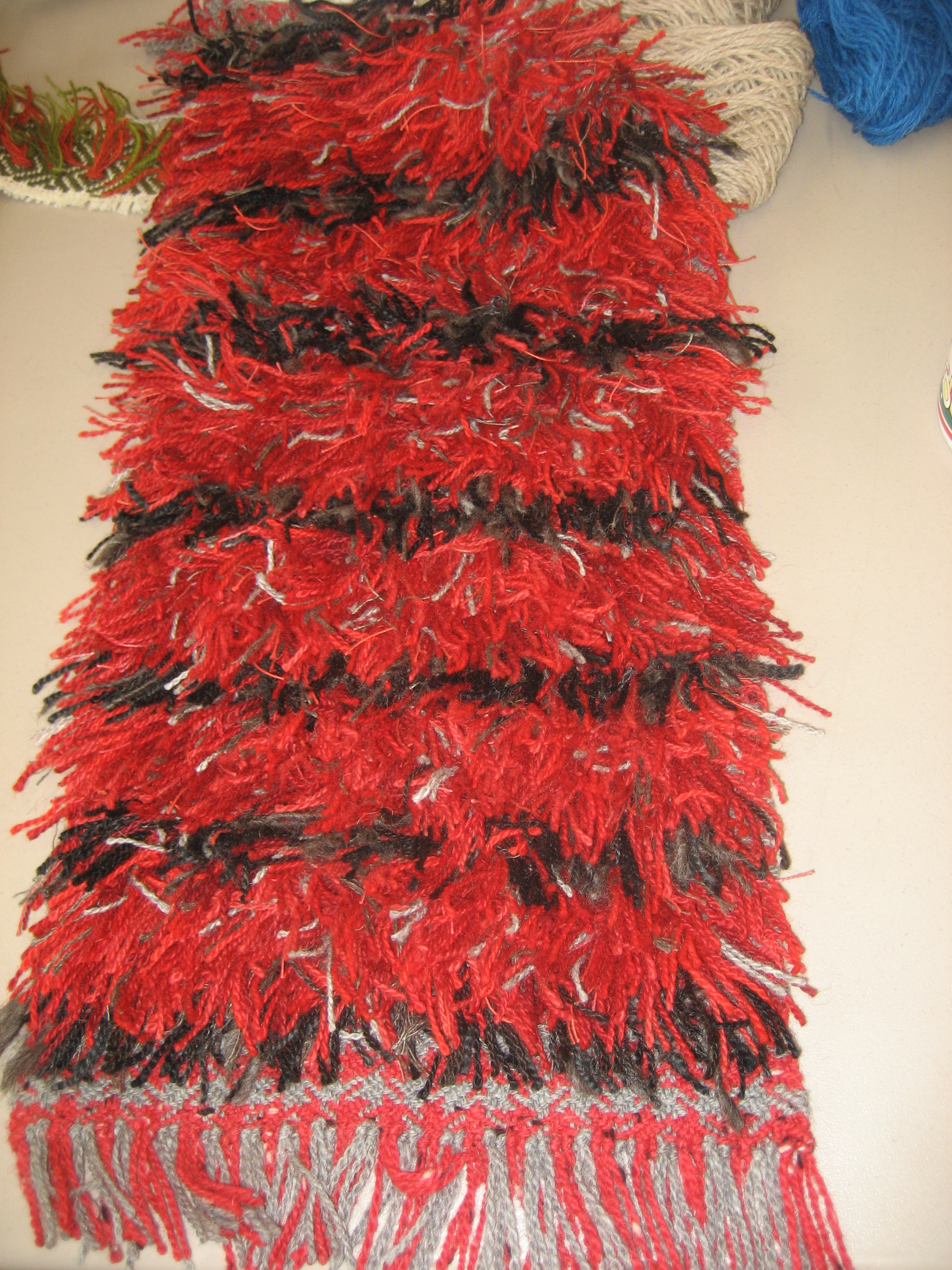
Jan Mostrom’s beautiful sample rya
Last summer, master weaver Jan Mostrom taught a popular class in beginning rya weaving at the Weavers Guild of Minnesota (WGM). (See The Zen of Rya). This winter, students braved both the bitter cold and a more complicated weave structure in Rya with Hidden Knots.
Jan drew her inspiration from an antique coverlet in the Vesterheim collection, which she previously analyzed for the Norwegian Textile Letter. The coverlet features sparse knots on a ground cloth woven in an irregular houndstooth twill. (The side with knots would have been placed toward the body, trapping air for warmth.) Due to the weave structure, the knots do not show on the non-pile side. The result is a vibrant masterpiece uniting form and function (See “Visiting the Vesterheim Collection” from the August 2012 issue.)
 To keep costs affordable, students used Harrisville Highland in contrasting colors for warp and weft, then dove eagerly into Jan’s treasured stash of Rauma yarn from Norway for their knots. Students also supplemented knots with yarns from their own stashes, including silk and linen for added visual interest.

Perhaps Anne Burgeson is counting to herself in this photo.
The weaving process was challenging. To achieve the houndstooth twill, the weaver must treadle continuously (1-2-3-4), stopping to tie knots every time treadle 1 is reached—while simultaneously changing weft colors every six picks. To further complicate matters, the knots alternate in placement. (Knots are tied above three lifted warp threads on one row, then tied over two lifted warp threads on the next row, and so on.) Students likened the process to patting one’s heading while rubbing one’s stomach, and there was plenty of counting-out-loud in the room.
In addition, students had the usual challenges of weaving, including keeping a consistent beat, avoiding draw-in, and creating even selvedges. Still, as in the previous class, students loved the tactile nature of rya: The soft knots just beg to be touched, and the simple, repetitive motion of tying them is soothing and meditative.

Lise-Anne’s loom bench cover
Students created their own designs, choosing to weave pillows, wall hangings, or loom bench covers. Jan pointed out that a simple, bold design works best to showcase the rya knots. Students heeded her advice, sticking to basic shapes while choosing a variety of means to show off both the knots and the houndstooth in the background.
Students also chose which yarns to incorporate into their knots to achieve the desired effect. For example, Geri Retzlaff wove enough yardage for a large pillow, alternating ground cloth and knots in an abstract pattern. She included hand-dyed silk thrums from a previous project, adding a touch of luxury to the finished product.

Anne Burgeson added unspun fleece to her houndstooth background.
While a novice weaver, Anne Burgeson is a skilled spinner. She chose to incorporate her own handspun into her knots, creating a riot of color and texture to offset her cheerful blue-and-cream houndstooth. She even used unspun locks of wool for her knots, creating the illusion of fat, puffy clouds against a bright blue sky.
Carol Harrington used thick wool yarn in cheerful colors that matched her inspiration, a painting of bright red poppies. The warmth of the colors brought a touch of spring, a welcome contrast to the bleak February landscape outside. Likewise, Susan Andrews paired rich teal and orange in her abstract wall hanging, balanced with black-and-white houndstooth, while Mary Holmgren added rosy linen to her bold red and purple stripes.
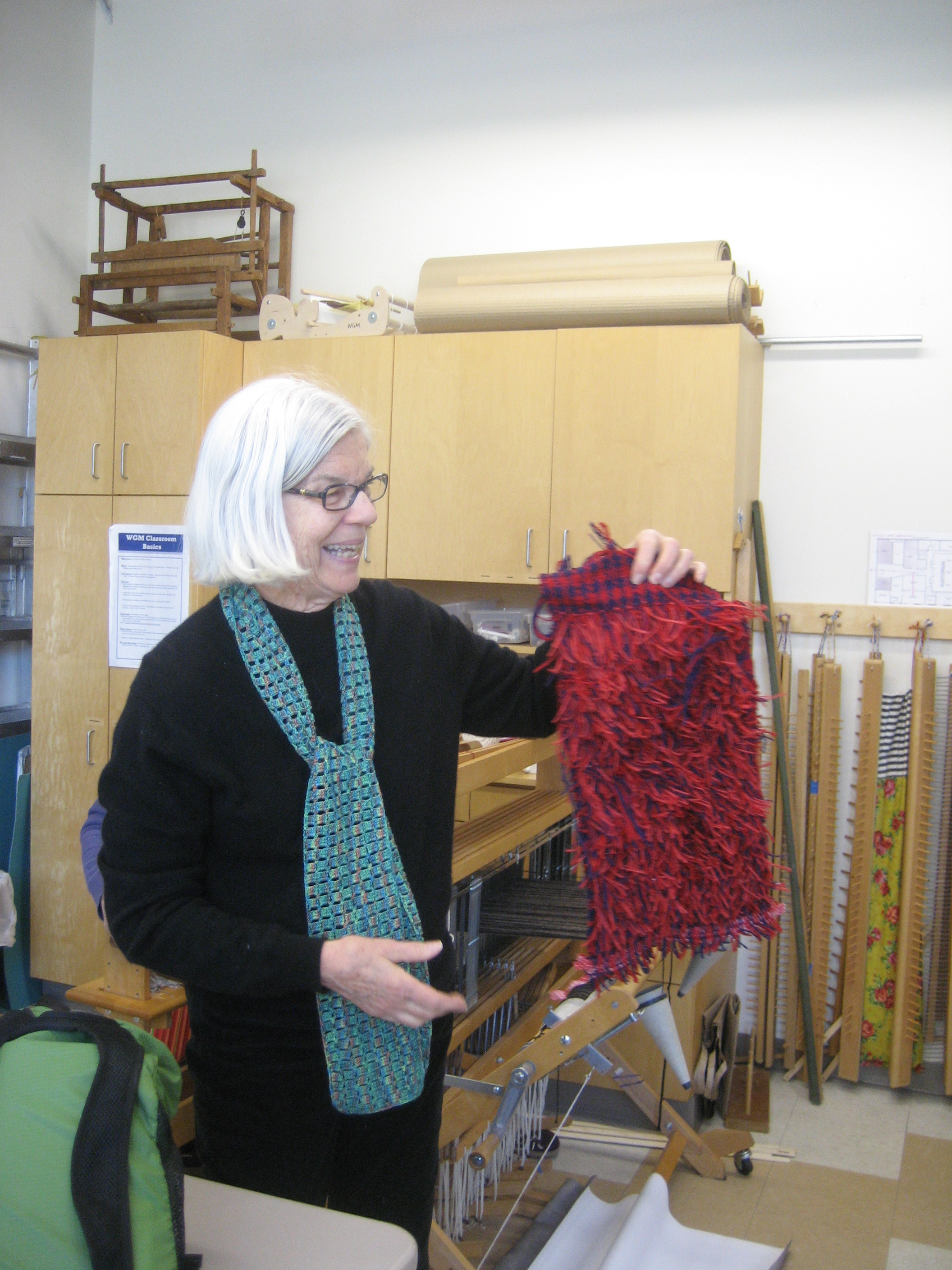
Mary Holmgren traveled all the way from the East Coast for the class

In process on the loom – Susan Andrews starts on her deep colors
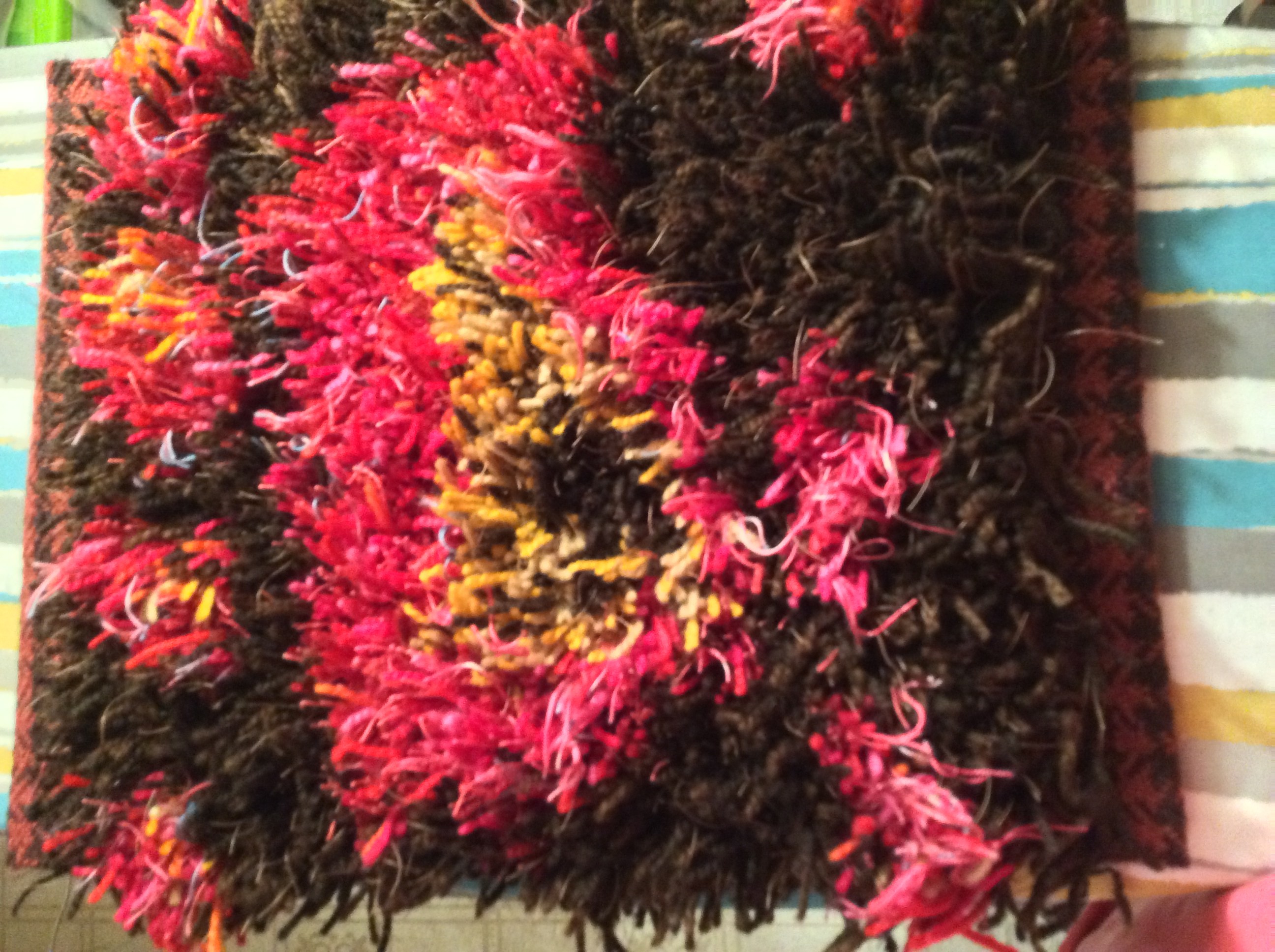
A poppy in eye-popping pink on Carol Harrington’s rya
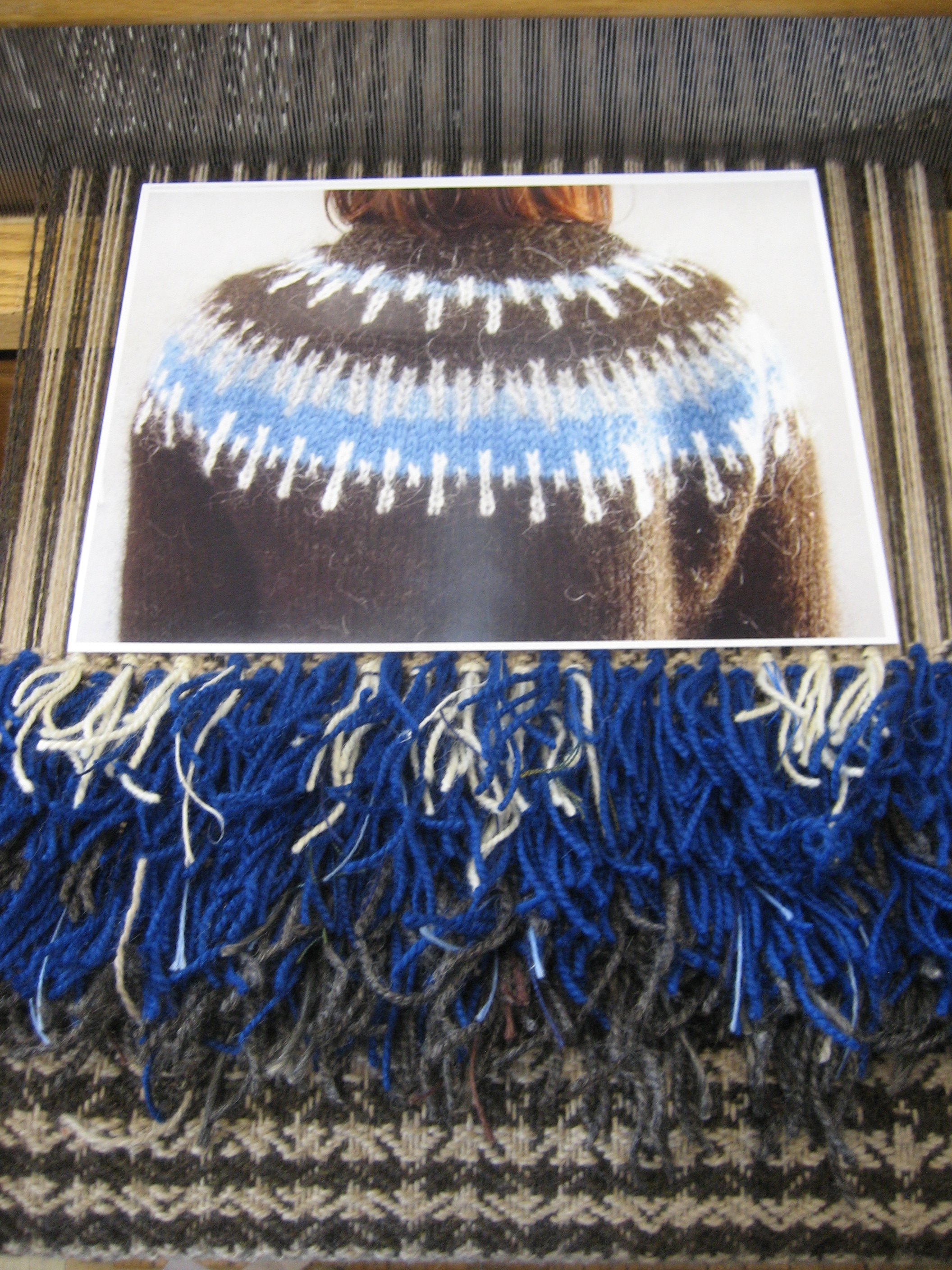
Lise-Anne Bauch’s rya was inspired by an Icelandic sweater.
I chose to weave a loom bench cover using a palette of brown, grey, white, and blue inspired by a photo of an Icelandic sweater. The beautiful blue Rauma yarn was a present from my mother from her recent trip to Norway. As for those hidden knots…well, mine turned out more “partially-obscured” than hidden!
Finally, lifelong weaver Louise French recently earned the coveted Certificate of Excellence from the Handweavers Guild of America. (Lou is the first member of WGM to achieve this honor.) As part of the certification process, she wove several pile weavings using cut weft or Ghiodes knots, like those used in rya. Intrigued by the process, Lou signed up for Jan’s class to learn more. Lou wove a wall hanging in copper and grey based on a painting by Paul Klee, one of her favorite artists.

Lou French’s hanging was inspired by a Paul Klee painting in a German book.
“I had no idea what a treat I was in for,” Lou commented. “I’m normally not a particularly patient weaver – one shuttle is my game – but I loved it. I loved the mystery of the hidden knots, I loved the story of why the Norwegians created such pieces, and I loved the contemplative nature of choosing the yarns that would create the next knot.”
Throughout the class, Jan remained patient and encouraging, helping each student bring their unique vision to life.”It is wonderful fun to teach rya,” she noted, “because the weavers’ creativity goes wild and the results are inspiring.” Rya exploration will continue at WGM through a year-long interest group, to culminate in an exhibit in the fall of 2015. Stay tuned for more adventures in rya!
This post brings apologies from your editor. Completing an interim position at the Weavers Guild of Minnesota plus other consultant work, and then family obligations, stalled the rewarding job of publishing the new issue of the Norwegian Textile Letter. However, there was one saving grace – the money I earned is earmarked for a trip to Norway in August. (Plus it was a fabulous experience.)
The keynote article of this issue, “Petrine’s Quilt: A Remembrance from America,” will please mystery fans, as Katherine Larson follows the threads of a story about a crazy quilt acquired by a northern Norway museum and the immigrant woman who stitched her family names. Follow along with Kay in her quest (and be inspired to document some of your own significant textiles, to help those in future generations).
As evidence of the continuing passion for rya in Minnesota, “Rya – The Adventure Continues!” describes Jan Mostrom’s most recent rya class offered at the Weavers Guild of Minnesota. This time the featured technique was weaving a rya with hidden knots on a base of houndstooth, inspired from an artifact from the from Vesterheim Norwegian-American Museum. The students in Jan’s class came up with very creative pieces.
 Also, you might be interested in reading about a student from Jan Mostrom’s rya class last summer, who turned into a teacher for her friend with Sami background. Read: “Rya Exploration: A Class, A Student, a Student Teacher” on the Weavers Guild of Minnesota website.

A detail from Annika Ekdahl’s “Follow Me” Facebook site
Though my summer trip to Norway will be mainly to show the beauty of the country to my husband who has never visited, it will include two important textile detours. First, Swedish tapestry artist Annika Ekdahl recently finished two large tapestries on display at the Andrea Arntzen’s Hus at Oslo and Akershus University College of Applied Sciences. Amazing! I’ve been following the progress of the tapestries on the Facebook site she created to mark the progress. It’s worth reading through all of the posts she wrote during this epic weaving project. Also, watch this video.

“Høisommer,” (High Summer), one of four tapestries deposited in the Stavanger Art Museum by SpareBank.
Second, this summer a retrospective of Frida Hansen’s tapestries will be shown at the Stavanger Art Museum. There was an interesting article in the Norwegian newspaper, Aftenbladet, “Nå skal Frida Hansen hedres” (Now Frida Hansen will be Honored). You should follow the link to see the accompanying photos, but I’ve translated the text below. I think it would be amazing if a Norwegian Textile Letter reader actually turned up a missing Frida Hansen tapestry! Have you seen one?
Next year Stavanger and Rogaland’s most internationally-recognized artist will be celebrated with a major exhibition in Stavanger’s art museum. The textile artist Frida Hansen had her international breakthrough at the World’s Fair in Paris in 1900, where she received the Gold Medal.
Her textile works were purchased by several arts and crafts museums in Europe, for which the Stavanger Art Museum can be thankful today. Many of the works in the upcoming exhibit are borrowed from these museums in Norway and Europe. Our regional art museum owns none of her works, but has deposited four pieces that the Norwegian SpareBank purchased.
Where are they now?
Several important weavings by Frida Hansen have disappeared, some in Europe and the United States, and some in Norway, maybe even in Stavanger. And there may be others, unknown works by her hanging in private homes, notes Inger M. Gudmonson, the conservator with Stavanger Art Museum and one of the two curators for the upcoming exhibition. “De Fem Kloge or de Fem Daarlige Jomfruer” (“The Five Wise and Five Foolish Virgins”) is one of the works that everyone thought has disappeared, but which perhaps still exists somewhere. The weaving is dated 1900 and was displayed at the World’s Fair in Paris. It was also displayed in Glasgow, Florence and Stocklholm. It was sold in Florence, but disappeared during the First World War.
“Sørover” (“Southward”) from 1903 was exhibited several places in the United States, and was purchased by Mrs. Berthea Aske-Bergh. The current owner is unknown. “Svinedrengen” (“The Swineherd”) was accepted by the salon in Paris in 1909, and sold from an exhibition in Berlin the year after. “Frieriet” (“The Wooing”) was displayed and sold in Oslo in 1903; it’s owner is unknown.
Bankruptcy
Frida Hansen dreamed of becoming an artist, but had to drop her plans when she married the wealthy Wilhelm Severin Hansen. When her husband went bankrupt they lost two large businesses and a model farm in Hillevåg. Not long after Frida Hansen began an embroidery business in Stavanger and discovered old Norwegian coverlets. In 1892, nine years after the big collapse, the family moved to Kristiania (Oslo) and Frida Hansen established a weaving and dyeing business in Tullinløkka. She had many employees, but participated in the operations. She patented the techniques she developed.
Forgotten for many years
Frida Hansen was famous and successful as a textile artist, but was more or less forgotten until the 1970s. Gudmonson believes this was because interest in Art Noveau died out. Frida Hansen’s work places her in the direction that was popular around 1900. But not long after her work was considered both tasteless and excessive for years. When interest in Art Nouveau revived around 1950-60, so did interest in Frida Hansen’s works.
Another reason for a lack of interest in Frida Hansen, Gudmonsen explained, was that she was too internationally-oriented. Norwegian arts and crafts museums preferred works that referenced Norse mythology or Norwegian folk tales. Therefore they chose Gerhard Munthe and not Frida Hansen.
Art Historian Anniken Thue is the advisor for the two curators who are working with the upcoming exhibition at the Stavanger Art Museum. She wrote a book on Frida Hansen in 1986, building on her master’s thesis in 1973.
This year the Museum of Decorative Arts and Design (Kunstindustrimuseet) in Oslo created a traveling exhibit, shown also at the Stavanger Kunstforening and the Vestlandske Kunstindustrimuseum i Bergen. It had been over one hundred years since Frida Hansen’s art was displayed in a large exhibit in Norway.
The link is here.
As the editor, I considered each of these articles as gifts – I hope you do, too.
We may all have to add band weaving to our New Year’s resolutions; Heather Torgenrud’s new book will be out this month to inspire and instruct us.
Or maybe you will be inspired to weave a new piece on a warp-weighted loom after reading about Marta Kløve Juuhl’s exploration of diamond twill.
This issue inaugurates a new series. Occasionally we will publish the story of a “fabulous find,” a Scandinavian textile that has been found and and now preserved and loved. We’ve all heard stories of marvelous runners or coverlets or tapestries found in a pile of textiles in an antique store or thrift shop, or handed over from a distant relative, or at the bottom of a box at an estate auction. The thrill is in the find. To share those stories, and display our finds online, I’ll continue to search out stories and images of “fabulous finds” to share. Do you have one? This series will serve as a virtual exhibit of the beautiful Scandinavian textiles we have in our homes. They may never be displayed in a museum or gallery, but they will be shared and appreciated within our Norwegian Textile Letter community.

Here you see a very basic, functional version of the rya, woven in Sweden, a manifestation of the widespread pile-woven textiles for everyday use found throughout Scandinavia. It is of this everyday use and the place that this rya has in our family that I write.
One summer in the mid-1970s, my husband Roland, our children, and I were visiting my mother-in-law, Ellen, on her farm in Tröjamåla, near the town of Ryd in southern Småland, Sweden. One evening, we sat at the kitchen table, sipping coffee and discussing a multi-household auction that would be held in town, at Folkets Park.
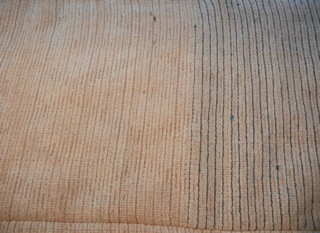 Country auctions, in those days, were most interesting and educational for me. They revealed the inventories of a disappearing way of rural life, and I got to see up close and touch the tools, textiles, and every kind of everyday objects that reflected people’s lives. Those who came to auctions were mostly curious locals, in themselves interesting to me, who might bid cautiously on things they could use or things with which they identified. But this auction was well advertised in the local press, a summertime auction sure to be attended by tourists and cabin folks, especially Danes and Germans. We decided to go, for the fun of it.
I suppose it is audacious to say that I spotted “my” rya immediately. In fact, it was piled on a table with other textiles of all sorts, but it caught my eye. When the bidding began, I didn’t trust myself to stay on top, keeping up with German, Danish, and the local dialect, but Roland helped. It seemed, at first, as though there was not much interest. Then, a Dane entered the bidding, and it went back and forth between us, until my bid won. Who knows? Did the Dane really understand what was at stake, that there was more than met the eye to this old thing that could be sold in a Copenhagen antique shop? No matter–now it was mine.
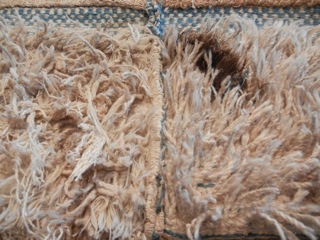 Next came finding out about the piece. Roland and I went to the Smålands Museum, in Vaxjö, where the curator explained the textile’s genre—slitrya–meant to be placed pile-side-down on the bed. Common, she said, ours nothing out of the ordinary.
But, this is not the end of the story.
In fact, my mother-in law Ellen’s place in this story IS this story. She tracked the slitrya’s history back to the household of a town merchant in Ryd, whose descendant remembered its being used in the upper floor bedroom, where the children slept close to a chimney for warmth. Which explains the wonderful smoky scent it had when we bought it. Imagine the skills that this simple, homely bedding embodies and the whispers of the children it kept warm.
 Today this slitrya hangs on a wall in our living room. Woven in two pieces that have been sewn together, it measures approximately 47”x 72”. Its warp and weft are tow linen–likely handspun–with the exception of the top and bottom edges, which have dentate patterns, woven in blue and beige wool weft. There are a few blue wool picks in the body of one half, as well. The deep pile consists of various natural shades of handspun wool, combined with some linen yarns, knotted to form a goose-eye motif, best discerned from a distance. ¾” (2 cm.) weft separates the knots, which are visible on the presentation side. The person(s) who wove and assembled the coverlet chose to join the two sections in opposite directions, so that the piles face away from each other and the decorative head and foot edges do not match, although the overall motif is fairly aligned. Possibly, use and storage have faded the presentation side of the rya, but the pile side is true to its original, natural colors.
The spinner’s and weaver’s hands have long been stilled, the children are long gone, the earth and animals that provided precious fibers are long forgotten. And yet they are here, in this slitrya, a meaningful part of our lives.

It was five years ago and I had just returned from a trip to visit a friend in Bodø, Norway. While there I was lucky enough to see an exhibit of tapestries by Hannah Ryggen. I was totally astonished with her work and had to learn more about the great Norwegian tapestry weavers, so I started searching the Web for information about Norwegian tapestry.
 While searching the Internet, I ran across an article about a man in London who was selling his father’s textile collection. The inventory of textiles was fantastic, but not much interested me until I saw a picture of the Wise and Foolish Virgins. I was able to contact him by email and asked what he knew about the piece. According to his father’s inventory information, it was purchased in Western Norway from a private party 50 years ago. The tapestry was put in a drawer and only discovered recently by the son of the individual who originally purchased it. Imagine this great tapestry filed in a drawer for 50 years.
The new owner was not really interested in Norwegian textiles and asked if I would like to purchase it for $140.00. We agreed on this price and it arrived in Minnesota about a month later.
When it arrived, I was horrified to see the condition of the parcel. It was wrapped in Christmas paper that had been turned with the back side out. The tapestry was folded in a small bundle, wrapped in Christmas paper and sent by boat. The parcel was in terrible condition, but thankfully someone at USPS was kind enough to put it in a plastic bag and it was eventually delivered to me. Fortunately there was no damage to the piece.
 I contacted the seller regarding the condition of the package and he told me his father used to send packages in this shabby manner to his family in East Germany so the authorities there would not confiscate the package.
Again, I was so thankful it arrived in great condition.
Sometime later, I took the tapestry to Laurann Gilbertson, the Curator at Vesterheim Norwegian-American Museum, for inspection. I was delighted to hear that is was Norwegian and from late 19th century or early 20th century. Most likely the piece was a cover for a bench and used for a wedding. The bride and groom sat on the bench for the wedding service. I can tell you from experience that Lutheran services can get fairly lengthy.
I’ve always had good luck at estate and rummage sales over the years, but never imagined owning a Wise and Foolish Virgin tapestry.
Corwyn Knutson (Corky)
2742 Lakeview Ave
Roseville, MN 55113
651-330-6500
Email: Knutfrondal@gmail.com

Editor’s note: Marta Kløve Juuhl wrote this article for the Østeroy museum blog, and for readers of the Norwegian Textile Letter, after receiving many inquiries about their investigation of diamond twill weave on the warp-weighted loom. If you would rather read the original Norwegian text, it is found here. The English translation below is thanks to Edi Thorstonsson.
After having given many classes in weaving on the vertical loom, including at Østerøy Museum, where I work, and at Vesterheim Norwegian American Museum, in Decorah, Iowa, I had Elizabeth Johnston from the Shetland Islands and Hildur Håkonardottir from Iceland as students in a class at Østerøy Museum in the summer of 2010. After the course, we discovered that we had so much in common that we wanted to continue our work together. We hope that our combined efforts will result in a published book. Others have become aware of our work, and we have received some inquiries about weaving particular textiles using this technique.
Up to the present, what has been the most exciting—and demanding—for us has been to weave fabric in broken lozenge twill, also known as diamond twill.
A few years ago, objects including a tunic were found at the edge of a glacier, Lendbreen, in Lomsfjella (Gudbrandsdalen). This tunic was in amazingly good condition. It was eventually conserved by the Kulturhistorisk Museum (Museum of Cultural History) in Oslo and described as being 1,700 years old. Information regarding the find was placed on the Internet.
Last spring (2013), the director of the Norsk Fjellmuseum i Lom (Norwegian Mountain Museum, Lom) called us at the Østerøy Museum to tell us that this tunic would be exhibited during the summer of 2013. They would like to borrow a warp-weighted loom from us, therefore, for the purpose of demonstrating the kinds of equipment used to produce cloth. Lise Bender, textile historian and specialist in the study of Iron Age textiles, had determined that the fabric had been woven on a vertical warp-weighted loom. We were pleased to lend our loom to the Fjellmuseum, which promptly came to pick it up.
Then, a couple of weeks later, the museum director called again and asked whether we might consider weaving fabric in diamond twill on the warp-weighted loom that could remain on the loom through the summer. To this we answered yes, with a bit more hesitation. I don’t believe that the people at the Mountain Museum quite knew what they were asking for…
Weaving diamond twill on a horizontal loom is a simple matter, as it is on a vertical loom as well, if one knows how. But the first time requires a lot of thought.
We could not find the answers to such matters, because the conservation report on the tunic could not be made public before it had been published in a national professional journal. Besides, not all answers to our questions would likely be found there.
But there were good images of the tunic on the Internet, and we knew that the material was made of wool yarn. It so happened that we had arranged earlier for Elizabeth to be at the museum with us during this week in May, which was incredibly good timing.
We ordered yarn from Hoelfeldt-Lund Norsk Kunstvevgarn (Helfeldt-Lund Norwegian Fine Handweaving Yarns), single ply spelsau yarn number 4.5, gray for the warp, brown for the weft. This yarn is suited for 10 warp ends per centimeter and somewhat fewer in the weft. We then calculated that our fabric would be slightly courser than the original, without being sure. We later learned that our calculation was correct.
 Using the photographs on the Internet, we were able to determine how many threads there were in each “diamond” or repeat. The photographs were so good, in fact, that we could count the threads. Therefore, we counted the repeat using a close-up of one of the sleeves.
We decided to wind a warp 60 centimeters wide in the reed, that is, 600 warp ends, and use a heading cord along the beam edge, as is done in weaving åkler (coverlets) in the West Norwegian tradition. Of course, we knew nothing as to what method was used in setting up the original textile, but we knew how to carry out this method and that it would work well. Besides, since we had so little information about the original, ours could not be an exact copy.
We started out cautiously with light loom weights, 50 grams per warp end. This worked.
So far, so good. The biggest problem were the heddles. For diamond twill, one needs four sheds: 3 heddle rods and a 4th natural shed. The warp is threaded so that points appear in the woven fabric. These points result when one threads two or one warp ends in their heddles on a particular order. With the help of Marta Hoffmann’s The Warp Weighted Loom, we figured out the procedure, which we modified for “our” cloth. Elizabeth and I worked together to thread the heddles. I stood behind the loom and picked out the threads that she, who stood in front of the loom, then knitted the heddles around. We threaded the second and fourth heddle rods (counted from the top) at the same time, and lastly the first heddle rod at the top. The natural shed corresponded to rod number three and remained between rods two and four during the weaving. In order to make sure that we wouldn’t skip any threads on rods two and four, we followed a rule that we repeated aloud every time: single, double, double, double, double, double, single times 2. This was one repeat. Each repeat, therefore, had 24 threads in both the warp and weft.
 This process was the most time-consuming. All else was quite easy. After three days’ worth of fairly intensive work, the loom was ready. We wove enough to see that our technique was correct.
Then, Elizabeth returned home to the Shetland Islands, and Randi Andersen, director of our museum, and I removed the fabric from the loom, with the heddle rods still in place, and drove to Lom. When the Norwegian Mountain Museum opened for the summer, our cloth was on the loom, alongside the glass case with the tunic inside. I stood weaving on the opening day, and everyone saw the similarity between our cloth and that of the tunic.
Hildur was not physically part of this process, since she was back home in Iceland. Just the same, we all agree that all three of us can take equal credit for what we succeeded in doing.


Fig 1. Schiffer Publishing. ISBN 978-0-7643-4751-1. Size: 8½”x11″, Illustrations: 152. Pages: 176. Binding: Hardcover. Price: $24.99. Available: December 2014
I’m excited to tell you about my new book, Norwegian Pick-up Bandweaving, Schiffer Publishing, 2014 (Fig. 1). This is the book I would have liked to have had more than forty years ago, when I wove my first pick-up band on an inkle loom. I was fascinated by the beauty of pick-up patterns, but knew little of their history. As my fingers delighted in the rhythm of the technique, I longed to know about the culture in which pick-up weaving had flourished. What did pick-up bands look like in the old days? What had they been used for? What significance did they have for the people who wove them?
Although pick-up bandweaving in various forms has been known in many places around the world, for me a connection to Norway had the most personal meaning. My late husband’s ancestors immigrated to America from Norway in the mid-1800s. Some came from Hadeland and Valdres in Oppland, others from Hallingdal in Buskerud. Other than one spinning wheel from Valdres that had once occupied pride of place in his great-grandmother’s home in Minnesota, we knew of no textiles or textile tools that had been brought from Norway. But succeeding generations of the family had retained some of their native dialects, which sparked a desire in us to learn the language. This in turn led me to discover the links to pick-up weaving history that I had always yearned for, and I soon became passionate about putting the stories I found into book form.To summarize the book in a nutshell, “Part 1: History & Tradition,” tells how pick-up bands were used in the rural communities of Norway in the 1700s and 1800s. “Part 2: Vesterheim Collection” looks at a selection of pick-up bands brought to America from Norway. “Part 3: How to Weave Pick-up” has instructions for weaving two different types of pick-up on traditional band heddles. There are 123 photographs and diagrams, and 29 pages of charts that include more than 100 patterns from bands in museum collections. Part 3 is for weavers, but Parts 1 and 2 can be enjoyed by anyone interested in Norwegian culture, textiles, costumes, and folk art.

Bandgrind (band heddle), collection of Vesterheim Norwegian-American Museum (Artifact No. 1979.27.1). Photo: Alison Dwyer.
For me, the bandgrind (band heddle) is the perfect symbol for the story of Norwegian pick-up bandweaving. Take the one shown here, from Vesterheim’s collection. It was apparently carved in 1828 for a young woman whose initials were MJD and was likely given to her as a courting gift as a token of a young man’s affection. As a courting gift, it represents a traditional way of life, governed by time-honored conventions. As a tool, it represents the value that the old farm culture placed on skill with the hands. It spoke to the young man’s proficiency in woodworking and to the young woman’s proficiency in the textile arts—highly desirable skills for a couple to have in a society where families had to be largely self-sufficient. This particular heddle might be empty now, but at one time the young woman likely wove pick-up bands on it in intricate patterns and rich colors—bands that played significant roles in many important and deeply-rooted customs of the day, from the way a young girl’s hair was braided to the way a baby was dressed for christening.
“Part 1: History & Tradition” paints a picture of life in the old rural society and of the textile traditions that were an integral part of that life. Then it explores the customs surrounding pick-up bands of all kinds: Bands used in folk dress, as hairbands, apron bands, belts, suspenders, stocking bands, clothing trim, and coat bands. Bands used to swaddle babies and protect them from unseen harmful forces. Bands used to fasten and decorate baskets of food for special occasions. Bands with woven-in names, initials, or dates. And bands sewn together to make wider textiles like coverlets and cushion covers. The story continues through the social movements that began in Norway in the late 1800s to preserve hand crafts and folk costumes, and through the immigration to America of many people from areas with strong pick-up weaving traditions. Here you can also read about the tools that were used to weave the bands and what we know of their history and about the use of band heddles as courting gifts.
“Part 2: Vesterheim Collection” looks closely at twenty bands from Vesterheim Norwegian-American Museum, many of which were brought to America by immigrants. The bands came from Nord-Østerdalen in Hedmark, Øst- and Vest-Telemark, Setesdal and Åmli in Aust-Agder, Hordaland, Sogn og Fjordane, Trøndelag, and Øvre-Numedal in Buskerud. They represent the significance pick-up bands had for the immigrants, and they tell us much about traditional materials, colors, and regional patterns.

Two kinds of band heddles—the bandgrind (at top) and the spaltegrind (which has extra slots for the pattern ends).
“Part 3: How to Weave Pick-up” is a complete primer for weaving your own bands, with information on tools, materials, weave structures, basic warping and weaving techniques, and two types of pick-up. One type of pick-up is shown on both the regular bandgrind (band heddle) and the spaltegrind (band heddle with extra pattern slots), since the two heddles require different ways of working. (See fig. 3) And the pick-up instructions are easily adaptable to other kinds of looms, such as the inkle loom. To help the beginning bandweaver, there are clear photographs, diagrams, step-by-step instructions, and hints and tips. For the advanced bandweaver there is a wealth of inspiration in the numerous pattern charts.
I like to think of Ingeborg Olsdatter, one of my late husband’s forebears, born in 1811 in Hallingdal, who likely would have put up her hair with a pick-up band and might have trimmed her skirt with a pick-up band, according to the customs of that valley. And I like to think that she would be pleased and honored that I, too, weave pick-up bands in the same techniques, 168 years after she and her family immigrated to Winneshiek County, Iowa.
To illustrate the two types of Norwegian pick-up bandweaving, let’s look at two Hallingdal-style bands, similar to those Ingeborg might have woven and used.
In Øvre-Hallingdal the bandgrind (band heddle) was used to weave hairbands and skirt bands. (Noss 1966, 126.)

Fig. 5 Band woven after hairband in Hallingdal Museum (HFN.11750)
Hallingdal hairbands traditionally used red wool for the pattern and unbleached cotton yarn for the background. A red end at each selvedge created a whipstitched appearance as it was encircled with the natural cotton weft on each row. Sometimes another color, like green, yellow, or blue, was used for these selvedge threads. Bands were named for their pick-up patterns. The finest bands were woven in a hatched diagonal cross pattern, like the one shown in Fig. 7, and were called spåraband (spår meaning animal tracks in this instance). Those woven in a simple chevron pattern were called klauveband (klauv meaning hoof). The bands varied in width from .75 to 1.5 cm. (from a little less than ⅜” to a little more than ⅝”) and were usually about 3.7 meters (4 yards) long. (Noss 1992, 17–18.)

Fig 7. Pattern chart for red and white band.
A hairband in the Hallingdal Museum (HFN.11750), that I used as a model for the band shown in Fig. 5, was woven in red wool and white cotton and is 1 cm. (⅜”) wide. I used the same pick-up pattern for my band, in Bockens Möbelåtta 8/2 wool in red (color 3822) and Bockens Bomullsgarn 8/2 cotton in natural (color 0000), for a width of ½”.

Fig 6. Warp draft for red and white band.
The warp draft is shown in Fig. 6. The red squares represent ends in red wool and the circles represent ends in natural cotton. There are a total of 37 ends—11 pattern ends (marked with asterisks) in red wool, 24 background ends in natural cotton, and 2 red wool ends at the selvedges that are not a part of the pick-up pattern. The pattern chart is shown in Fig. 7, where dark grey represents red pattern ends. The natural cotton was used for weft. Each of the yarns I used was “lively”—when I allowed a large loop of yarn to hang freely it wanted to twist on itself—so the band has a tendency to spiral a little when it is hanging up, but it is delicate and lovely.

Fig 8. Band woven after one in Norsk Folkemuseum (NF.1964-0160) and used to trim a knitted-and-fulled wall pouch or basket for holding bandweaving shuttles.
Several different textile techniques were used to make bands to trim the lower edge of women’s skirts in Hallingdal. Pick-up weaving was one technique; ornate wool embroidery and weft-faced tapestry weave done on the cradle loom were two others. The pick-up bands had a diagonally-checkered pattern and were called rutaband (ruta meaning diamond or square), trerutaband (tre meaning three), or simply bragdeband or band med bragd (patterned bands). Most used wool for both warp and weft and were from 2 to 4 cm. (about ¾” to 1½”) wide. Red, green, and yellow was a common colorway. (Noss 1992, 188.)
The band in Norsk Folkemuseum (NF.1964-0160), that I used as a model for the band in Fig. 8, was sewn as trim along the bottom edge of a red plaid cotton skirt. I used the same pick-up pattern for my band, in Borgs Brage 7/2 wool in red (color 6745), green (color 6609), and yellow (color 6038), for a width of ¾”.

Fig 9. Warp draft for red, green, and yellow band.

Fig 10. Pattern chart for red, green, and yellow wool band.
The warp draft is shown in Fig. 9. There are 38 ends represented by colored squares. The 36 pattern ends are marked with asterisks. The pattern chart is shown in Fig. 10. The dark grey represents red pattern ends, the medium grey represents green, and the light grey represents yellow. The red wool was used as weft.
I used my band to trim a hanging pouch or wall basket that I’ll use it to hold bandweaving shuttles, and it could have many other uses. The pouch was knitted in Rauma Vamsegarn 5/3 wool (color V27, a red/rust twist) and then fulled (its finished dimensions are 4¾” by 7¼”).
The skirt band technique uses an even number of pattern ends that are picked up in pairs, and an even number of total warp ends yields balanced selvedges. The hairband technique uses an odd number of pattern ends for a central pivot point, and an odd number of total warp ends yields balanced selvedges. In threading the heddle shown in Fig. 4 for the skirt band technique, I added an extra red selvedge end on the left (so I had 39 ends total, instead of the 38 shown in the warp draft). This built a slight curve into the band so it fit perfectly around the pouch, where the bottom edge of the trim needed to be slightly longer than the top edge.
I hope that in the pages of this new book you will delight in the beauty of pick-up bands, as I do, and find enjoyment, inspiration, and your own satisfying connections to the past.
REFERENCES
Noss, Aagot. 1966. “Bandlaging.” In By og Bygd, Norsk Folkemuseums årbok. Vol. XIX. Oslo: Johan Grundt Tanum.
———. 1992. Nærbilete av ein draktskikk—Frå dåsaklede til bunad. Oslo: Universitets forlaget AS.
Copyright Heather Torgenrud, 2014. All rights reserved.