Archives

Editors Note

This month’s header is a collage of details from photos of the ribbon-winning pieces at this years Exhibition of Weaving in the Norwegian Tradition.  It’s an annual joy to see the talented work of weavers exhibited at the Vesterheim Norwegian-American Museum.  This year, since we are not limited by a certain number of pages in print, I’ve included a gallery of all the pieces that were entered, in addition to the article featuring the ribbon winners.

samplesI admire the collaboration of Heidi Goldberg and Sharon Marquardt in teaching the Nordic Arts class at Concordia College in Moorhead.  In this issue Sharon shares her instructions for the inexpensive student loom she developed for the class.  The students may not go on to be weavers, but they will definitely appreciate traditional and modern weavings they see in the future, armed with their hands-on knowledge of weaving structure, and the books and pieces that Sharon shared with them. Thank you, Sharon, for all the work you did for the students and in documenting the process that others can use in the future.

Lisa Bauch documented the two rya classes held this summer as a collaboration between the Weavers Guild of Minnesota and the American Swedish Institute (ASI).  The classes, together with the Finnish ryijy exhibit at the ASI and the exhibit of ryas by local weavers at the ASI, built a momentum to keep weaving rya.  A Weavers Guild “Rya Exploration Group” is being formed.  The group, composed of people who will each weave a rya for an exhibit at the Weavers Guild beginning October 15, 2015, will meet at least five times in the coming year for support, study, and show and tell.  The first organizational meeting will take place at the American Swedish Institute on Saturday, September 20, at 2 pm.  The group will tour the exhibits and then hash out details of future meetings over coffee at the Fika.  (Questions?  Contact me.)

And by the way, did you hear that Norges Husflidslag has been designated a UNESCO Organization of Intangible Cultural Heritage?

Robbie LaFleur


Developing a Loom to Teach Scandinavian Weaving

As Heidi Goldberg, Associate Professor of Art at Concordia College, Moorhead, Minnesota, developed her “Nordic Arts” class, she asked me to teach Scandinavian weaving to her students. There was a major challenge–we needed looms.

I had experimented with a cardboard tube loom first introduced to me by Latvian-American weaver Anna Smits, who taught weaving at the University of Minnesota over 37 years and was a founding member of the Weavers Guild of Minnesota. She had invited the Scandinavian Weavers Group of the Weavers Guild to her home to learn band weaving on this simple backstrap loom. It is based on the principle of winding a warp around a tube first clockwise then counterclockwise to produce a natural shed.

I adapted the loom for Heidi’s class by adding spacers to keep the warp spread at 8 ends per inch. Using the spacers, along with bubbling the weft to prevent draw-in, keeps the warps spread. The opposite shed is formed by using string heddles on a heddle stick. Tension is created by tying a slip knot in the warp and looping it over a C-clamp.

Simple materials and low-cost yarns kept the cost at about $5 for each loom. I used ¾-inch PVC pipe purchased at a hardware store, mini-blinds from a thrift store for spacers, pick-up sticks and shuttles. I punched holes for the spacers with a regular paper punch. Thrums or cotton rug yarn served for warp. Many types of yarns were donated to Heidi’s class for weft.

The pvc loom is set up and ready for a student.

The pvc loom is set up and ready for a student.

photo 3 copyInstructions for assembling the loom and weaving a sample accompany this article.  PVC Pipe Loom: An Affordable Loom for Teachers and Students is published in two sections: “Part One: Loom Construction and Starting to Weave” and “Part Two: An Introduction to Scandinavian Weft-Faced Weaving.”

In five hours of class time, students progressed from plain weave to stripes, kjerringtenner (pick-and-pick), krabbasnar (brocaded tabby), krokbragd (boundweave), and flossa (rye with shorter pile).

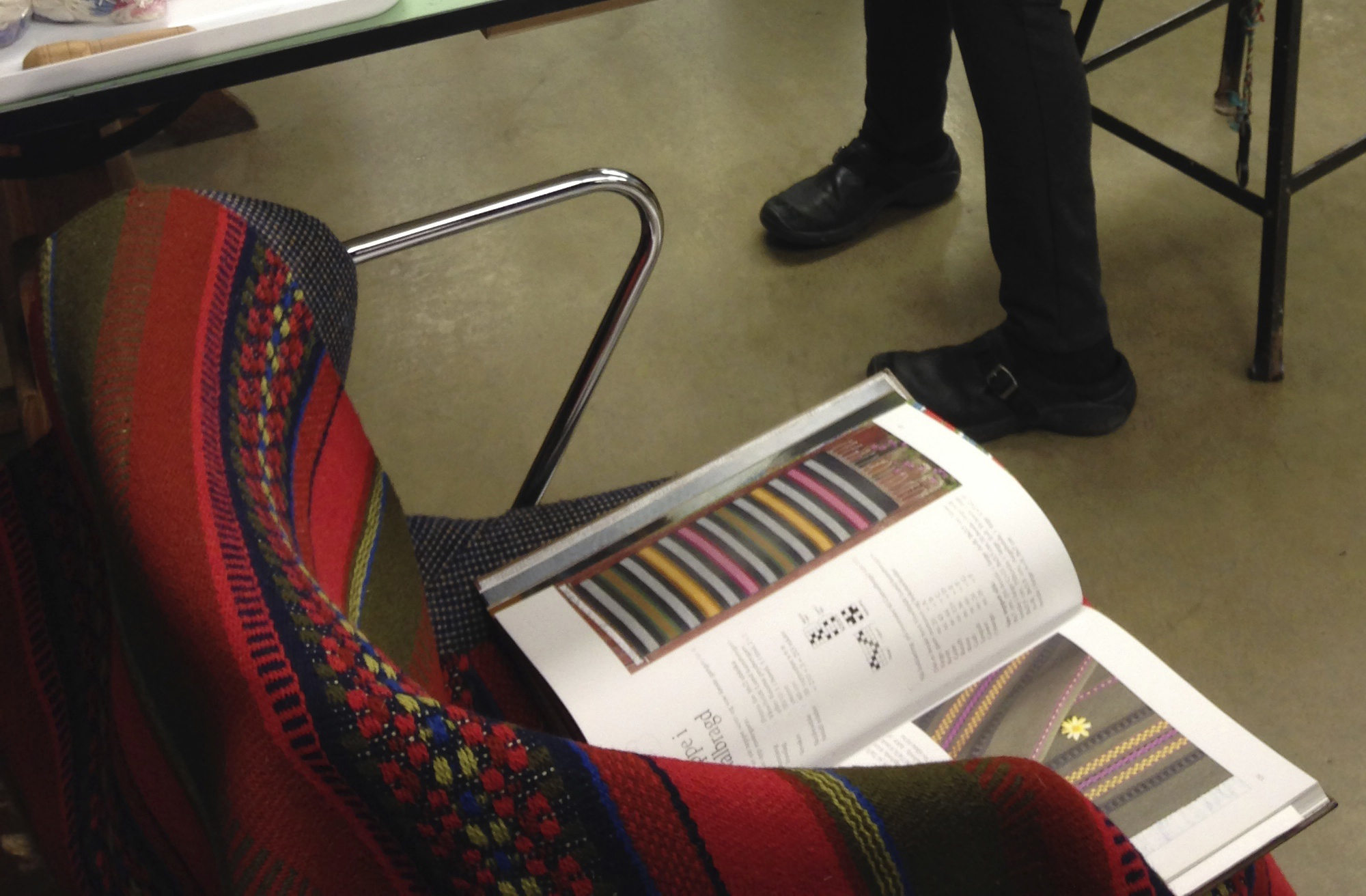
Sharon explains a chart.Students received already-warped looms; the weave structures were graphed. Here I learned a valuable lesson: the clearer my graphs, the faster my students learned. Students were misinterpreting my handwritten graphs, so I took the time to computerize them.

Once students grasped plain weave and the importance of bubbling the weft to keep the warp spread, the graphs served them well. I demonstrated each weave before students advanced to that structure and remained available to trouble-shoot as they were weaving.

I noticed one student with severe draw-in on his loom. As a result, he had fallen behind on weaving each structure. We fixed it by bubbling the weft a little more and flicking our fingers horizontally across the warp to spread it. As the old saying goes, “If at first you don’t succeed, try, try again.” He tried. His mother, who had taken Heidi’s class the previous year and had since purchased a loom, reported to Heidi that her son had taken his finished piece home and had hung it on the wall for all to see.

IMG_0672It was a teacher’s dream to teach Heidi’s capable students. We had introduced them to both cultural activities and to Scandinavian handcrafts. It seems quite a few people have an inherent desire to work with their hands. Weaving may fulfill those desires, and its many techniques engage the mind, as well.

Gallery of student work in various stages of completion:

See also the article in the February, 2014 issue of the Norwegian Textile Letter, “Transforming Through Tradition: Teach Nordic Arts at Concordia College, Moorhead.”

Sharon Marquardt holds a Master’s degree in theater arts with an emphasis in costuming. Instead of constructing costumes and placing them in storage after a show’s run, Sharon decided to weave heritage textiles. She learned Scandinavian weaving techniques at Vesterheim Norwegian-American Museum in Decorah, Iowa, where she also took private weaving lessons from Syvilla Tweed Bolson. Her interest has taken her to her grandmother ‘s home in northern Norway where she still has relatives in Tromso. Sharon has a broad range of teaching experience.  She has been employed as an English and gifted/talented teacher in two public schools. She has taught rigid-heddle weaving through weaving stores, university extension classes, and conferences. She has also taught warp-weighted loom weaving. She adapted the Norwegian West Coast weaving techniques, which she taught at Vesterheim Norwegian-American Museum, for the PVC loom used in Professor Heidi Goldberg’s Nordic Arts class at Concordia College, Moorhead, Minnesota. 

shmarquardt (at) gmail.com

The Zen of Rya

Jan M Rya 2In August 2014, teacher Jan Mostrom offered a long-awaited class in rya weaving at the Weavers Guild of Minnesota. The Weavers Guild presented the class in partnership with the American Swedish Institute, in conjunction with their exhibition The Living Tradition of Ryijy – Finnish Rugs and Their Makers. (For a description of the exhibit, see http://norwegiantextileletter.com/article/finnish-ryijy-rugs-at-the-american-swedish-institute/)

Jan is an accomplished teacher and weaver in the Nordic tradition, and her class was eagerly anticipated, proving so popular that a second session was added immediately. All in all, eleven students participated. None had prior experience in weaving rya, and several of the students were first-time weavers.

Jam Mostrom's sample rya, front (detail)

Jam Mostrom’s sample rya, front (detail)

Jan Mostrom's sample rya, back (detail)

Jan Mostrom’s sample rya, back (detail)

To make the class welcoming and fun for students at all levels, Jan chose a simple project to get us started. Her inspiration was a traditional style from the Närke region of Sweden that alternates rows of plain weave with rows of rya knots. This type is also known as a sparse rya, because the background fabric shows through the pile. This weft-faced fabric often bears distinctive checks or vertical stripes, providing a more symmetrical counterpoint to the softer knotted sections. Jan brought in several of her own pieces in this style for inspiration.

Yarn for Ryas 1Student projects were small woven pieces 16” wide, suitable for a wall hanging or cushion cover. (Length varied based on design.) The warp was sturdy Finnish seine twine and the weft was Rauma brand yarn spun from spelsau, a native Norwegian sheep. Rauma is tightly spun and has a beautiful sheen, making it both durable and attractive. Weavers supplemented the Rauma with a variety of other yarns from their personal collections. Overall, students found the rya knots easy to tie, making for a relaxing weaving experience, while the thick pile felt scrumptious to the touch.

Within the basic framework of size and materials, weavers were free to play with color and design. It was truly inspiring to see the wide variety of finished products. Each rya was completely unique, reflecting its maker’s personality and preferences, proof that this seemingly simple style of weaving holds endless possibilities.

Susan Andrews

Susan Andrews: Graphic rya with red

Kelly Nordstrom: Rya inspired by a fish graphic

Rya inspired by a fish graphic

Several students created clear geometric shapes with clean lines in contrasting colors, taking advantage of the rya’s graphic possibilities. Kelly Nordstrom’s project was inspired by the bold black-and-red design of a fish on a Finnish napkin. Susan Andrews and Edi Thorstensson also chose to work with red, paired with gray and white respectively, creating bright, dramatic contrast.

Edie Thorstensson

Edie Thorstensson

Marie . explored a stash of knitting yarns for an autumn palette.

Marie . explored a stash of knitting yarns for an autumn palette.

Cynthia Werner's piece includes the natural shades of sheep

Cynthia Werner’s piece includes the natural shades of sheep

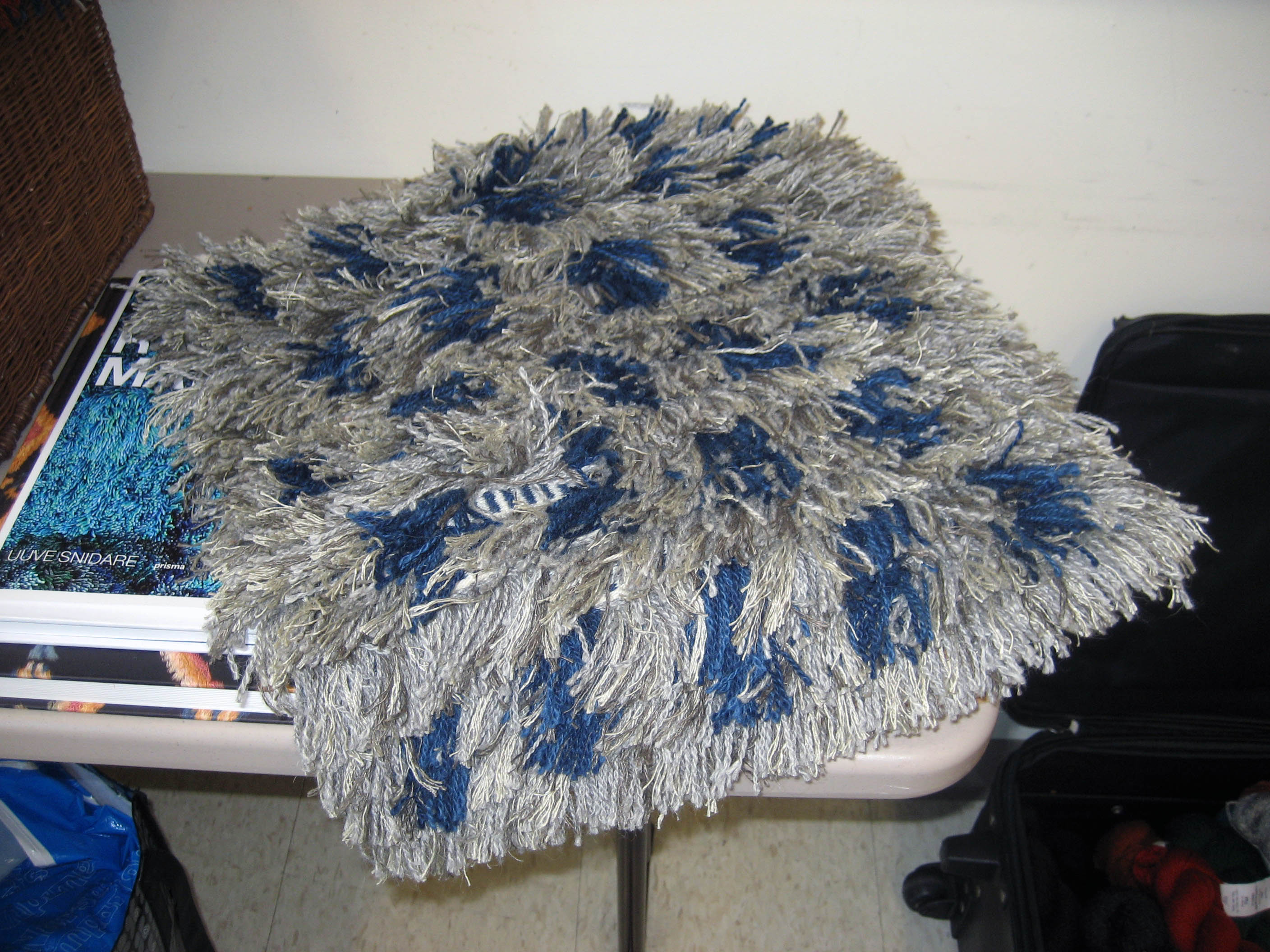
Others created a more abstract effect by blending colors seemingly at random. Marilyn Moore was inspired by the abundant lilies in her garden, while Marie Larson dug into her stash of knitting yarns to create a riot of colors and textures in her favorite autumnal palette. Cynthia Werner is an experienced yarn spinner who loves to work with Shetland wool. Her design—featuring shades of white, gray, and black—echoes the natural tones of a dappled Shetland fleece.

Marilyn Moore

Marilyn Moore: The colors of lilies

Geri Retzlaff  explored shapes in soft tones

Geri Retzlaff explored shapes in soft tones

Wanda inspired by palette..celtic blue

Wanda inspired by palette..celtic blue

Jan brought a stack of books to inspire us, allowing students to draw on the rich history of rya to spark their own projects. Wanda Truman was struck by the flower design on a traditional wedding rya woven in red, but chose to weave in her favorite Celtic blue to reflect her own heritage. Geri Retzlaff and Carol Harrington were inspired by the abstract designs of twentieth century ryas and also took on the challenge of creating rounded shapes. Geri wove in soft pastels, while Carol contrasted purple and orange for a contemporary look.

Many students, like Carol Harrington, drafted cartoons before weaving

Many students, like Carol Harrington, drafted cartoons before weaving

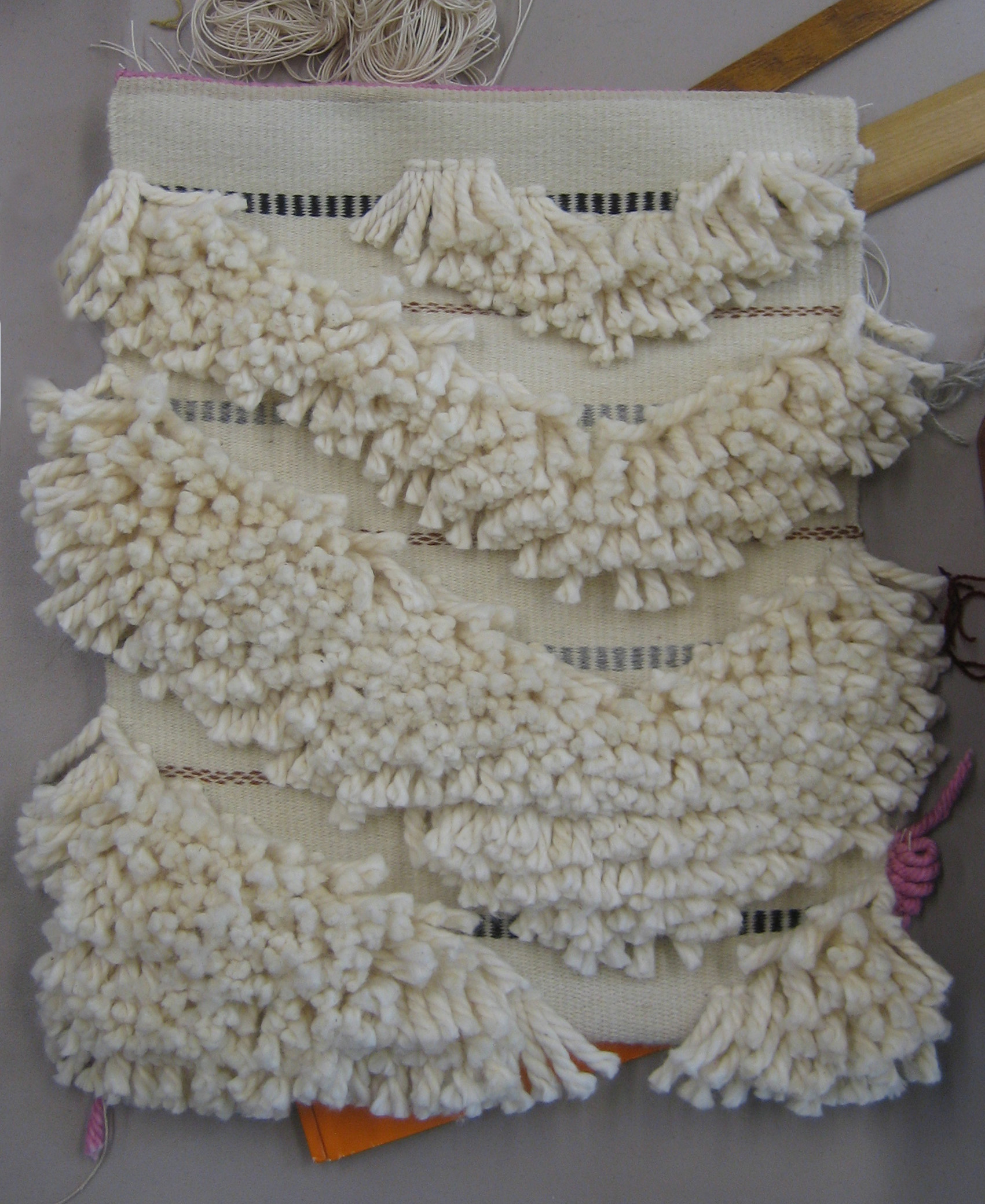
Allison N Rya 3Other students explored rya’s three-dimensional possibilities. Allison Nassif chose to work almost entirely in white, using a heavy yarn similar to that found in mops for her rya knots. The knotted design of thick chevrons alternated with plain weave, creating heavy piles that viewers longed to sink their fingers into.


Lisa B Rya 1Besides working in wool, most weavers in the class added silk or linen to the knots to create varied texture and visual interest. My own project was inspired by Edvard Munch’s 1895 painting Moonlight. I was fascinated by the way Munch captured the glint of moonlight on water and tried to replicate the effect by adding linen, which catches the light, to the wool knots. I also used a pale yellow yarn, thicker than the Rauma, in the moonlit sections, hoping to draw the viewer’s eye.

Lisa Bauch was inspired by Edvard Munch's painting, "Moonlight"

Lisa Bauch was inspired by Edvard Munch’s painting, “Moonlight”

Jan’s class took place over four days, and visitors stopped to view our progress, many of whom had been to see the exhibit at the American Swedish Institute. Two of our guests were women from Finland, who were pleased to see their beloved national weaving style being taught in the United States.

For their part, Jan’s students are eager to continue their explorations. “Rya weaving was surprisingly easy to learn,” says Geri Retzlaff. “The weaving and knot tying are relaxing and I found myself pondering other designs while weaving my class project.” Students agreed that the simple repetitive movements of tying the knots can produce a zen-like calm—but also leaves the attention free for lively conversations in class, if preferred.

Inspired by the success of the beginning class, Jan is planning to teach a more advanced rya class in 2015. “I found it very exciting to teach this class,” she explains. “The creativity in the students’ rya pieces was inspirational. It made me excited to start a new rya piece myself. It is gratifying to an instructor when the students are excited and enthusiastic about what they are learning and have such successful results.”

In addition to classes, the Weavers Guild is forming a year-long interest group, open to anyone interested in beginning or continuing their study in this style. Members are invited to create work for an exhibit in the fall of 2015.

Thanks to Jan Mostrom and her students, the American Swedish Institute, and the Weavers Guild of Minnesota for helping to ensure that this living tradition lives on!

 Lisa Bauch is a writer and editor – and newly-enthusiastic rya weaver – living in Minneapolis, Minnesota.  She is on the board of the Weavers Guild of Minnesota.

labauch (at) visi.com

33rd National Exhibition of Folk Art in the Norwegian Tradition

IMG_7474 - Version 2This summer, beautiful weavings were displayed in the galleries of the Vesterheim Norwegian-American Museum, interspersed with rosemaled items, hand-made knives and wood carvings.

The National Exhibition of Weaving carries on the tradition of Norwegian weaving by encouraging the preservation of traditional weaving techniques, and also spurring weavers to create contemporary pieces that depart from the historical in technique, colors or materials. This year the judges considered all entries together, rather than dividing ribbons by traditional and contemporary categories.  The judges wrote comments individually on each piece.  Then they met together to evaluate the 18 entries for ribbon competition and decide how many of each type of ribbon to award.  Finally they considered these pieces and the eight pieces entered by Gold Medalists to identify the single best weaving.

Blue Ribbon:  Donna Lacken, of Rockford, Illinois, for a table runner in krokbragd technique

Krokbragd, Donna LakenBlue Ribbon:  Judy Ness, Eugene, Oregon, for “Inner Lights,” a wall hanging in krokbragd.

Inner Lights by Judy NessRed Ribbon:  Jane Connett, Roseville, Minnesota, for a card-woven Telemark belt.

Telemark Belt by Jane ConnettWhite Ribbon:  Mary Glock, Decorah, Iowa, for a wall hanging in krokbragd.

Mary Glock wall hanging in krokbragdKeith Pierce, Lauderdale, Minnesota, for “Ouroboros,” a belt in tablet-weaving technique.

Keith Pierce, "Ouroboros"Honorable Mention:  Melba Granlund, Minneapolis, Minnesota, for “Summer Sizzle,” a wall hanging in Vestfoldsmett technique.

243 copyMarilyn C. Moore, Cedar, Minnesota, for a tablecloth in Östgötadräll technique.

248Best of Show Weaving:  Jan Mostrom, Chanhassan, Minnesota for “Folk Dance,” a wall hanging in boundweave technique.

260 copy

260 copyInner Lights by Judy NessPeople’s Choice:  This award had a tie between Jan Mostrom’s “Folk Dance” wall hanging  in boundweave and Judy Ness’s “Inner Lights” wall hanging in krokbragd technique.


Many worthy woven items were submitted, but were not awarded ribbons.  Several of them were submitted by weavers who have received gold medals from Vesterheim; their works are eligible for the “Best of Show” award.   Here are images of all submitted items: GALLERY.

Laurann Gilbertson has been Textile Curator at Vesterheim Norwegian-American Museum for 19 years and is now Chief Curator.

lgilbertson (at) vesterheim.org, 563-382-9681

Vesterheim Exhibition Gallery

These are the woven items entered in the 33rd Annual Exhibit of Folk Art in the Norwegian Tradition.  You can click on any photo to see a larger version.  Once any photo is in the large size, you can scroll through the items, all in larger size.

Editor’s Note: A Celebration of the NTL Archives

As your editor, I apologize for the delay in publishing this issue.  The content is worth it!  All twenty volumes of the Norwegian Textile Letter are now online.

Many articles are promised for future issues. Among others, you can look forward to articles on unexpected textile treasures from flea markets and antique stores, more articles on Norwegian textile artists, a review of Norwegian yarn sources, a report on this year’s National Exhibition on Folk Arts in the Norwegian Tradition, and an article on using an easily-made backstrap loom for teaching krokbragd and other techniques to college students.

vol2no2When I realized all the articles were for future issues, and Issue Number 3 was thin, I decided to scan all of the earlier years of the Norwegian Textile Letter. That means if you are a recent subscriber, you have many years of articles to enjoy, all in one fell swoop.  But, as often happens, I underestimated how time-consuming the scanning and publishing task would be. Then, unexpectedly, I took a six-to-eight month position as the Education Coordinator of the Weavers Guild of Minnesota, stepping in to help until our Managing Director, Becky Franklin has her baby and then returns from maternity leave.  I will work myself out of the job when a permanent Education Coordinator is hired, and best of all, have enough money to go on the Textile Tour to northern Norway next May!

IMG_1577

“Oak Leaf” by Laura Demuth

Once I realized that it is daunting to open all the older issues in pdf format and read through them, I thought it would be nice to put together some compilations on articles on various topics.  And what could be more perfect this summer than rya? It ties in nicely with the exhibit of Finnish ryijys at the American Swedish Institute, and the accompanying exhibit of ryas done by local artists.  We planned to include a review of the ASI Ryijy show in the August issue, but since I had many notes from the opening of the show, I wrote them up now.  I hope the article entices any NTL readers who have not seen the show, and can possibly make it to Minneapolis, to visit and see Dr. Toumas Sopanen’s fabulous collection.

This issue’s header is made of photos of Nancy Ellison’s Icelandic ram.  I feel the need to visit Nancy’s farm at least once each year.  All the sheep were skinny and sheared the day before my visit, except these two, which Nancy planned to tackle soon after.

Robbie LaFleur

Celebrate the Rye – or Rya – or Ryijy!

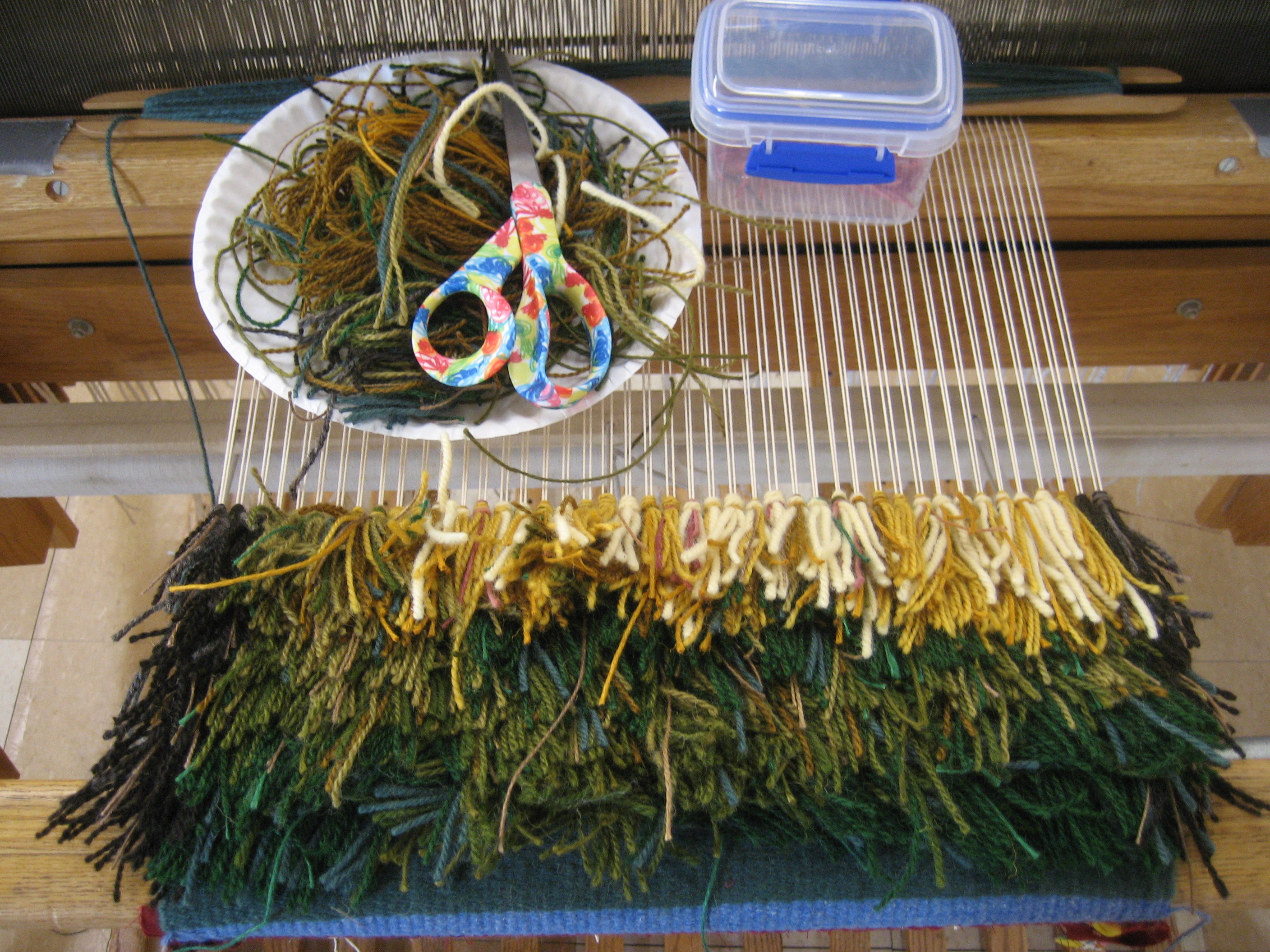
february-2010Nineteen years of the Norwegian Textile Letter are a trove of information on a variety of textile techniques – particularly rye.  Or is that rya?  The Norwegian authors consistently use the official Norwegian spelling – rye – but Americans often substitute  the version ending in ‘a.’ There have been articles on historical boat ryes, on contemporary ryes in Norway, articles about Textile Tour participants learning to weave ryes, analyses and drafts of ryes in the collection of the Vesterheim Norwegian-American Museum, and a report of a rye study group.  All told, rye articles from Volumes 1-19 comprise 50 pages! They’ve been scanned individually and as a compiled document.

The compiled document:

Rye – Rya – Ryijy? A Compilation from the Norwegian Textile Letter, 1999-2013

Individual Articles:

A Small Båtrya from Lofoten.” Janet Meany.  Vol. 6, No. 2, February 2000.

Weaving a Norwegian Style Båtrya. Sally Scott.  Vol. 5, No. 4, August 1999.

Nordnorsk Ryer.”  Inger Anne Utvåg.  Vo. 7, No. 3, May 2001.

Båtrya.” Ellen Kjellmo. Part of “Viking Women’s Textiles: A Report of a Seminar at the Viking Museum at Borg in Lofoten.” Vol. 10, No. 3, May 2004.

Ryas in Norway.” Helen Engalstad (translated by Loraine Leftwich and edited by Betty Johannesen). Vol. 11, No. 2, February 2005.

New Rya Study Group Forming (an initial notice).” Vol. 12, no. 2, February 2006.

Voss Ryer – Traditional Bedcover and Contemporary Art.” Marta Kløve Juuhl. Vol. 12, no. 3, May 2006.

Excerpt from Båtrya i gammel og ny tid.” Ellen Kjellmo (translated by Lorraine Leftwich). Vol. 13, No. 1, November 2006.

The Contemporary Rya Rug in America.” Marion T. Marzolf. Vol. 16, No. 2, February 2010.

Textile Artist Laura Demuth.” Vol. 16, No. 2, February 2010.

Visiting the Vesterheim Collection.” (First in a series)  Jan Mostrom. Jan analyzed a rya in the Vesterheim collection and provided a weaving draft to reproduce it. Vol. 18, No. 2, February 2012. (Vesterheim description)

Some Pieces from the Rya Study Group Exhibition at Vesterheim.” Vol. 18, No. 2, February 2012.

Visiting the Vesterheim Collection.” (Second in a series.) Jan Mostrom. Jan analyzed a rya in the Vesterheim collection and provided a weaving draft to reproduce it. Vol. 18, no. 4, August 2012.

Visiting the Vesterheim Collection.” (Third in a series.) Jan Mostrom. Jan analyzed a rya in the Vesterheim collection and provided a weaving draft to reproduce it. Vol. 19, No. 3, May 2013.

Visiting the Vesterheim Collection.” (Fourth in a series) Jan Mostrom. Jan analyzed a rya in the Vesterheim collection and provided a weaving draft to reproduce it. Vo. 20, No. 1, November 2013.  (Vesterheim record)

Robbie LaFleur

Finnish Ryijy Rugs at the American Swedish Institute

ASI-rya

“Etude Two,” by Katri Haahti. (2005) This study is a tiny piece, only 14 x 13 centimeters.

From May 31 to November 2, 2014, textiles fill the mansion of the American Swedish Institute.   The exhibit, The Living Tradition of Ryijy – Finnish Rugs and their Makers,  highlights Finnish rugs of the past 300 years, from early utilitarian pile rugs to wedding rugs filled with auspicious symbols, to mid-century abstract designs, and even a modern piece with hair bands and a bra strap woven in.

Collecting magnificent rijiy is the post-retirement passion of Dr. Toumas Sopanen, a former plant physiologist and biochemist.  He began with five pieces, purchased for his home.  After Dr. Sopanen purchased about 25 ryijy rugs, a local museum mounted an exhibit of his collection.  “I almost cried when I saw how beautiful they were,” he said.  It spurred his collecting, and he now owns 390, almost all purchased from auctions.  He became increasingly interested in the historical development of ryijy, which is considered the national craft of Finland, and in 2008, along with Leena Willberg, published The Ryijy-Rug Lives On: Finnish Ryijy-Rugs 1778-2008.

IMG_7196Dr. Sopanen visited Minneapolis for the opening of the exhibit.  He spent his first day up close with his collection, combing the pieces.   The ryijiys are rolled on tubes for transport between exhibits, he explained, smashing down the pile. His special textile tool?  An everyday hairbrush.

While combing, he told me a story of the difficulty of having textiles cleaned.  When he had the piece he is combing in this photo (“Penguin,” by Lea Eskola, 1962) professionally cleaned, it came back ruined.  All the dirt had been pulled up from the base and sat in the top ten percent of each strand.  It looked worse after the cleaning than before. A friend of his rescued it by painstakingly separating the strands of each knot and pulling off the dirt.  Hundreds and thousands of strands, Tuomas emphasized.

IMG_0479At an opening night tour, Dr. Sopanen enthusiastically described his collection, or at least the 42 rugs that hang throughout the ASI – in galleries, in a doorway, and even over bookcase glass.  We began in the Nelson Gallery on the lower level of the ASI, where his earliest pieces, dating back to the late 1700s, are beautifully displayed.  including one on an antique bed and another on a sleigh. Ryijys dating before 1750 don’t exist for a number of reasons: they may have been worn and thrown out, or buried with their owners, or destroyed in a time of pestilence.

The Nordic ryijy tradition dates from the time of the Vikings, but their exact origin is unknown – perhaps the Viking saw Coptic textiles with a similar structure in Ireland or Egypt. The basic structure is exactly the same as Oriental carpets, but with only about ten percent of the knots, and longer pile.

Ryijys were used on boats up to modern times, as the woven textiles with warm pile wouldn’t stiffen in salt water like animal hides. It’s difficult to find an old Finnish boat ryijy; Dr. Sopanen just purchased his first boat ryijy, dated 1814.

From the 1400s on, ryijys used as bed coverings were recorded for both the wealthy and the servant class.  The quality and decoration varied depending on social class.  When rijiys became popular as wedding textiles, the imagery became more complex.  Protective symbols, brides, and birds of happiness appeared.  They commonly included initials and the year.

IMG_0499

Detail of a wedding ryijy from 1798

IMG_1594

A wedding ryijy from around 1800. It features a tree of life, one of the most popular wedding symbols.

In old ryijys used as bedcovers, a narrow band was often woven at the head end.  People didn’t wash so much in those days, Tuomas noted, so you might not want to rest your head in the same spot as unwashed feet.  In the 1800s, when ryijys served more ceremonial and decorative functions, the tradition of the narrow band persisted.

A beautiful piece with this narrow band is hanging from a free-standing frame at the ASI.  Both sides have pile, and both the decorative side and the largely white side are visible. You can see that the top bar tilts at an angle in order to keep the sides of the ryijy hanging straight.  That didn’t surprise one tour participant, Craig Rasmussen, Exhibits Director for the Joan Mondale Gallery at the Textile Center of Minnesota.  “I can tell you after hanging many handmade rectangles – they are never square,” he commented.

IMG_1587

Scale surface bedcover ryijy for two persons. Turn of the 18th and 19th centuries.

IMG_1588Older ryijys can be divided in two groups: upper-class ryijys woven by professional weavers, with shading and sharper detail in the images; and folk ryijys—simple and naive, with broad borders, one color in each object, and clumsy letters and numbers (because the weavers were largely illiterate).

Sleeping under ryijiys stopped in about the 1820s. Through the rest of the century, they were more commonly used as daytime bed covers.

Dr. Sopanen talked about the beautiful, lustrous wool colored with plant-based dyes used in earlier pieces. In the later 1800s, newly-available analine dyes in bright colors were used, but the bright colors weren’t colorfast over the years.

In the late 1800s many ryijy weavers used motifs from cross stitch or embroidery patterns from Germany and Sweden. There was a loss of creativity in the images.  Also around this time they moved from bed covers and began to be hung on walls.

IMG_1598Two events help popularize ryijys widely early in the twentieth century.  A large exhibit in at a gallery in Helsinki in 1918, and a detailed study of ryijy in 1924 by U.T. Sirelius, educated Finns about the cultural and historical importance of the craft. By the 1930 almost all Finns wanted to own a ryijy.  In addition to woven ryijys, kits became available.  They included woven backing, a design, and wool to tie the knots.  Dr. Sopanen made one of the pieces in the exhibit from a kit, “Zebra One” by Eva Brummer.  He listened to music while tying knots, 250 hours in all.  “One row is about three piano sonatas,” he said.

IMG_7514The ASI mansion is a perfect venue for many of the pieces. Often, when the installation offers a distant view of a piece, the beauty and subtlety of the yarn combinations shine.  When seen close-up, you notice there are several red shades in “By the Midsummer Bonfires” by Eila-Annikki Vesimaa (designed in 1956).  When you back up, the flames of the bonfire shimmer.

IMG_1607

IMG_1606Around 1980 artists began to experiment with varying lengths, creating relief. The piece may vary from the standard rectangular shape and in the use of materials, adding linen and other fibers.  Tenka issakainen, in “Rose-coloured Ryijy,” (2006) even added artificial flowers, elastic lace, and a bra strap.

Dr. Sopanen feels there is renewed interest in ryijy in Finland today. Young couples are having wedding ryijys commissioned.  Contemporary artists are interpreting the technique in new ways. If you visit this exhibit, you’ll understand the resurgence of ryijy.

Robbie LaFleur, July 2014



Ryas at The American Swedish Institute – The Local Connection

In conjunction with the American Swedish Institute exhibit, The Living Tradition of Ryijy – Finnish Rugs and their Makers, an exhibit of ryas made by selected weavers in Iowa and Minnesota is on view in the ASI Community Gallery, on the lower level near the classroom and the Nelson Gallery. Ryas: The Local Connection is the inaugural exhibit in this space, in which Curator Curt Pederson plans showcase local talent in a variety of media.  Following is a list of the pieces included in the show.  (Two notes: In this overview, the Americanized term rya is used. Click on the thumbnails for larger images of individual pieces.)

Ryas by Laura Demuth hanging in the Community Gallery at the American Swedish Institute

Ryas by Laura Demuth hanging in the Community Gallery at the American Swedish Institute

IMG_1582IMG_0670 “Surrounded by Houndstooth,” by Laura Demuth. 53” x 65”, wool.  This coverlet was woven from handspun yarns from the artist’s own Shetland fleece. The black yarn was spun from a black fleece and the remaining yarns were hand-dyed with natural dyes.  The ground weave is a color-and-weave 8-harness houndstooth twill. The coverlet was woven in two sections, and sewn together by hand in order to create a textile that fits a queen bed.

Rya2 Rya3“Doubleweave in Purple and Green,” by Laura Demuth.  27” x 42”, wool.  This is one of two pieces woven with doubleweave pick-up on one side and pile on the other.  In this combination of techniques it is possible to hide the rya knots between the two layers of doubleweave, thereby creating a textile with a pick-up design on one surface and pile on the other. The doubleweave design was adapted from a traditional Scandinavian pattern.

Rya1IMG_1583“Wrapped in Rya,” by Laura Demuth. ” 38” x 56”, wool.  Norwegian spelsau yarn was used for this piece that combines two techniques: doubleweave pick-up and rya.  To accomplish it, Laura taught herself to tie the rya knots upside down on the lower surface while she wove the pick-up pattern on the upper surface. The design for the pick-up pattern was inspired by a Norwegian sweater pattern.

IMG_1577 IMG_0665“Oak Leaf,” by Laura Demuth.  36” x 65”, wool.  This coverlet was an exploration of combining rya knots with doubleweave overshot. The doubleweave provides a space between the two layers where the rya knots can be hidden. Because the doubleweave overshot pattern is completely loom controlled and no pick-up work is required, the rya knots can be tied on the upper surface. This allows for more color and pattern work on the rya surface.

IM000401.JPGLaura Demuth has been a weaver for over 30 years and enjoys all aspects of textile production, from raising the sheep to taking a finished piece off the loom. Because she lives on a small acreage just seven miles northeast of Decorah, the Vesterheim National Norwegian-American Museum has been a continual source of education and inspiration throughout her weaving career. Laura has focused on traditional weaving structures and techniques, and is a Vesterheim Gold Medalist.

IMG_1576

IMG_7182IMG_7186“Mostly Handspun,” by Mary Lønning Skoy. 50” x 25”, wool. Mary wove this piece in two panels, as so many older ryas were woven.  In this case, she used the method to weave a horizontal piece wide enough to fill a space above her fireplace mantel.  The base is woven of chemically-dyed red yarn, but the visible red header yarn was dyed with madder.  Her initials and date are woven in with wool dyed with walnut hulls.  Most of the pile is hand-spun wool, sparked with additional fibers, including linen and cotton.

MaryHeadMary Lønning Skoy, Minneapolis, Minnesota, traces her fiber roots to her Norwegian great aunt Sunniva Lønning,  a fiber artist, teacher and activist in the 1930s, 40s, and 50s in Norway, who also worked to preserve and protect ancient sheep breeds in Norway, particularly spelsau. Mary has taught classes in knitting and in weaving on the rigid heddle frame loom and published a book for beginning frame loom weavers called Weaving on the Frame Loom: A First Project.  She embodies her interest in natural fibers by making and using handwoven household rugs, pillows, and table linens.  She also knits and weaves garments and accessories.  She is a long-time member of the Weavers Guild of Minnesota Scandinavian Weavers Study Group.

“Dandelion,” by Anita Jain.  13” x 14”, wool pile knotted onto burlap canvas. Many of Anita’s pieces are inspired by nature, as is the case in the the hand-knotted Dandelion ryijy.


IMG_7506“Tulip,” by Anita Jain.  10″ x 12″, wool pile knotted onto burlap canvas.  This piece was draped on a podium, with a label saying, “Go ahead and touch this ryijy! Soft and thickly piled, ryijys are incredibly warm, making them the perfect accompaniment for a Nordic (or Minnesotan!) winter.”

Anita Jain was born in Finland – and born into fiber.  Both of her parents were designers and worked mostly with fabric; she was exposed to everything fiber from an early age.  Her fiber art pieces are diverse in technique, including woven pieces embellished with beads and found objects.  She creates fiber sculptures with felted wool and over-dyed wool pieces and other materials, with sewn and needle-felted details. For many of her wall pieces she uses a free machine sewing technique.

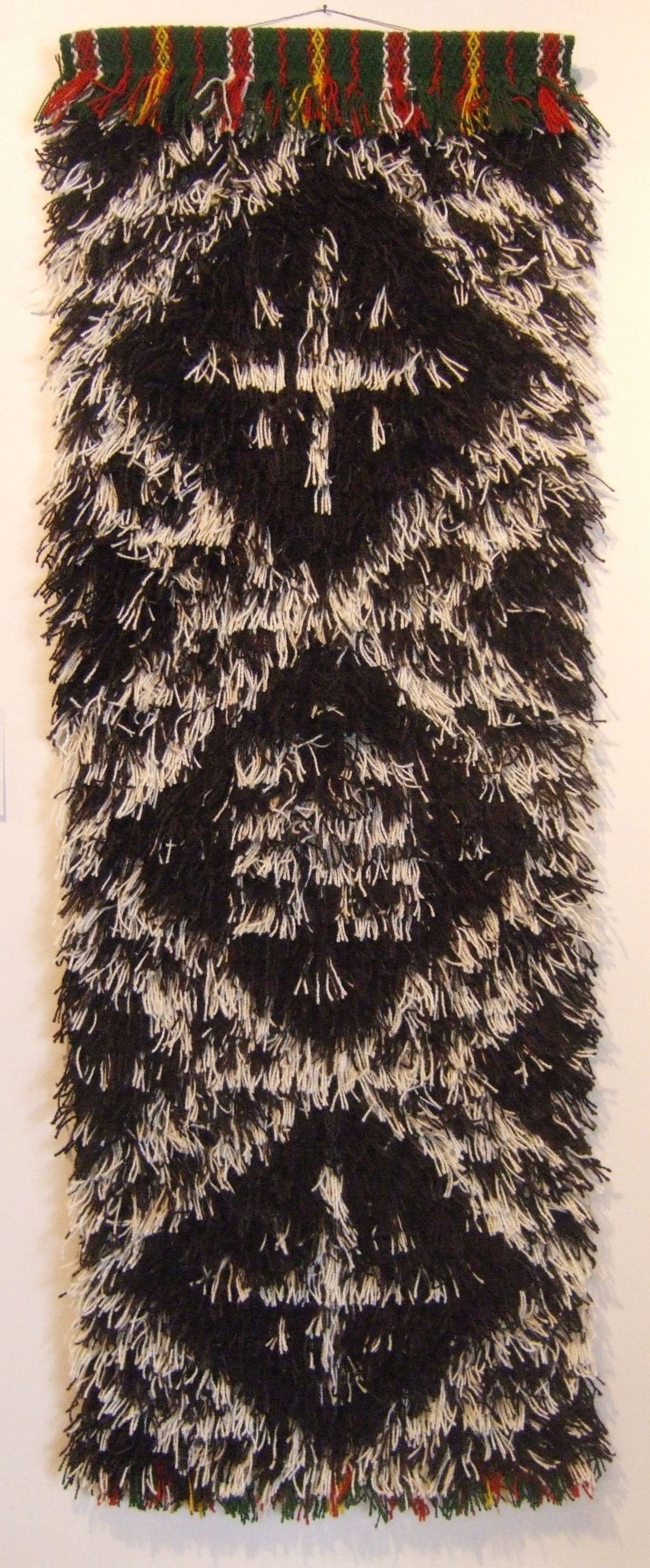
MostrumJan_Protection_Rya“Protection,”  by Jan Mostrom. 19″ x 56″, wool.  The knotted design is inspired by the protective symbols painted in white on the inside walls of a medieval house in the Folkemuseum in Hardanger, Norway.  The painting was also decorative, the white paint lightening the dark windowless room.  The bright striped backing is based on a rya coverlet in the Vesterheim Norwegian American museum collection. Jan analyzed that coverlet and published a draft to reproduce the coverlet in the xxx issue of the Norwegian Textile Letter. (article link)

Mail AttachmentJan Mostrom. Chanhassan, Minnesota.  Jan has been a weaver for 40 years.  Her main area of interest is in Scandinavian textile techniques.  She has taken classes from a variety of Scandinavian instructors and traveled to Scandinavia.  She is a Vesterheim National Exhibition of Folk Art gold medalist and a long-time member of the Weavers Guild of Minnesota Scandinavian Weavers Study Group.  Jan has taught classes at Vesterheim Norwegian American Museum, the Weavers Guild of Minnesota, the American Swedish Institute, and at conferences.    She is teaching two rya classes at the Weavers Guild of Minnesota in connection with the Living Tradition of Rijiy exhibit.
Robbie-ASI

Ryas by Robbie LaFleur in the Community Gallery at the American Swedish Institute

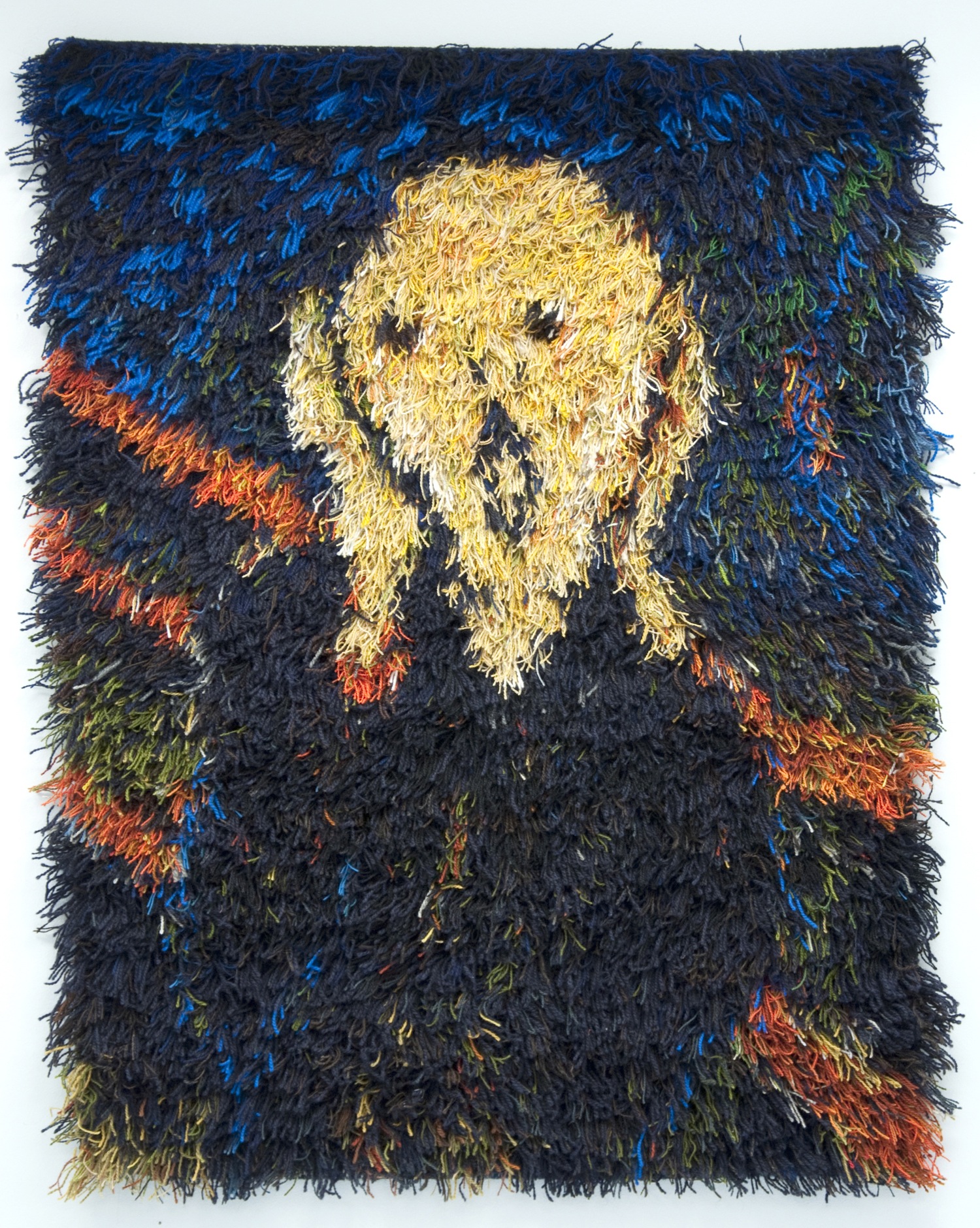
Image“Hard Realities: A Homage to Edvard Munch,” by Robbie LaFleur.  31” x 48”, wool. This piece was woven in a pixelated fashion, similar to the work of Chuck Close.  Each knot yarn bundle was compared to the corresponding place in a gridded cartoon. (See details of the process here.)


IMG_2497”Squeezed: A Homage to Robert Motherwell,” by Robbie LaFleur.  29” x 45”, wool.  The shapes in this rya were inspired by many of Robert Motherwell’s variations of “Elegy to the Spanish Republic.” For more information about weaving the piece, see “Weaving a Rya was endless, but Satisfying.”


icelandic-flat icelandic-shaggy“Icelandic Crosses” (A dyptych), by Robbie LaFleur.  “17” x 35”, wool.  These two pieces were woven on a warp-weighted loom of the same variety on which a Viking may have woven a rya bed coverlet or shoulder covering a thousand years ago.  The yarn is fastened with an Icelandic knot.  Rather than tied around two warp threads, the pile yarn piece is looped around one warp and carried under two-three warp threads beside it.  The knots that stand at attention  are  reminiscent of  the short, stiff manes of Icelandic ponies.

robbie-head-shot-2014Robbie LaFleur, Minneapolis, Minnesota, has been following a thread of Scandinavian textiles since she studied weaving at Valdres Husflidsskole in Fagernes, Norway in 1977.  She has continued her study with Scandinavian instructors at workshops in Norway and the U.S.  Recent projects include interpreting Edvard Munch’s “Scream” painting into a variety of textile techniques, and weaving tapestry portraits of her relatives. She was awarded the gold Medal in Weaving from the Vesterheim Norwegian-American Museum in 2006.  Robbie coordinates the the Weavers Guild of Minnesota Scandinavian Weavers Study Group and is on the board of directors of the Weavers Guild of  Minnesota
Rya pillows by Lila Nelson and Marie Nodland, which no doubt resided on a couch or chair for years, are now elevated to a beautiful display.

Rya pillows by Lila Nelson and Marie Nodland, which no doubt resided on a couch or chair for years, are now elevated to a beautiful display.

IMG_7187“Pillow in Green,” by Lila Nelson. 18” x 25”, wool face with cotton backing.  Lila is best known for her often political or humorous images in tapestry.  For this densely-piled pillow in rya, Lila retained the characteristically rich, saturated palette of her tapestries.

lila-croppedLila Nelson, St. Paul, Minnesota.  Most people in this area who weave in Norwegian techniques count Lila Nelson as a role model and mentor.  She was the long-time Curator of Textiles at the Vesterheim Norwegian-American Museum, and a core member of the Scandinavian Weaving Study Group at the Weavers Guild of Minnesota.


IMG_1572“Pillow with Handspun Wool,” by Marie Nodland.  20” x 20”, wool face with linen backing. This piece is made of mostly handspun wool.  In contrast to many Scandinavian pile hangings with sparse pile, this pillow-top has densely-packed knots that make the long pile stand almost straight up.

Marie Nodland (deceased).  Traditional Scandinavian weaving has deep roots among the descendants of immigrants in the Midwest.  Long-time weaver Marie Nodland wove in many Scandinavian techniques and was one of the founders of “De Norske Vevere” (The Norwegian Weavers) at the Weavers Guild of Minnesota, the fore-runner of the current Scandinavian Weavers Study Group. 

Sissel Calmeyer: In Memory of a Norwegian Textile Artist

By Ingebjørg Monsen
Sissel Calmeyer

Sissel Calmeyer was friendly, thorough, hard-working, and modest. Here she is in her studio on February 19, 2010, in the photo she approved for this article.

In January 2010 I visited Sissel´s studio to seek information for this article. She was busy finishing the restoration of one of her early works, I parken (In the Park), first finished as part of a 1972 exhibition “Bellevue, Bellevue” in Oslo Kunstforening (Oslo Society of Art). On this occasion a group of Bergen-based textile artists displayed their textile art with one goal only: to make a difference – which they did!

The exhibition was a break with habit and tradition in textile art.  They wanted to take textile art from the “Scandinavian home” into the art scene of society.

rag-rug-w-centerThis tapestry is framed by a rag rug in different brown-greyish colors, leading your eyes to the central motif made in wool and linen in a gobelin weft-faced tradition.

Maybe this symbolizes everyday life (rag rug), and possibly a different world including a green planet leading through layers and layers of pink/white  curtains to a beautiful dreamlike landscape?

center-motif-detail

Detail of the tapestry I parken (In the Park)

Sissel finished the work and this was to be her last commission.  The cycle was completed.  She died peacefully in September 2012. The tapestry  is on display on Ortun Skole in Bergen, Norway.

But in between…. where did it all start? Sissel was born on the 10th of May in 1941 in Rjukan, Telemark, Norway.  Her education was at the National College of Art and Design, Oslo (1960-64,  Diploma), and the Bergen College of Arts and Crafts, Bergen (1964-65, Design).  Her education was in the relatively recent Norwegian tapestry tradition and the Bauhaus tradition of art and design, among others, with a strong focus on art and craftsmanship.

The group behind ”Bellevue, Bellevue” had Galleri Finnegården in Bergen as their main scene for a short period at the start of their career, and they had their studios close by in the old buildings at Bryggen from 1968 onwards.  Later some of these artists, including Sissel, moved their workshops to USF Verftet (1985).

She was always seeking new knowledge based on existing knowledge.  In one of our previous meetings she told me about her fascination with spinning!

For one whole year she concentrated on this craft, tracking all different types of spinning equipment all over the world, and learning to use some of them from local specialists, hands on. Then she practiced to improve her skills and enhance her performance.  This tells us a lot about her attitude towards knowledge, information and håndbåren kunnskap, the knowledge of our hands.  She knew no shortcuts or easy ways.

cat-damask

She must have been content with this damask textile, The Cat, as she kept it on display in her studio

She taught for approximately 10 years at Bergen Kunst- og Håndtverkskole (Bergen Art and Handcraft School).  At the same time she was experimenting on different aspects of warp and weft, and two and more layers (double-weave and more) held together in advanced structures. Above is one of her damask samples (she loved her cats!).  Then came the pleating period, and then the felting and cutting period, all resulting in wonderful textiles giving new dimensions to the experience of textiles. She had a special focus on details, always. Her colors changed from strong vibrant colors via natural white; then white, black and red; and finally back to more subtle colors.

humle-flowers

Sissel arranging “Humle Flowers” for Norwegian Textile Letter readers in 2010

In 1988 she received a guaranteed income grant from the Norwegian State, which gave her more time to experiment and make scaled-up artworks.   She had both a critical and a humorous eye concerning society and life.  This surfaced in different ways in her art works, for instance she depicted the head of a tiger looking down at his hide spread as a carpet on the floor.   Her works were often three-dimensional and sculptural, with advanced weaving techniques enhancing the expression.

luftskipet

2013 Høstutstillingen, Oslo: Utsikt fra Luftskipet Norge II (View from the Norway Airship), 1973

This tapestry was made in the year between the referendum on European Economic Community membership and the Kunstnerakjson -74 (Artist Action -74).  Her artistic comments are maybe as valid today.

She also had a strong feeling for Norwegian textile heritage: tablecloths, towels, woolen coverlets and blankets and other everyday textiles. She used the materials and techniques, and lifted them with splendor into the artistic hemisphere, never losing touch with their roots.

pleated-folded

From Sissel´s studio, 2010. Details in focus! Back to the roots! The look-a-like of a bridal head-cloth (right) & pleated skirt (left)

Premier (awards & grants) for Sissel Calmeyer 

  • Bergen bys stipend, 1976  (City of Bergen Grant)
  • Kultur- og vitenskapsdepartementets vikarstipend, 1983  (Norwegian Culture and science Department temporary scholarship)
  • Hordaland fylkes stipend, 1983 (Hordaland County grant)
  • Statens reise- eller studiestipend, 1985 (Norwegian State travel and study grant)
  • Statens garantiinntekt for kunstnere, 1988  (Norwegian State guaranteed income grant)
  • Kulturdepartementets utstillingsstipend, 1995 (Norwegian Culture department Exhibition grant)

Artwork Innkjøpt (Purchased by):

  • Ortun skole, Bergen
  • Bergen.Husflid skole/Bergen Husmor skole, Bergen, 1978  (Tekstilt teppe v/Sissel Calmeyer & Sissel Blystad)
  • VKI Vestlandske Kunstindustrimuseum, Bergen, 1978
  • Selskapet Kunst på Arbeidsplassen, Bergen Kommune
  • Norsk Kulturråd
  • Norges Bank
  • Sogn og Fjordane fylke
  • … and more

Artwork Utstilt (Exhibited at):

  • Vestlandsutstillingen (Annual exhibition of western Norway) , 1970, 1972, 1977, 1980
  • Norsk vevkunst i det 20.årh (Norwegian contemporary weaving in the 20th century), Sonja Henies og Niels Onstads Stiftelser, 1970
  • “Bellevue, Bellevue” Bergenskunstnere (Bergen based artists), Oslo Kunstforening, 1972
  • Lær å se (Learning to see), Unge Kunstneres Samfunn, 1973
  • Nordisk tekstiluttrykk (Nordic textile expressions), Anger, France, 1973
  • Tendenser (Tendencies), Galleri F15, Moss, 1975
  • Unge Kunstneres Samfunn tekstilgruppe (Young artists society textilegroup), Stavanger Kunstforening, 1975
  • Samliv (Relationship), Bergens Kunstforening, 1977
  • Kunst og Kunstnere (Art and artists)  Bergen, VKI Vestlandske Kunstindustrimuseum, 1978
  • Høstutstillingen (Annual autumn art exhibition of Norway), Kunstnernes Hus, Oslo, 1981
  • Tekstil (Textiles), (Anne Sæland, Sissel Blystad og Sissel Calmeyer) , Bergen Kunsthall, 1996
  • Tekstilobjekter (Textile objects), Sissel Calmeyer at USF Verftet, Bergen, 2000
  • Juleutstilling: Sissel Calmeyer, tekstil; Åsne Slaattelid, akvarell; Sveinung Iversen & Magne Vangsnes, grafikk. Galleri Voss, 2005
  • Høstutstilling (Annual autumn art exhibition of Norway), Kunstnernes Hus, Oslo, 2013

Links/Sources: