
Archives

Visiting the Vesterheim Collection: A Båtrya

By Jan Mostrom

The most recent rya collected by Vesterheim Norwegian-American Museum in Decorah, Iowa is a båtrye (boat rya) made by Nikoline Indreberg about 1890 in Skodje, Sunnemøre, Norway for her new husband Ole Indreberg.  Ole was traveling back and forth by boat to Lødingen in Lofoten from Skodje to build houses on the island and no doubt the rya provided warmth  and safety for his sea journeys.  After Ole’s death in 1898, Nikoline and her children Else and Petter traveled about 15 miles by foot to Spjelkavi where they settled.  The rya was one of the few belongings they brought with them on their trek.
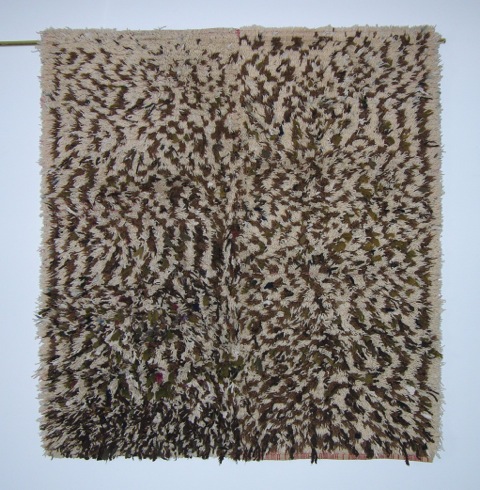
Vesterheim-rya

Vesterheim rya (Photo: Vesterheim staff)

Petter eventually immigrated to Seattle but was not able to convince his sister Else to come to America.  Else’s granddaughter brought the rya with her when she immigrated in the United States in 1978 and it was one of her most cherished possessions.  Else Bigton donated the rya to Vesterheim in 2010 in memory of Else Indreberg Spjelkavik.

The pile side of the båtrya is made up of rows of evenly dispersed knots of white and brown heavy yarn in a somewhat random pattern.   At first glance you may not notice the many rag strips that are included in the knots.  There are frequent strips of dark brown/green twill  which blends well with the brown yarn.   When you look closely you will notice surprising pieces of homespun plaids in rust, green, purple and white and cottons in light blue, pink, black, navy, white and red.  It made me wonder if these scraps could have been from Nikoline or Else’s dresses or Petter’s jacket.

Vesterheim-rya-detail

(Photo: Robbie LaFleur)

The knots are closely set across a row with the knots being made around two warp threads and create a pile that is about 1 ¾ inches long.  The rows of knots are a scant 1” apart.

The rya is made up of two sections sewn together. The warp in the backing is of thin white and red wool sett at about 32-33 epi.  This close sett creates a warp face fabric on the side opposite the knots and the knots do not show.  Because this is a  1 / 2 twill the weft shows on the side with the knots. The weft appears to be an off white 2 ply cotton.  The warp stripe repeat is made up of 24 white, 6 red, 24 white, 4 red, 4 white, 4 red, 5 white, 27 alternating red and white, 6 white, 27 alternating red and white, 5 white, 4 red, 4 white, and 4 red ends.  This is repeated across the warp so that there are 6 repeats and continues in a partial repeat to the 6 white warps between the alternating warp stripe pair.  At that edge several warps were added so that the seam can be made with that center stripe remaining at 6 threads.

Vesterheim Rya back.  (Photo: Robbie LaFleur)

Vesterheim Rya back. (Photo: Robbie LaFleur)

The rya is hemmed at both ends with a rolled to the pile side hem that is very neatly sewn with a red thread that creates a line on the non-pile side of the rya but does not show on the reverse.  The finished size of the rya is 63.25 inches in length and 56.75 inches in width.

vesterhimdraft5 Graph Paper-5x5Click here for a pdf version of the draft.

Additional information and photos can be found on the Vesterheim website: Identification # 2010.008.001.

Also, visits to study textiles in the collection can be arranged by contacting Laurann Gilbertson; lgilbertson (at) vesterheim.org, or 563-382-9681.

Jan Mostrom began a long love for Norwegian weaving in a class at Luther College taught by Lila Nelson.

janmostrom (at) yahoo.com


Varafeldur: An Icelandic Rya Reconstruction

By Marta Kløve Juuhl

This is a norrøn vararfeldur, the closest you can come to a rya in the Viking period. In Norwegian it’s called a gråfell (grey fleece).

It was woven in Iceland in November, 2010 by Hildur Hakonardottir from Iceland, Elizabeth Johnston from Shetland, and me. It is the first gråfell which has been made for more than 1000 years.

It is told in Snorre, the Norwegian kongesaga (king saga), that our king Harald Gråfell was in Hardanger with his men one summer (this must be just before year 1000), and there came an Icelandic ship loaded with vararfeldur which people did not want to buy. They gave one to the king, and he started wearing it. Suddenly the Icelanders got rid of all their gråfellar, and the king got his name. At that time this was a big export from Iceland, before the vadmål took over. In fact vadmål became a trade item later on.

Concerning our weaving, it all started in the summer of 2010. We had a class with weaving on a warp weighted loom at Osterøy museum where I work. Both Hildur and Elizabeth attended that class, among many other students, and I was the teacher. They set up a loom with vadmål.

During that week we found that the three of us had so much in common that we wanted to continue the work with this loom. So before they left we decided to meet in Iceland in November.

When we arrived at Hildur’s house at Selfoss, she had decided that we should try to set up a vararfeldur, which she had read about in the Icelandic legal text, Grågås. There it was strictly regulated how it should be made, 4 ells long and 2 ells wide and 13 knots with wool in each row. Hildur had also read somewhere about the technique, and from that we chose tabby.

Image 6

Hildur Håkonardottir in Iceland. (Photo courtesy of Marta Kløve Juuhl)

The warp is white 2-­‐ply yarn, double, and the weft is also double two-ply yarn, grey. We picked the yarn from what we thought would be the best quality for this. My experience from weaving åkle helped finding the weight of the stones for each thread. Hildur obtained some grey fleece; in fact we needed fleece from three sheep to finish this one. We used long fibres, only dekkhår. It took a long time to take away the underwool with carders.

In 2012 Hildur and Elizabeth came to Bergen and we set up a loom at the museum with Norwegian yarn (Hoelfeldt Lund strikkegarn) and wool from spelsau in Osterøy. So this vararfeldur is black and brown, very beautiful. We demonstrated weaving at the Osteroy Museum and at the Bjørgvin Viking market at Hordamuseet. This time we tied the knots in front of the loom. We decided that was best for demonstration purposes. It worked quite well, but we had to put an extra string across the piece to keep the wool away. It’s faster to weave with the knots on the back side.

Image 3

The rya woven at Osterøy museum (Photo courtesy of Marta Kløve Juuhl)

In 2014 we hope to publish a book on the technique, written in a way that everybody can read it and use it when they want to set up a warp weighted loom.

Image 5

A course was held at Osterøy Museum, where the varafeldur was used as inspiration. (Photo courtesy of Marta Kløve Juuhl)

Marta Kløve Juuhl taught weaving in the Norwegian Husflidsskole system for many years.  She now works part-time at Østerøy museum, primarily with textiles, and also in her private studio. Her current commissions include bands for bunads and wall hangings for churches.

marta.klove.juuhl (at) gmail.com

Editor’s note: During the Vesterheim Textile Tour in June, 2011, Marta Kløve Juuhl joined the group for a day. She brought her varafeldur and discussed its creation.  It was a magnetic object to all the fiber-crazy people on the bus; you could hardly keep from stretching your hands to feel the unspun locks of the coverlet.

Marta displays the varafeldur on the Vesterheim tour bus (Photo: Robbie LaFleur)

Marta displays the varafeldur on the Vesterheim tour bus (Photo: Robbie LaFleur)

Here is the back.

Varafeldur detail (Photo: Robbie LaFleur)

Varafeldur detail (Photo: Robbie LaFleur)